


US4 min(s) read
Aviation expert says 'unusual' conditions of private jet meant it was 'doomed' before it crashed killing all 9 on board

An aviation expert has revealed how a private jet that crashed in Florida, killing all nine people on board, may have been doomed after encountering what he described as highly unusual icing conditions.
Denys, a Boeing 737 captain who hosts the YouTube channel Pilot Blog, has analyzed both the footage and audio from the cockpit of the November 1 Learjet 60 disaster, which claimed the lives of nine people.
The crash happened in Palm Beach County, Florida, after the aircraft reportedly encountered turbulence and icing while flying through stormy weather.
Aviation expert discusses 'unusual' condition of private jet
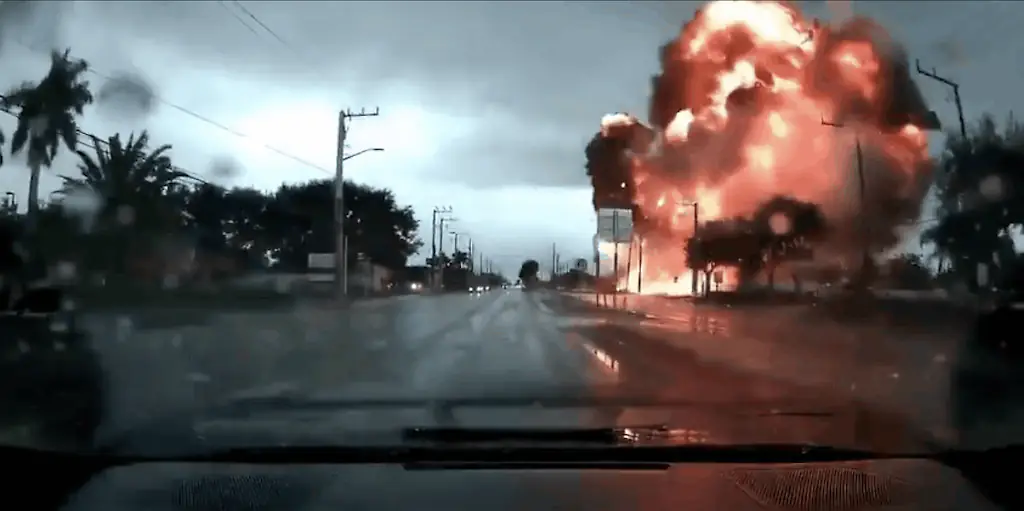
In his analysis, Denys focused on footage which appeared to show the aircraft entering the ground at an almost vertical angle, revealing how he was initially stunned by the steepness and speed of its descent, but noticed something potentially significant when examining the wreckage.
The captain claimed the footage appeared to show the aircraft without its horizontal stabilizer, a crucial component of its tail that helps control the plane's pitch, suggesting the structure may have detached under extreme forces as the jet descended, potentially leaving the pilots unable to regain control.
"Without the horizontal stabilizer you cannot fly the airplane," he claimed.
Denys also examined the aircraft's final moments using air traffic control communications, which captured the crew reporting worsening conditions before declaring an emergency.
The recording includes the pilots describing moderate turbulence and icing, before reporting that the aircraft was descending at an increasingly alarming rate, with a crew member heard saying: "We're descending 8,000. Mayday. Mayday. We're descending 10,000 ft per minute."
The situation then appeared to deteriorate further, with the crew reporting a descent of 20,000ft per minute.
"We are in an overseas condition. Descending 20,000 ft per minute... We're going to crash into the ground," the pilot told air traffic control.
Denys described the recording as one of the most distressing aviation communications he had ever heard, although he acknowledged that the official investigation would have to establish exactly what and how it unfolded.
He then turned his attention to the weather conditions, arguing that the reported icing was particularly unusual given the aircraft's altitude and the extremely low temperatures.
According to the captain, the jet was flying at around 35,000ft when the crew reported moderate icing and turbulence, with the outside temperature reportedly around minus 47 degrees Celsius.
He explained that the most severe icing conditions are generally associated with temperatures much closer to freezing, when moisture can accumulate on an aircraft's surfaces.
"This is something really unusual," he admitted, before Denys suggesting that ice may have affected the aircraft's aerodynamic performance, potentially contributing to a loss of pitch control and an uncontrolled descent.
He also examined the Learjet's anti-icing equipment, which is designed to prevent ice from building up on important parts of the aircraft, explaining that the engines and wings use heated air to prevent ice accumulation, while the horizontal stabilizer has an electrically heated system.
Expert references similar disasters involving Learjet aircraft

He then highlighted an older Federal Aviation Administration directive dating back to 1999, which involved a serious incident with a Learjet 55.
In that case, investigators found that electrical wiring in the horizontal stabilizer's anti-icing system had been incorrectly connected, causing its heating elements to operate in the wrong sequence.
The central heating element, which should have remained continuously powered, was instead switching on and off, allowing ice to subsequently amass on the stabilizer, creating a potentially dangerous loss of pitch control.
Denys pointed out that the directive also covered the Learjet 60, although he did not establish that the same fault was present on the aircraft involved in the Florida disaster.
He also referenced other historical safety notices involving icing and anti-icing equipment on different Learjet models, including one 2011 warning, which concerned wing ice accumulation and the risk of an aerodynamic stall if anti-icing systems were not activated.
However, the captain stressed that these incidents involved different aircraft models and did not prove that the Florida jet sustained the same malfunctions.
He suggested that ice accumulation could have affected the aircraft's control surfaces, triggering a rapid descent and placing enormous forces on the structure, believing the horizontal stabilizer may subsequently have detached, making recovery impossible.
"They were doomed since it happened," he claimed.
The captain later estimated that icing was responsible for the disaster with an 80 to 90 per cent likelihood, while admitting that his assessment was speculation rather than an official finding.
While Denys believes the reported icing conditions could explain the aircraft's apparent loss of control, his theory has not been confirmed by investigators.