


US6 min(s) read
Lindsay Clancy trial: rules jurors must follow during visit to Duxbury home where children died
.jpg_I4Ebof?tr=cr-0.338.2730.3068,f-webp,q-70,w-100)
Warning: this article contains details that some people might find distressing
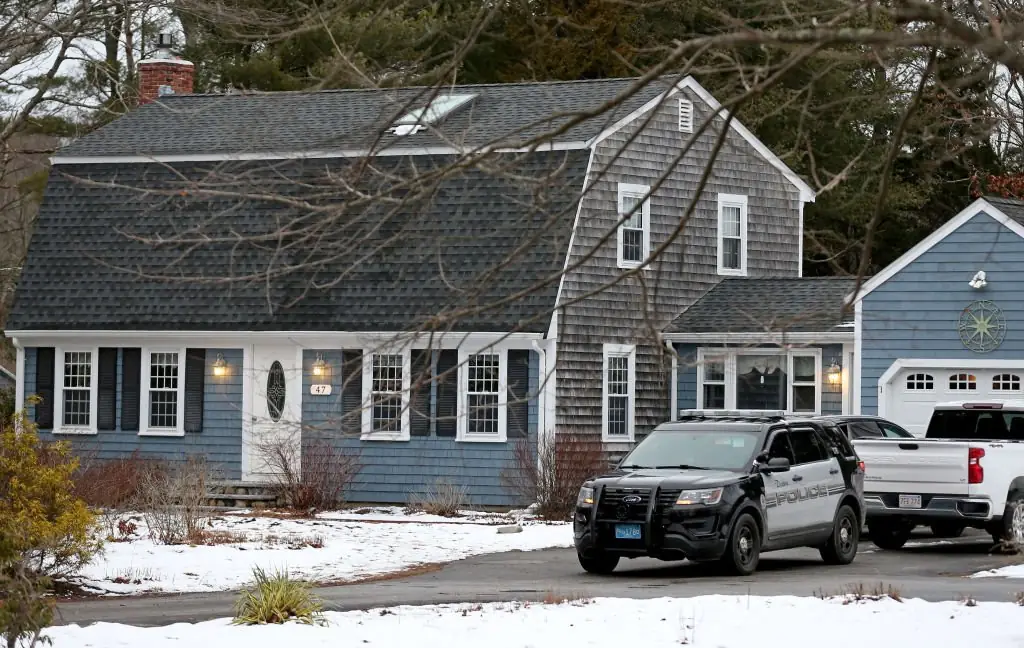
Jurors in the Lindsay Clancy murder trial are visiting the Duxbury, Massachusetts, home where prosecutors say she strangled her three children on the evening of January 24, 2023.
The visit is taking place today, Day 4 of a trial that has already heard two days of testimony from Clancy's ex-husband Patrick, the 911 call he made when he found the children, and accounts from 10 first responders who arrived at the scene.
Clancy, 35, is charged with three counts of first-degree murder in the deaths of Cora, five, Dawson, three, and Callan, eight months.
She admits she killed them but has pleaded not guilty on the basis that she was suffering from severe postpartum psychosis at the time and was not criminally responsible for her actions.
Her husband has since revealed that a voice in her head told her to do it.
What rules must the jurors follow inside the house?
According to a court order issued ahead of the visit, jurors are permitted to inspect the outside of the property, the basement, and all rooms on the first and second floors.
They are not allowed to open any closet doors. They cannot touch anything inside the house. They cannot move or disturb any items.
Neither the prosecution nor the defence teams are permitted to interact with items in the property during the visit.
The jurors will be supervised by police throughout.

What else will the jurors see today?
Before arriving at the house on Summer Street, the jury bus will pass two other locations connected to the night of the killings.
First, ThreeV restaurant in Plymouth, where Patrick Clancy picked up takeout food that Lindsay had ordered. Then the CVS pharmacy in Kingston, where he collected medicine for Cora.
Patrick testified on Wednesday that he called Lindsay while he was at the CVS to check he was picking up the right item.
"She was pretty quiet. It sounded like she was busy," he said.
"I remember hanging up thinking she was probably in the middle of giving baths or something like that."
Prosecutors allege Clancy deliberately chose a restaurant far enough from the house to give herself time alone with the children.
The defence says she was in the grip of a psychotic episode and not capable of that kind of planning.
What happened at the Duxbury house?
On January 24, 2023, Clancy sent Patrick out of the house to pick up food and medicine.
While he was gone, prosecutors say she took the three children to the basement and strangled them using exercise resistance bands.
She then went upstairs, cut herself, and jumped from a second-storey bedroom window.
The fall left her paralysed from the waist down. She has used a wheelchair throughout the trial.
When Patrick returned home, he found Lindsay outside on the ground.
He then went inside and discovered the children in the basement.
His 911 call, played to the jury earlier this week, captured him saying: "I need help in the basement right now... she killed the kids!"
Clancy sobbed with her face in her hands as the recording played in court.
Patrick was later shown photographs of the children's bodies while on the stand.
Graphic crime scene images were also presented to the jury during his testimony.
Paramedics who testified on Thursday described trying and failing to save the children. One said the scene "turned very chaotic very quickly".
.webp_Wzfz8s?tr=cr-0.0.720.405,f-webp,q-70,w-1024)
What are the two sides arguing?
Prosecutors say the killings were premeditated.
They point to internet searches Clancy made in the days before, including one for the phrase "can you treat a sociopath" four days before the children died.
They allege she researched how long Patrick would be away and timed the killings accordingly.
They say she "did not feel love or connection with some of her kids".
A handwritten note found at the scene has also been entered into evidence.
The defence says Clancy was a loving mother who had been failed by the mental health system. Her lawyer Kevin Reddington has said she was prescribed more than a dozen different medications for postpartum depression and anxiety, and that the drugs caused homicidal and suicidal ideation rather than treating her condition.
"Our society fails miserably in treating women with postpartum depression, or even postpartum psychosis," Reddington said.
"It's medicate, medicate, medicate. Throw the pills at you, and then see how it works."
He described Clancy as "a beautiful person who was thoroughly destroyed by these medications".
Clancy had been a labour and delivery nurse at Massachusetts General Hospital.
Patrick has separately filed a civil lawsuit against her medical providers, alleging they failed to properly monitor her prescriptions and ignored warning signs including panic attacks and suicidal thoughts.
Who was Lindsay Clancy before this?
By every public account, she was a devoted mother. Patrick's own mother told a grand jury: "She loved her kids, and she was a nurturing mother who smiled all the time."
After her youngest child Callan was born in May 2022, Clancy's mental health deteriorated.
She managed symptoms of postpartum anxiety after her first two children through exercise, meditation, and therapy.
After her third, it got worse.
She sought help, went to outpatient psychiatric care and inpatient care and was prescribed drug after drug.
Patrick has said he asked her three specific questions every morning to monitor her mental state.
After her arrest, Clancy was described as unable to express emotion or feel anything.
When Patrick asked her why she did it, her response became one of the most discussed details of the case.
Whether the system that was supposed to help her instead contributed to what happened on January 24 is now the central question of the trial.
A GoFundMe for Patrick raised over $1 million in the weeks after the children's deaths.
What happens next?
After the jury view, the trial returns to Plymouth Superior Court this afternoon.
Jurors are expected to hear testimony from medical staff at South Shore Hospital who treated Clancy after her fall.
The trial is expected to continue for several more weeks.
If convicted of first-degree murder, Clancy faces a mandatory life sentence without parole.
If the jury accepts the insanity defence, she would be committed to a psychiatric facility rather than prison.
If you or someone you know is experiencing emotional distress or a mental health crisis, you can reach the 988 Suicide and Crisis Lifeline by calling or texting 988.




.webp_lli6Ty?tr=cr-74.9.445.380,f-webp,q-70,w-100)





.webp_lli6Ty?tr=cr-74.9.445.380,f-webp,q-70,w-1024)

