


US3 min(s) read
Devastating simulation shows reality of X2 Six Flags rollercoaster as 2 die and others left needing brain surgery
.jpg_xKEaT0?tr=cr-0.328.2730.3058,f-webp,q-70,w-100)
A simulation of the X2 rollercoaster at Six Flags, which has left two people dead and several injured, has been revealed for the first time.
The popular attraction first opened in 2001, but this summer it has finally been shut down following several warnings from experts.
As a result of the ride, two have died, and others were left with serious health issues.
X2 has remained shut since July 12 at Six Flags Magic Mountain in Valencia, California.
The latest incident involved Hawaii resident Pamela Guillen, 40, and Los Angeles resident Naomi Greer-Wilkinson, 25, who both needed emergency brain surgery after riding the high-intensity coaster in July.
As the latter remains in a coma, attention has been brought to the ride and how it has been allowed to stay open for a quarter of a century.

Simulation of X2 rollercoaster
Now, a simulation of the popular rollercoaster has been produced by US publication CNN alongside NearMap.
Doctors have treated the victims, who have since been pictured, and noted that they hadn't been involved in a crash, fall, or similar.
Injuries encountered in patients are consistent with those from high-speed collisions or violent accidents where the brain can twist and slam in someone's skull.
The simulation shows just how brutal the coaster is, as its fourth-dimensional quality means its seats rotate 360 degrees around the track, as trains reach speeds of up to almost 80 miles per hour for roughly two minutes.
Only three such roller coasters exist in the world - one in China and one in Japan, with the latter closing temporarily last year following a fatal injury.
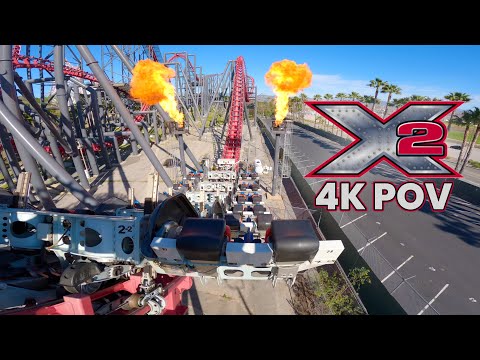
The simulation shows that there is a backwards initial ascent to a peak elevation of 200ft on the coaster, followed by '360° rotating seats and head-first, face down drops'.
Then, there is the first of two raven turns, which the theme park describes as 'half loops that change their minds midway and become sheer drops'.
Then, those in the seats that stretch out from the centerline face a hard time, with some riders claiming that the spins and loops are more intense when sitting on the outside.
Finally, the second raven turn comes, sending riders up backwards, before a sheer drop.
Many of the victims suffered injuries from their brains smashing against their skulls when their heads hit the backboard of the ride.

Roller coaster risks assessed by experts
Despite years of warnings from visitors as well as legal and medical experts, officials allowed the ride to keep operating.
Speaking to CNN, Lyndia Wu, a mechanical engineering professor at the University of British Columbia, said: “I personally don’t think head injury should be an expected risk from going on a roller coaster ride, and there is no reason a ride can’t be properly designed to prevent injuries like this.”
Wu has researched the effects of roller coasters on the brain alongside other experts, and they found that the risk of traumatic brain injuries associated with roller coasters is very low.
However, most of this research goes back by years, with Wu admitting that there are higher-risk rides, such as X2, which need to be further investigated.
There are other attractions which have caused casualties, such as the Goliath roller coaster at the same Six Flags location, as a woman with pre-existing conditions died after riding the attraction in 2001, after an aneurysm ruptured in her brain.