


World3 min(s) read
Footage shows real-life 'Death Simulator' that allowed its riders to experience death without dying
.webp_SmgFsc?tr=cr-292.0.1244.952,f-webp,q-70,w-100)
Footage posted by CNBC in April 2016 offered a gripping look into a bizarre Chinese attraction that allowed living people to experience what it feels like to die and be cremated.
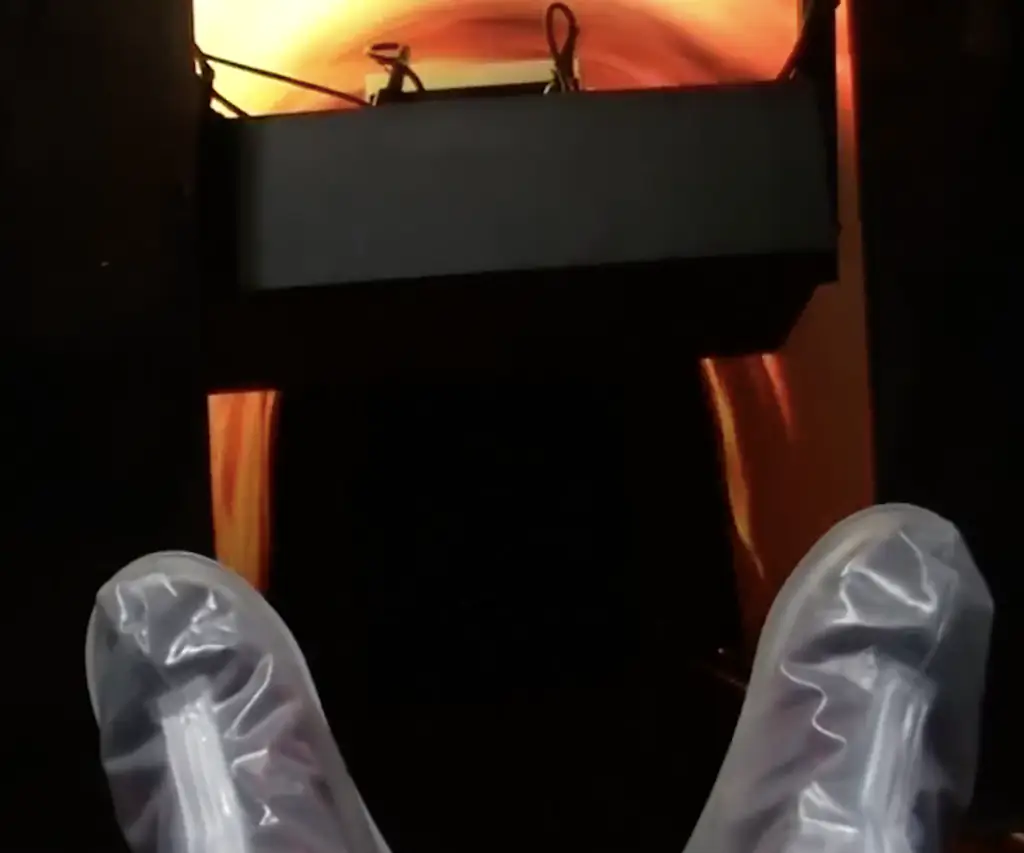
The video captured participants lying on flat conveyor belts before being pushed into dark tunnels filled with heat and light, leaving viewers online both fascinated and disturbed.
The concept originally launched in September 2014 as the Samadhi – 4D Experience of Death in Shenzhen. Following its initial debut, founders Ding Rui and Huang Wei-ping opened a highly publicized version called "Xinglai" (meaning "Awaken") in Shanghai in April 2016.
Unlike standard haunted houses, the attraction operated as an intense psychological game designed to help people face their mortality. The founders wanted participants to confront deep fears, evaluate life problems, and gain a fresh perspective on their daily lives.

How the psychological simulation worked
Every session invited a group of 12 participants into a room to engage in high-stakes moral dilemmas. Armed with tablets, players debated various life-or-death scenarios.
One prompt involved an American squad in Afghanistan that was compromised when a local, unarmed herdsman accidentally spotted their location. The group had to debate whether to execute him or let him go, risking their own safety.
When an impasse was reached, or a round concluded, players voted on who gave the worst explanation for their survival strategy or who should sacrifice themselves. The person voted off was chosen for the ultimate punishment: fake death.
The selected participant was laid flat on a conveyor belt and pushed into a dark tunnel. Projections of 360-degree flames filled the space, accompanied by dramatic sound effects and blasts of hot air reaching up to 100°F to mimic cremation.
Afterward, the participant crawled through a narrow, soft latex womb chute into a brightly lit, padded white room to symbolize rebirth.
Extensive research went into it
The attention to detail inside the exhibit came from years of preparation. Ding and Huang spent four years developing the attraction, which included visiting real-world crematoriums.
The founders even convinced a crematorium manager to let them lay inside a real, deactivated cremation furnace so they could accurately study the sensory layout, space constraints, and visual cues before building their conveyor belts.
The creators also heavily incorporated tetraphobia, the fear of the number four, into the operational structure. In Chinese culture, the word for "four" (sì) sounds nearly identical to the word for "death" (sǐ).
To lean into this symbol, the entry ticket cost 444 yuan (roughly $65 to $68 USD). The Shanghai exhibit opened its doors on April 4th (4/4) and initially operated 4 days a week, running exactly two two-hour sessions per day.
After crawling out into the white room, participants were given a final game survey. Their primary task was to write out their actual last words and a living will. They could either take the paper home as a reminder to live better or throw it into an on-site paper shredder to symbolize leaving past regrets behind.
The business behind the attraction
The project originally began through philanthropy and crowdfunding rather than big corporate backing. Ding and Huang had experience in palliative care and wanted to offer life education to the public. They raised 410,000 RMB (about $65,000 to $67,000 USD) on the Chinese crowdfunding platform Jue.so in just three months.
Despite gaining widespread attention across the world, the physical "Xinglai" venue in Shanghai eventually closed down. Financial difficulties brought an end to the exhibit, as high operational costs became impossible to maintain. Many prospective visitors also complained that the ticket price of 444 yuan was simply too expensive.
Although the original venue is no longer open, similar concepts continue to pop up globally. For example, the National Gallery of Victoria recently hosted an extended-reality installation called Passing Electrical Storms, which used virtual reality and medical monitors to simulate the de-escalation of human life.