


World3 min(s) read
Remote structures resembling Egypt's pyramids found on Google Earth spark terrifying theories

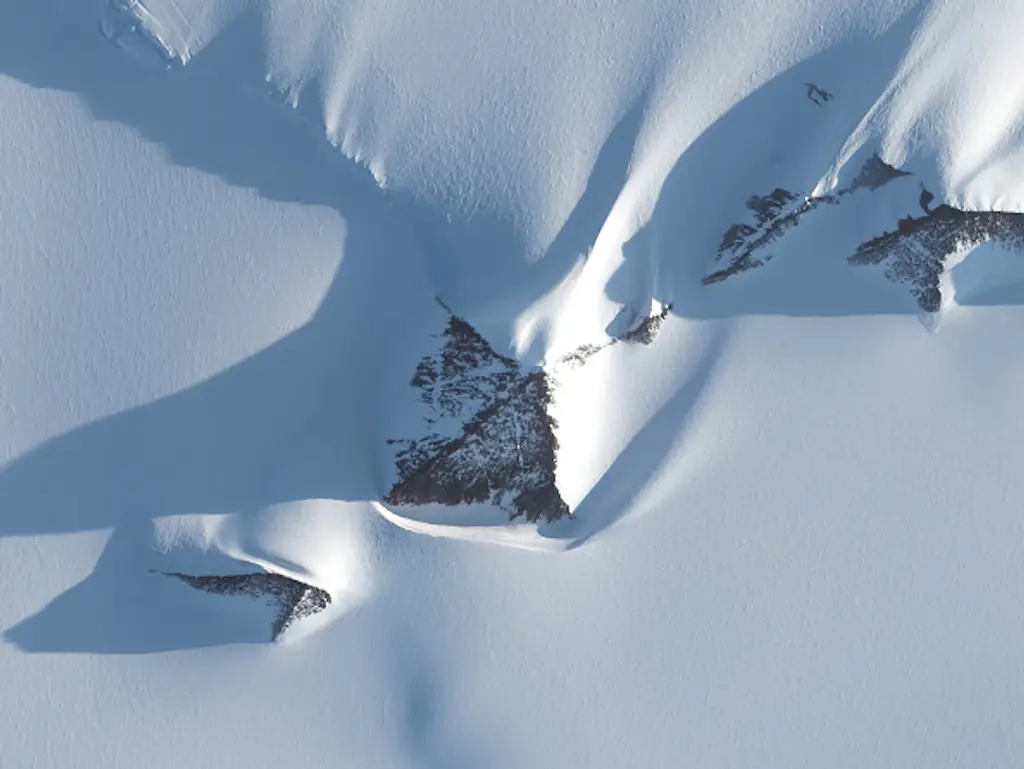
A strange set of mountain formations in Antarctica that appear to resemble Egypt’s famous pyramids has sparked widespread speculation about a possible lost civilization.
The discovery was highlighted by independent researcher Jay Anderson, who identified the ice-covered peaks using Google Earth. He compared the structures to satellite images of the pyramids on the Giza Plateau, noting a striking visual similarity in their arrangement.
What has been learned about the remote structures?
The formations sit deep within the Ellsworth Mountains, a remote and rugged region of Antarctica. Online, the images quickly gained attention, with some people questioning whether the peaks could be artificial rather than natural.
One user speculated: “If true, this would be absolute proof of crust displacement; in other words, the surface of the Earth was once in different positions.” They added: “It would also prove that there was a very advanced civilization that significantly pre-dates our oldest records.”
However, many experts strongly disagree with those theories, pointing instead to natural geological processes. Scientists say the pyramid-like appearance can be explained by erosion over vast periods of time. Freeze-thaw weathering — where water enters cracks in rock, freezes, expands, and breaks it apart — can gradually shape mountains into sharp, angular forms.
The central Antarctic peak rises roughly 4,500 feet and has four steep sides, with two smaller peaks nearby, creating a formation that some say mirrors the layout of the three pyramids at Giza — Great Pyramid of Giza, Pyramid of Khafre, and Pyramid of Menkaure. While some have linked that arrangement to the stars of Orion’s Belt, the idea remains widely debated.
Experts, however, maintain there is nothing mysterious about the Antarctic peaks. Eric Rignot, a professor at the University of California, Irvine and NASA researcher, previously explained that the structure is “just a mountain that looks like a pyramid.”
Similarly, Mauri Pelto noted that similar shapes can be found elsewhere, such as the Matterhorn, which was also formed through erosion.
Conspiracy theorists have their say
The images have prompted conspiracy theorists to offer their speculative interpretations, and unsurprisingly, there have been some pretty left field takes.
In 2016, a YouTube video claimed it was an alien base hidden in the ice. Some viewers supported the idea, with one saying: “Excellent report... I also believe things are about to get very dramatic, and that is for everyone on our planet.”
Others were more skeptical, with one commenter responding: “I have spent a LOT of time on snow-covered mountains... and this looks natural to me - not manmade anyway!”
Researchers say the feature likely resembles what is known as a nunatak — a natural peak that rises above surrounding ice.
UFO researcher Nigel Watson dismissed more extreme claims, explaining: “Pictures of the pyramid structures are either photoshopped... or simply pictures of natural formations called nunataks.” He added: “They are mountainous formations created by shifting glaciers and erosion, not by laser zapping aliens.”