


Space3 min(s) read
Twisted simulation shows what would happen to your body if you fell into a black hole and underwent 'spaghettification'

A simulation has revealed what would happen to your body if you fell into a black hole and underwent "spaghettification".
There is something eerie about a "black hole" - an empty void of inescapable danger where time breaks down.
Although completely invisible, black holes have a gravitational pull so powerful that nothing, not even light, can escape them once it gets too close.
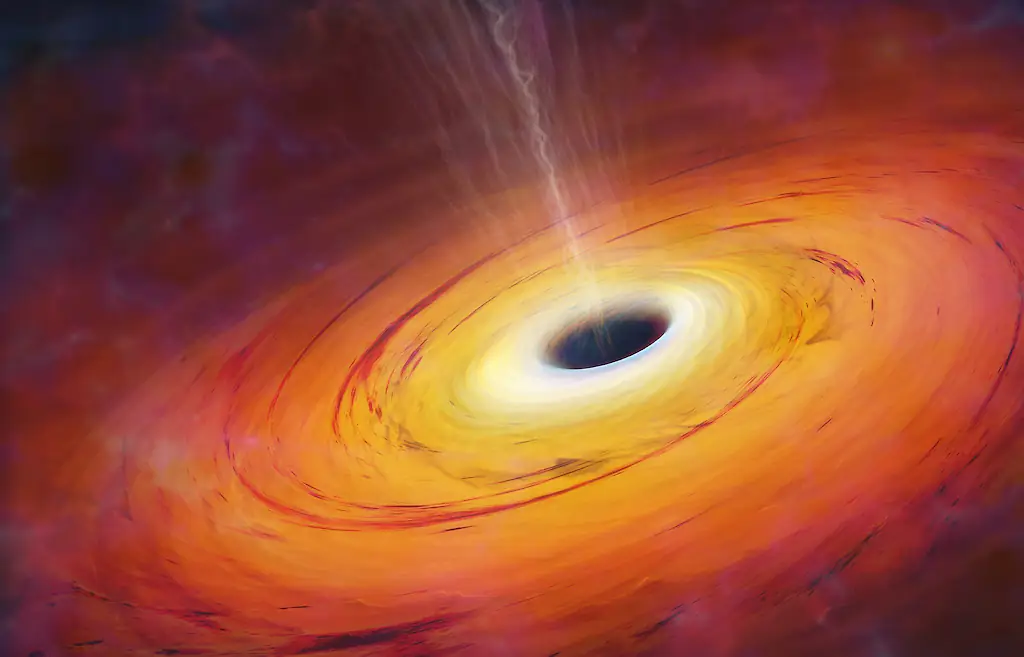
What happens if you fall into a black hole?
Zack D. Films created an animation that illustrates the terrifying reality of falling into one of these cosmic voids.
He explained that the gravitational pull "would stretch you out" in a process called spaghettification.
"As you get closer, the gravity at your feet would be much stronger than at your head, pulling you longer and thinner. Eventually, you'd pass the Event Horizon at this point, time would appear to slow down for an outside observer, but for you, time might seem to speed up," he said.
"Finally, you'd be crushed by the immense gravity merging with the singularity at the black hole's center, lost forever in its depths," he added.
The simulation left many viewers unsettled, with many taking to the comments to share their thoughts.
One person pointed out: "I think the scariest part of this is dying in a way that no other human had died before, making it the loneliest, unpredictable and most terrifying death ever."
"That was terrifying, and actually traumatising," another admitted, while a third added: "It’s actually INSANE something like this really exists somewhere out there. Horrifying."
Another viewer expanded on the eerie time-distortion effect shown in the clip: "To outside observers, not only would the person being sucked into a black hole look like they're slowing down in time, but they would just completely freeze. The person would slowly and gradually fade away until there's no visible trace left of them."

How are black holes made?
BBC Earth explained that black holes are born from the small, dense, remnant cores left behind when massive stars die.
If a dying star's core has more than roughly three times the mass of our Sun, gravity overwhelms every other force. This causes the remnant to collapse inward on itself.
Astronomers believe most large galaxies, including our own Milky Way, have black holes at their centers.
Scientists have grouped them into three main categories.
Stellar-mass black holes are the smallest - weighing between 1 and 100 times the mass of the Sun. They form when a giant star collapses and explodes in a supernova.
Intermediate-mass black holes are mid-sized, and they bridge the gap between stellar-mass and supermassive giants.
The largest ones are known as supermassive black holes, and they can have masses that are millions, or even billions, of times greater than the Sun. Scientists believe they grow to such huge scales by swallowing surrounding stars and merging with other black holes.