Uncategorised3 min(s) read
uncategorised3 min(s) read
space5 min(s) read
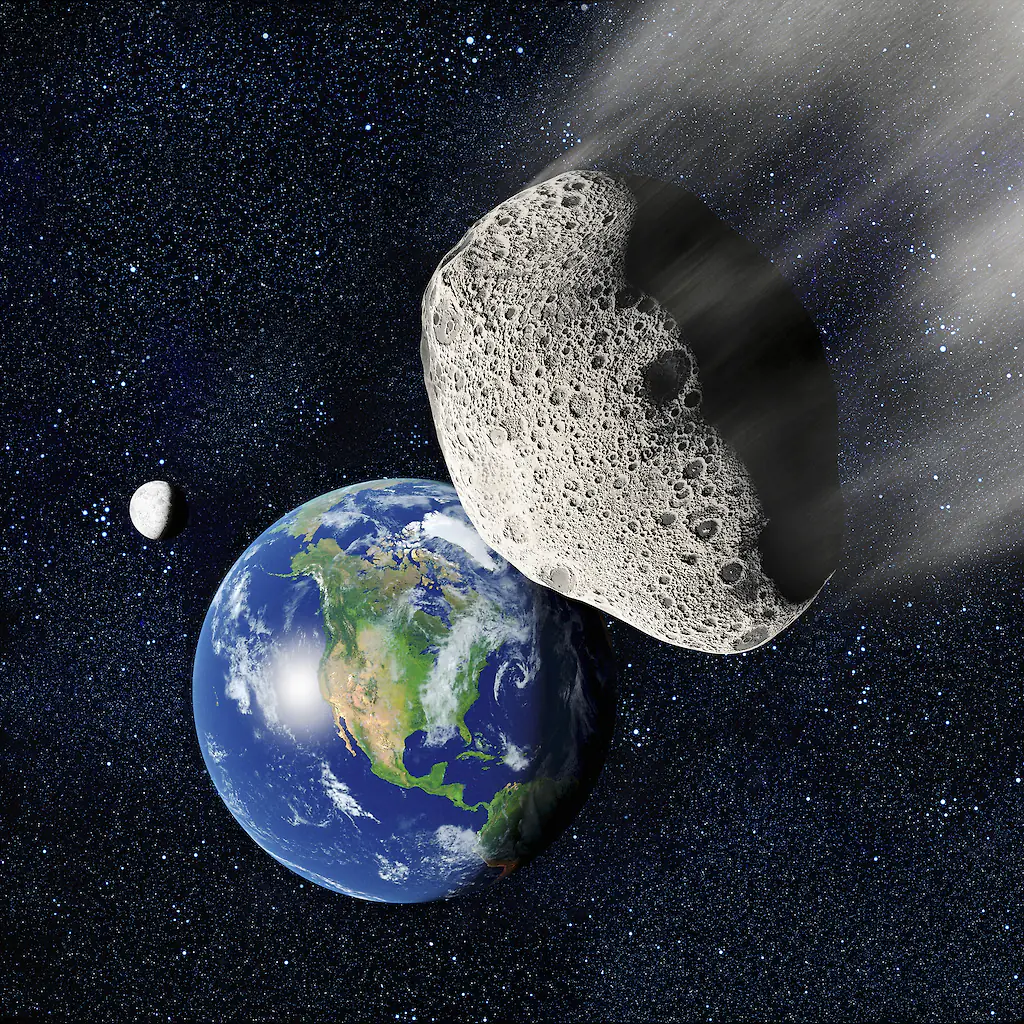
Five asteroids are set to come dangerously close to the Earth this year, before a comet the size of Mount Everest is set to pass by next year.
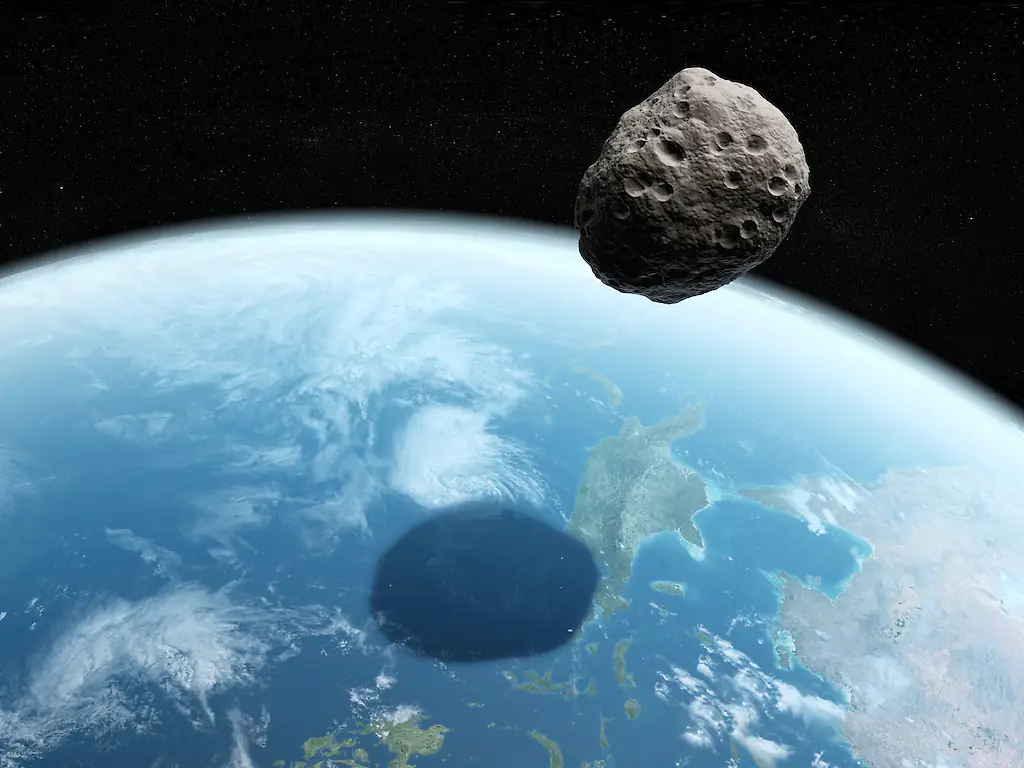
According to reports, five asteroids are due to pass by our planet before the end of the year, varying in size from that of the Golden Gate Bridge to one the size of a school bus.
For most of us, space can be a simultaneously fascinating and terrifying thing. While scientific advancements have given us knowledge about a lot of what's out there, there's a whole lot more that still remains unknown.
And some things we'd rather not know - such as the fact there are giant space rocks hurtling near to us in the next month and a half.
As reported by the Daily Mail, NASA has flagged five asteroids that will come close to our planet this year, beginning with (2019 CZ2), which is an Apollo-class asteroid - those that cross the orbit of the Earth and shed meteorites that occasionally collide with the Earth.
This will pass by the Earth on November 25 at a distance of 666,000 miles (1.1 million km), and is a pretty small asteroid with a diameter estimated to be between 68ft (21m) and 308ft (94m), making it comparable to a school bus.
This one is not thought to pose any potential danger to our planet, but is a near-Earth asteroid all the same.
(2013 VX4) is set to pass by on December 4, with this asteroid believed to be between 144ft (44m) and 325ft (99m) in diameter, similar to the Statue of Liberty in size.
This Apollo-class asteroid will come to around 1.2 million miles (1.9 million km) from the Earth when it reaches its nearest point.
139622 (2001 QQ142), is also an Apollo-class asteroid and is also pretty terrifyingly massive, as it is believed to be between 0.2 miles (0.347km) and one mile (1.552km) in diameter - so similar to the size of the Golden Gate Bridge.
This one is bigger than 97% of all known asteroids, and will be closest to the Earth on December 6, at 3.4 million miles (5.5 million km) away.
Another asteroid, 341843 (2008 EV5), is set to pass us on December 20 at a distance of 3.9 million miles (6.3 million km).
This one is an Aten-class asteroid, meaning it is one that spends the majority of its time hidden by the sun and has an orbital period of less than a year.
341843 (2008 EV5) is also no small rock, as it is believed to have a diameter of 1,300ft (0.4km), similar to the size of the US Capitol building.
Next up is 2020 YO3, another Apollo-class asteroid, which is thankfully smaller than most - but still measures in at between 101ft (31m) and and 230ft (70m) in diameter, making it around the same size as the London landmark Big Ben.
This one will get closest to the Earth on December 23, flying past at a distance of 47,000 miles (1.3 million km), and is not believed to be potentially hazardous to Earth like some of its larger counterparts.
As if that's not enough to give you a cold sweat, next year there's a comet which is nicknamed the "devil" which is expected to be visible in June 2024.
Known as 12P/Pons-Brooks, this space rock is currently exploding "like a volcano" on its way toward Earth - but thankfully, scientists say there's no chance it will actually hit our planet.
12P/Pons-Brooks is set to reach its maximum brightness in June, which will make it visible to the naked eye.
And if you were wondering how big 12P/Pons-Brooks is, well, it's actually three times the size of Mount Everest - so that's terrifying enough to know.
While scientists are sure this one won't endanger the Earth, it was the huge Chicxulub asteroid that wiped out the dinosaurs 66 million years ago.
There's not expected to be another occurrence like that one anytime soon, but NASA has prepared a defense strategy just in case, in the form of the Double Asteroid Redirection Test (DART), which proved successful last year.
The space agency has so far discovered over a million rocks circling in our solar system, including over 30,000 near-Earth objects (NEOs), some of which they have classes as "potentially hazardous".
uncategorised2 min(s) read
uncategorised5 min(s) read
[[heroimage||http://cdn.junglecreations.com/wp/junglecms/2017/12/planet-earth-compressor.jpg||image]]
Or if you want more NASA boo-boos, there was the time that the agency launched the United States' first and only space station with seemingly absolutely no thought as to how it would come back down to Earth. Skylab lasted for six years in the space, before falling back down to Earth. Luckily NASA were able to guide most of the space station into the Indian Ocean, but that didn't stop pieces landing in the small town of Esperance, Australia. Thankfully no one was injured as a result. But if we're talking mistakes, then the deletion of the moon landing tapes probably takes the cake. One giant leap for mankind became one giant blunder for NASA when it was revealed they had foolishly taped over original recordings of the first humans landing on the moon in 1969. The space agency admitted in 2006 that no one could find the original grainy images of Neil Armstrong and Buzz Aldrin walking on the surface of the moon and it eventually exposed that they were erased and reused by NASA in the early 1980s. Officials insisted that newly restored copies of the original broadcast look even better than the old ones, but there's no doubt this fact didn't erase their embarrassment over the situation. Nonetheless, no one is perfect and we can all wipe our foreheads, take a deep breath and be happy that the more recent asteroid missed us - but that is not to say that there aren't thousands of space rocks out there that won't spell disaster for the only object in the Universe known to harbour life. Reportedly, there are more than 8,000 known Apollo rocks and nearly 1,500 could get close enough to Earth to become potentially hazardous. Not to mention a far larger asteroid named 3200 Phaethon is on course to pass by our planet this very month. Russian astronomers have warned us that we are set to have a terrifyingly close encounter with the three-mile wide celestial body on December 17. In case you were wondering, that is half the size of the rock that wiped out the dinosaurs 65 million years ago. Described by NASA to be "a potentially hazardous asteroid whose path misses Earth's orbit by only two million miles", you'll be happy to hear that the monster asteroid will do more good than harm this time; it is thought to cause the stunning Geminids meteor shower today and tomorrow, which will see hundreds of bright meteors beautifully illuminate the night's sky as they burn up in Earth’s atmosphere. So, we escaped the fate of all of those Tyrannosaurus Rexes and Velociraptors this time, but we have to say, it was a close call. All we can really do is cross our fingers and hope that NASA and the other space agencies of the world keep a better eye out in future.world4 min(s) read
Get ready - a mountain-sized "planet killer" asteroid is set to pass by Earth today.
The colossal asteroid dubbed 2011 UL21 will come within 4.1 million miles of Earth, making it one of the largest space rocks to approach our planet in 125 years, per LiveScience.
This "planet killer" asteroid will travel at a staggering 58,000 mph (93,000 km/h) during its flyby, offering a rare opportunity for skywatchers and astronomers to witness the event.
According to SpaceReference.org, it measures between 1.1 and 2.4 miles (1.7 to 3.9 kilometers) wide, making it larger than 99% of known near-Earth asteroids, as confirmed by the European Space Agency (ESA).
2011 UL21 is classified as a near-Earth asteroid, meaning its orbit brings it within 1.3 astronomical units (AU) of the sun, or roughly 1.3 times the average distance between Earth and the sun. The asteroid completes an orbit around the sun every three years.
Despite being categorized as a "planet killer" due to its massive size, 2011 UL21 is still much smaller than the Chicxulub asteroid, which is believed to have caused the dinosaurs' extinction approximately 66 million years ago.
Interestingly, 2011 UL21 does not follow the usual orbital path of most NEOs. Instead, it travels at a steep angle, possibly influenced by the gravitational forces of Jupiter.
The European Space Agency (ESA) has noted that Jupiter's gravity can sometimes redirect asteroids towards Earth.
According to simulations by NASA's Jet Propulsion Laboratory (JPL), 2011 UL21's approach will be the closest it has come to Earth in over a century.
Although its distance will be about 17 times that of the moon from Earth, it is still considered a potentially hazardous object by NASA.
Astrophysicist Gianluca Masi, director of the Virtual Telescope Project (VTP), noted in a recent statement: "It is interesting because it's probably one of the 10 biggest asteroids to pass within 4.7 million miles (7.5 million km) of our planet since 1900."
2011 UL21 will not come this close to Earth again until 2089, when it will approach within 1.7 million miles (2.7 million km) of our planet—more than two and a half times closer than this year's flyby.
There is no threat of a planet-killer asteroid impacting Earth for at least the next 1,000 years.
However, a second asteroid, named 2024 MK, will pass much closer on Saturday. Discovered only on June 16, 2024 MK will zip by at a distance of 180,200 miles from Earth - approximately 75% of the distance to the Moon.
Though significantly smaller than 2011 UL21, measuring between 120 and 260 meters wide, 2024 MK could still cause substantial damage if it were to impact Earth.
Dr. Greg Brown, an astronomer at the Royal Greenwich Observatory, commented on the significance of these events, via the Metro: "This week, two asteroids will pass somewhat nearby to the Earth. For small asteroids, this is a very common occurrence, with close passes dozens of times a month. However, these two asteroids are somewhat larger than we normally expect."
Dr. Brown highlighted the importance of asteroid 2024 MK's recent discovery: "While neither asteroid poses a threat to Earth, 2024 MK was discovered less than two weeks before its projected close approach.
"It is also thought to be considerably larger than the asteroid that caused the Tunguska event, which caused devastation across a 2,000 square kilometer region of — thankfully uninhabited — Siberian countryside in 1908."
For those eager to witness the 2011 UL21, the VTP will host a free live stream from the Bellatrix Astronomical Observatory in Ceccano, Italy.
The stream begins at 4:00PM ET on June 27, with the closest approach expected 15 minutes later.
Additionally, the asteroid will be visible through a telescope, appearing brightest on June 28 and June 29. Viewers in the Northern Hemisphere should look for a brightness similar to Proxima Centauri, the nearest star to the sun.