Uncategorised3 min(s) read
uncategorised3 min(s) read
space2 min(s) read
An Asteroid is set to hit Earth's atmosphere this week - but there's no need to flee to an underground bunker just yet.
Asteroids have long been a point of fascination and destruction for our planet, with the dinosaurs meeting their end 66 million years ago at the hands of the 10 km wide Chicxulub impactor.
If one that size were to ever hit our planet again, it would be a case of holding our loved ones tight and hoping our species gets resurrected in a more underwhelming version of Jurassic Park... Though Human Park doesn't have the same ring to it.
Per The Mirror, an asteroid is set to come pretty close to us this week, but there's no need to panic just yet as it's fairly small and won't make contact with Earth.
Asteroid 2023 BU was discovered by Gennadiy Borisov on January 21, with it scheduled to be at its closest to earth on Thursday (January 26).
It'll pass by 3500km from Earth, which put in perspective is less than three percent of the average distance between our home planet and the moon.
But say the asteroid suddenly changed course and began heading straight toward us, there would still be no need to panic due to how small it is.
According to the Centre for Near Earth Object Studies (CNEOS), the floating rock ranges between 12.4ft and 27.8ft, meaning it would break up while entering our atmosphere, as usually happens to any asteroids under 80 feet wide.
Anybody interested in watching the space event take place can do so over at the Virtual Telescope Project (VTP), which is a website that allows anyone to be an astronomer from the comfort of their own home.
The VTP is a group of robotic telescopes in Ceccano, Italy, and the live feed to watch Asteroid 2023 BU will go live on January 26 at 07:15 PM UTC (2:15 PM ET, 1:15 PM CT, 11:15 AM PT).
Similarly, a comet named C/2022 E3 (ZTF) will be making its first appearance in over 50,000 years in late January and early February and it won't be visible again for another 50,000, so best see it while you can!
Let's be thankful there's no doomsday event facing our planet just yet.
space5 min(s) read
Five asteroids are set to come dangerously close to the Earth this year, before a comet the size of Mount Everest is set to pass by next year.
According to reports, five asteroids are due to pass by our planet before the end of the year, varying in size from that of the Golden Gate Bridge to one the size of a school bus.
For most of us, space can be a simultaneously fascinating and terrifying thing. While scientific advancements have given us knowledge about a lot of what's out there, there's a whole lot more that still remains unknown.
And some things we'd rather not know - such as the fact there are giant space rocks hurtling near to us in the next month and a half.
As reported by the Daily Mail, NASA has flagged five asteroids that will come close to our planet this year, beginning with (2019 CZ2), which is an Apollo-class asteroid - those that cross the orbit of the Earth and shed meteorites that occasionally collide with the Earth.
This will pass by the Earth on November 25 at a distance of 666,000 miles (1.1 million km), and is a pretty small asteroid with a diameter estimated to be between 68ft (21m) and 308ft (94m), making it comparable to a school bus.
This one is not thought to pose any potential danger to our planet, but is a near-Earth asteroid all the same.
(2013 VX4) is set to pass by on December 4, with this asteroid believed to be between 144ft (44m) and 325ft (99m) in diameter, similar to the Statue of Liberty in size.
This Apollo-class asteroid will come to around 1.2 million miles (1.9 million km) from the Earth when it reaches its nearest point.
139622 (2001 QQ142), is also an Apollo-class asteroid and is also pretty terrifyingly massive, as it is believed to be between 0.2 miles (0.347km) and one mile (1.552km) in diameter - so similar to the size of the Golden Gate Bridge.
This one is bigger than 97% of all known asteroids, and will be closest to the Earth on December 6, at 3.4 million miles (5.5 million km) away.
Another asteroid, 341843 (2008 EV5), is set to pass us on December 20 at a distance of 3.9 million miles (6.3 million km).
This one is an Aten-class asteroid, meaning it is one that spends the majority of its time hidden by the sun and has an orbital period of less than a year.
341843 (2008 EV5) is also no small rock, as it is believed to have a diameter of 1,300ft (0.4km), similar to the size of the US Capitol building.
Next up is 2020 YO3, another Apollo-class asteroid, which is thankfully smaller than most - but still measures in at between 101ft (31m) and and 230ft (70m) in diameter, making it around the same size as the London landmark Big Ben.
This one will get closest to the Earth on December 23, flying past at a distance of 47,000 miles (1.3 million km), and is not believed to be potentially hazardous to Earth like some of its larger counterparts.
As if that's not enough to give you a cold sweat, next year there's a comet which is nicknamed the "devil" which is expected to be visible in June 2024.
Known as 12P/Pons-Brooks, this space rock is currently exploding "like a volcano" on its way toward Earth - but thankfully, scientists say there's no chance it will actually hit our planet.
12P/Pons-Brooks is set to reach its maximum brightness in June, which will make it visible to the naked eye.
And if you were wondering how big 12P/Pons-Brooks is, well, it's actually three times the size of Mount Everest - so that's terrifying enough to know.
While scientists are sure this one won't endanger the Earth, it was the huge Chicxulub asteroid that wiped out the dinosaurs 66 million years ago.
There's not expected to be another occurrence like that one anytime soon, but NASA has prepared a defense strategy just in case, in the form of the Double Asteroid Redirection Test (DART), which proved successful last year.
The space agency has so far discovered over a million rocks circling in our solar system, including over 30,000 near-Earth objects (NEOs), some of which they have classes as "potentially hazardous".
world politics3 min(s) read
Santa Claus isn’t the only thing soaring past Earth this holiday season.
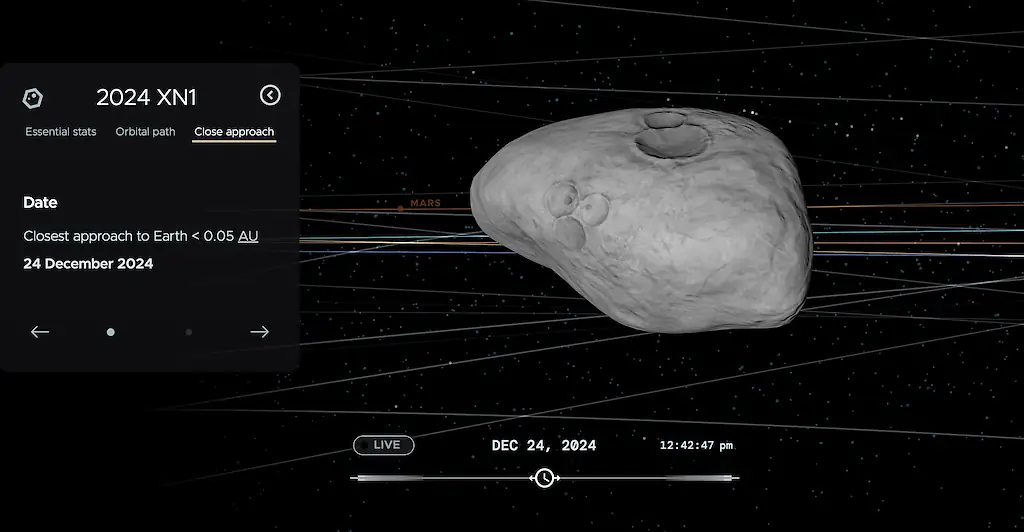
NASA has issued a heads-up about a massive asteroid, 2024 XN1, which is set to zoom past the planet tonight.
Measuring the size of a 10-story building, the asteroid will make its closest approach just before 10:00PM EST, passing by at a distance of 4.48 million miles, according to NASA’s Asteroid Watch dashboard.
By interstellar standards, this counts as a “close approach". NASA defines near-Earth objects (NEOs) as celestial bodies that pass within 4.6 million miles of Earth. However, astronomers assure us there’s no cause for alarm.
“It will be very far away, around 18 times further away from the Earth than the Moon is, and so with this predicted path won’t come close enough to hit the Earth,” Jess Lee, an astronomer at the Royal Greenwich Observatory, told The Daily Mail.
If it were to collide, the impact would be catastrophic. The asteroid, which was first detected on December 12, is estimated to measure between 95 and 230 feet in diameter and is traveling at a blistering speed of 14,743 mph.
Scientists estimate such an impact would unleash energy equivalent to 12 million tons of TNT and devastate an area of roughly 700 square miles, per the New York Post.
Lee drew comparisons to the Tunguska Event of 1908, when a similarly sized asteroid exploded over Siberia, flattening 80 million trees across 800 square miles.
Following tonight’s close call, 2024 XN1 won’t be making another “Earth tour” until January 2031, when it will pass even closer, at 3.1 million miles. (Which is still a little too close for comfort for my liking!)
The next major celestial visitor, however, will arrive sooner. A 1,310-foot asteroid is expected to pass within 2.29 million miles of Earth on January 5, 2025, according to The Daily Mail.
While neither of these space rocks poses a threat, they highlight the importance of tracking NEOs.
NASA continuously monitors the orbits of such objects, refining predictions with each new observation.
“The orbit of each object is computed by finding the elliptical path through space that best fits all the available observations, which often span many orbits over many years or decades,” NASA explains. “As more observations are made, the accuracy of an object’s orbit improves dramatically, and it becomes possible to predict where an object will be years or even decades into the future – and whether it could come close to Earth.”
New advancements may make identifying potential threats even easier. Spanish scientists have developed a method to calculate the gravitational bending of light, allowing for more precise tracking of asteroids heading toward Earth.
For now, stargazers can rest easy as 2024 XN1 makes its distant holiday flyby — no cosmic coal in our stockings this year.
space1 min(s) read
NASA has said that an asteroid "closer to the earth than the moon" will fly-by us in weeks.
Making its way past our pale blue dot at a speed of 18,253 miles per hour, the 2011 ES4 asteroid is estimated to measure up to 49 meters.
While this isn't particularly large for an asteroid, what makes this one notable is how close it will come to the Earth, and it's very close.
NASA astronauts shared their workouts on the ISS to help those in isolation:
[[jwplayerwidget||https://content.jwplatform.com/videos/wjW9oCDf-dkXnENEs.mp4||wjW9oCDf]]
According to NASA, the asteroid will be zipping past the Earth on September 1 at 10:49 am EDT (15:49pm BST) at a distance of 0.00048 astronomical units, which in layman's terms is the equivalent of 44,618 miles.
To put the difference between the asteroid and the moon into context, the moon is around 238,855 miles away.
The 2011 ES4 asteroid has been described as "potentially hazardous" by NASA, but because its diameter is so small, it's not been classified as a direct threat to our planet.
The asteroid is listed on the space agency's 'close Approaches' database, according to its Center for Near-Earth Object Studies (CNEOS), but before you start freaking out (it is 2020, after all), 'near-Earth object' (NEO) is simply one that's in the sun's orbit.
While in the context of space NEOs are close to the Earth, that doesn't necessarily mean that they are threats and a NASA spokesperson said that a comet or asteroid can be classed a NEO if it comes within 1.3 astronomical units of the sun on its approach.
One astronomical unit is the equivalent of 93 million miles, so in short, that's not very close at all. However, it is worth noting that the 2011 ES4 is coming closer than any asteroid on this list.
But when it was first discovered back in March 2011, hence its namesake, it actually wasn't very close to the Earth at all and was 5,000,000 miles from Earth.
It's been classed as an Apollo asteroid since then which means that it has a very wide orbit between the Earth and the sun.