RuPaul Charles made Emmys history last night, as he became the most awarded person of color in the event's 72-year history.
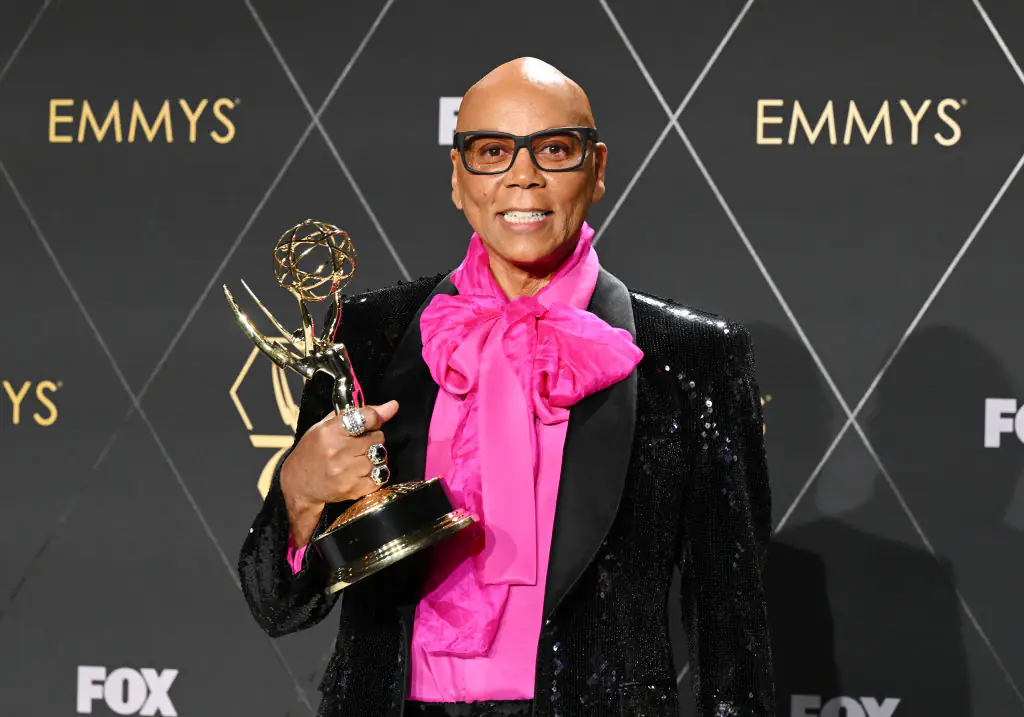
Last night, the iconic television host and drag legend won the award for Best Reality Competition Program for the 13th season of RuPaul's Drag Race. The win marked the 60-year-old's 11th Emmy.
The win meant RuPaul overtook cinematographer Donald A. Morgan as the most decorated person of color in the history of the awards show.
Speaking to the LA Times prior to Sunday night's big-name event, Rupaul said: "I have all the scars to show you from a career in show business.
"Actually, I climbed up on stage, the first time for money, in 1982 and I've been doing it ever since. It's been a long, hard road, but I have enjoyed every minute of it."
Accepting the award, RuPaul said during his speech: "Really thanks to all of our lovely children on our show from all around the world. They’re so gracious to tell their stories of courage how to navigate this difficult life that’s more difficult today."
"For you kids watching, you have a tribe that is waiting for you," he added, "we are waiting for you, baby. Come on to Mama Ru."
RuPaul delivered a powerful speech at the Emmys as he confronted anti-drag laws and explained why drag queens have an important place in society.
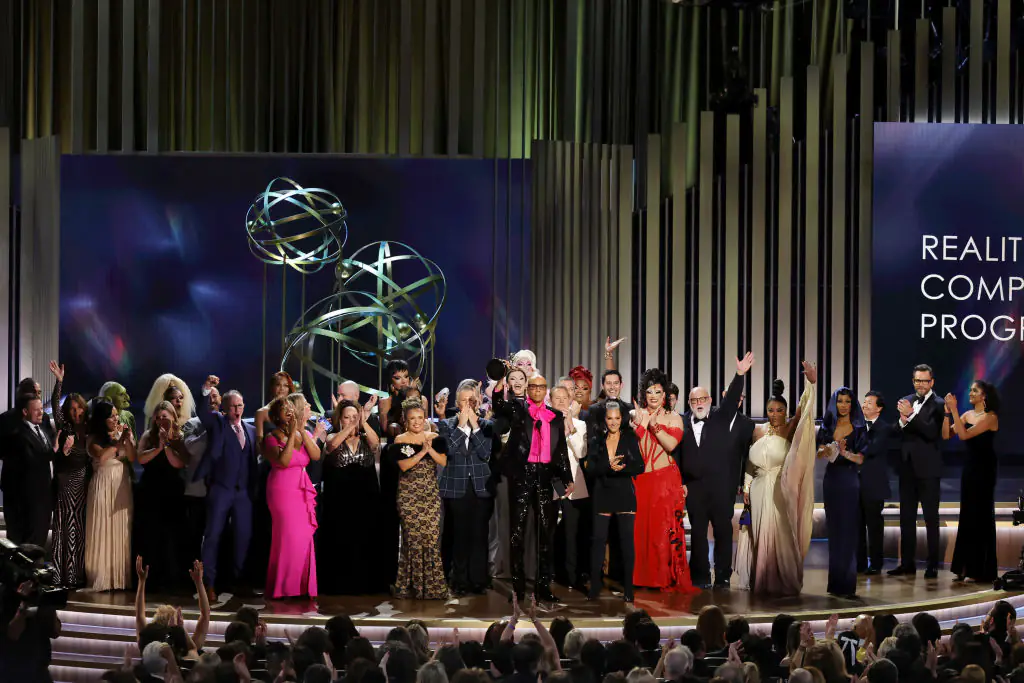
As RuPaul's Drag Race clinched another Emmy victory, the media mogul, joined by co-stars Michelle Visage and Ross Mathews, along with a group of drag queens, took a moment to reflect on the tough times the LGBTQ+ community has endured in the past 12 months.
Holding the award with gratitude, RuPaul expressed appreciation, saying: "Thank you so much, you lovely, lovely people. We are so honored to have this award."
Acknowledging the impact of the show in introducing countless drag queens to the world, RuPaul emphasized the importance of standing against the increasing number of drag bans.
Watch RuPaul's speech below:
"You guys are just lovely for honoring our show and for recognizing all of these queens. We have released into the wild hundreds of drag queens, and they’re beautiful. On behalf of all of them, we thank you," RuPaul stated.
He then addressed the legislative threats faced by drag performers, particularly mentioning bans on drag shows in states like Tennessee and Montana, as well as attempts in Texas and Florida.
"Listen, if a drag queen wants to read you a story at a library, listen to her," he said. "Because knowledge is power, and if someone tries to restrict your access to power, they are trying to scare you. Listen to a drag queen, thank you! We love you!"
RuPaul's Drag Race won the Outstanding Reality Competition Award. Credit: Kevin Winter/Getty
The Human Rights Campaign applauded RuPaul's remarks, recognizing the speech's significance "on the importance of protecting our power as LGBTQ+ people in the face of anti-drag attacks."
This isn't the first time RuPaul has addressed challenges faced by the LGBTQ+ community. In a 2020 interview with CBS Mornings, he expressed skepticism about the extent of acceptance, stating: "I don't know how accepted it is. … We're more polarized in our country than I think I've ever witnessed in my lifetime."
In February, a Tennessee law banning "adult cabaret" performances in public or in front of minors was signed by Republican Gov. Bill Lee. However, a federal judge blocked its enforcement in April, mere hours before it was set to take effect.
RuPaul used his platform to speak out against bans on drag queens. Credit: Gilbert Flores/Getty
The legal battle over the right to attend drag shows has extended to the Supreme Court. In November, the court declined to allow the enforcement of a Florida law prohibiting children from attending drag shows, upholding a lower court ruling while a legal challenge continues to unfold," according to CBS.
Over the last few years, drag culture has become more and more popular outside of the LGBTQ community - and a lot of that growth is down to RuPaul's Drag Race. The reality TV show, which pits a number of drag queens against one another in order to achieve a coveted $100,000 prize, has seen widespread success, and it's pretty much all down to Ru.
Unfortunately, the world-famous drag queen isn't always as inclusive and benevolent as he makes himself out to be on the show. In the past, a number of aspects of Drag Race had to be changed because they were considered transphobic (for instance, the pun "she-mail" was removed from the challenge announcements at the beginning of the episodes), and Ru has previously been called out by queens for not always practicing what he preaches.
Most recently, the self-professed supermodel of the world alienated a huge amount of his fans and followers when he said that transgender women should not do drag.
His comments came about in an interview with The Guardian, during which he was asked how a trans woman could be a drag queen. Ru then went on to reference Peppermint - a runner-up in last year's competition - who was out as a transwoman before she competed on the show.
"Peppermint didn’t get breast implants until after she left our show," he said, as if having breasts is the be-all and end-all of womanhood. "She was identifying as a woman, but she hadn’t really transitioned."
Ru was then asked whether he would accept a queen who had undergone gender reassignment surgery, to which he responded: "Probably not. You can identify as a woman and say you’re transitioning, but it changes once you start changing your body. It takes on a different thing; it changes the whole concept of what we’re doing."
Obviously, this was absolutely heartbreaking for many people to hear. Not only did his words imply that transwomen aren't women until they've had surgery, it also shows that he values cisgender men more than women, as he permits all of his male-identifying contestants to have cosmetic surgery.
To make matters worse, he then tried to apologize for his actions by tweeting what he believed to be the trans flag. Unfortunately, in another act of carelessness, he tweeted a green and yellow pattern, which is definitely not the recognized flag for transgender people.
He also issued a statement saying that - far from what the interview implied - he has an open mind and wants to learn from his mistakes.
"Each morning I pray to set aside everything I THINK I know, so I may have an open mind and a new experience. I understand and regret the hurt I have caused. The trans community are heroes of our shared LGBTQ movement. You are my teachers."
However, previous queens have called RuPaul out on Twitter for having said such an insensitive thing in the first place.
Hopefully, this whole incident will open Ru's - and a lot of other people's - eyes about the relationship between gender and drag, and the importance of being inclusive of transgender individuals in the LGBTQ community.
Last night's Emmy Awards took an unexpected turn on Monday night after viewers spotted a peculiar-looking guest in the crowd.
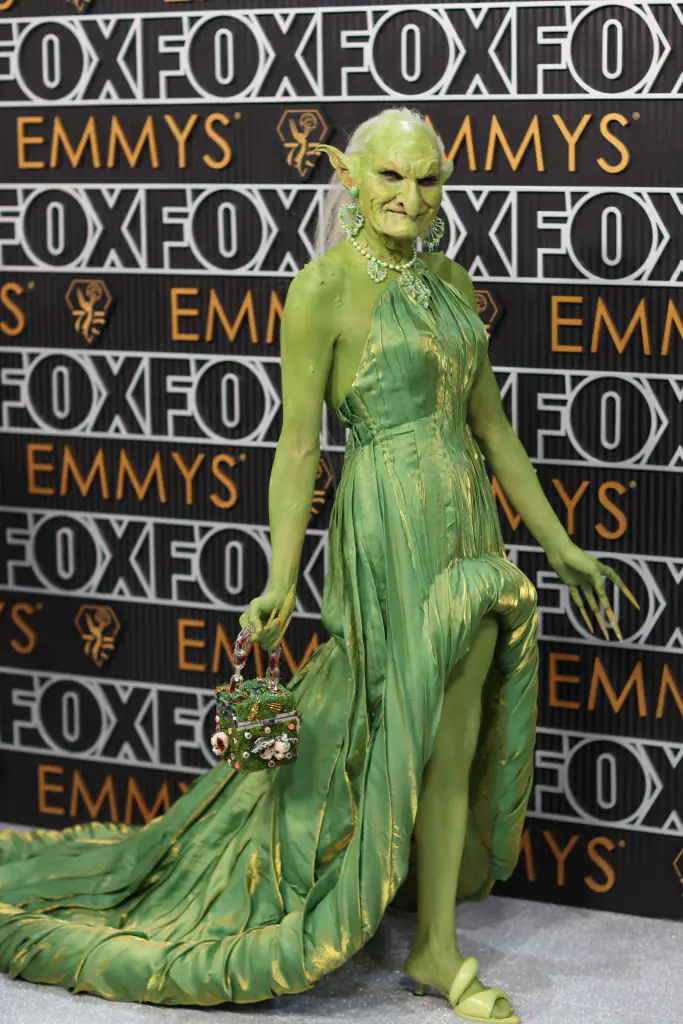
Sporting green skin, a hideous face, long claw-like nails, and a beautiful green gown, it didn't take long for the eye-catching guest to get people talking on social media.
Taking to X, people quick shared their bemusement, with one person writing: "does anyone have any intel about the goblin at the emmys? [sic]"
"A green creature has been spotted at the #EMMYs," the celeb-focused page Pop Base tweeted, while a third alarmed viewer asked: "WHO THE HELL IS THAT?"
Well, it wasn't long before internet sleuths got to work and were finally able to unmask the iconic goblin as reality TV star Princess Poppy - who is perhaps best known for being a contestant on season 15 of RuPaul's Drag Race.
While her fellow castmates opted for glamorous attire, Princess Poppy's unconventional choice left viewers in awe and confusion.
The Goblin took many viewers by surprise. Credit: Jay L. Clendenin / Getty
In an interview with Entertainment Weekly on the red carpet, Poppy explained her unconventional outfit choice, stating: "I wanted to do the exact opposite of what is expected of you when you go to an event like this. I wanted to take decorum and turn it on its head."
She continued: "Mainly I wanted to be a troll-slash-hag. I wanted to be so shocking that you just have to turn and look at me — in the worst way possible."
And just in case you wanted to see what Princess Poppy looked like out of drag:
Despite its over-the-top nature, Princess Poppy's outfit was fitting, considering RuPaul's Drag Race's continued domination in the reality television category. The long-running series secured the Emmy for Outstanding Reality Competition Program.
During his acceptance speech, RuPaul used the platform to issue a call to action, emphasizing the importance of embracing drag queens and to fight back against recent bans on drag shows - such as library readings. Check out the speech below:
He stated: "If a drag queen wants to read you a story at a library, listen to her because knowledge is power, and if someone tries to restrict your access to power, they are trying to scare you. So listen to a drag queen!"
The Human Rights Campaign praised RuPaul's speech on X for highlighting "the importance of protecting our power as LGBTQ+ people in the face of anti-drag attacks."
As reported by CBS News, singer Lizzo was another celeb to protest a recent law restricting drag shows in Tennessee. The 'About Damn Time' singer brought 20 drag queens - including RuPaul's Drag Race stars Aquaria, Kandy Muse, and Vanessa Vanjie Mateo - on stage during a show in Knoxville.
RuPaul's influence on mainstream culture and LGBTQ+ acceptance has been remarkable, but he remains cautiously optimistic. In a 2020 interview with CBS Mornings, he questioned the extent of LGBTQ+ acceptance in society, saying: "I don't know how accepted it is. … We're more polarized in our country than I think I've ever witnessed in my lifetime."
Princess Poppy's audacious appearance at the Emmy Awards served as a reminder of the power of individuality and self-expression in the entertainment industry, where creativity knows no bounds!
The 2020 Emmys was a historic event for a number of reasons, and one of the most positive outcomes from the show was the fact that it set a new record for the most wins by black actors.
Seven black performers took home awards in major categories last night, which tops the previous record for the most wins by black actors that was set two years ago.
An overjoyed Zendaya celebrates her historic Emmy's win:
Black actors received a particularly high number of nominations this year, and per Variety, the Television Academy reports that 34.3% of all nominees this year were black.
In total, nine of the 18 acting awards given out at the 72nd Emmys went to black actors, which is a huge increase from last year's numbers, where just 11.1% of winning actors were black.
Regina King, Yahya Abdul-Mateen II, Uzo Aduba, and Zendaya all received awards during last night's ceremony, joining Eddie Murphy, Maya Rudolph, and Ron Cephas Jones, who received awards during Saturday's event.
Both Murphy and Rudolph won their Emmys for their December 2019 performance in the same episode of Saturday Night Live, with Rudolph also scooping her second Emmy for outstanding voiceover performance for her role on Netflix's Big Mouth.
The first parent-child duo to win an Emmy also emerged victorious at the 2020 event, with Jasmine Cephas Jones, the daughter of winner Ron Cephas Jones, winning the short form acting award for Quibi's #FreeRayShawn alongside Laurence Fishburne.
Zendaya's lead drama actress win for HBO's Euphoria was also a historic win, as at 24 she became the youngest ever actor to scoop best lead actress in a drama series.
This award became a historic win in more than one way too, as it marked the second time that a black woman has won in that category in the Emmys' 71-year history, with the award first being given to Viola Davis in 2015 for her starring role in How To Get Away With Murder.
RuPaul’s Drag Race is a phenomenon. One of the biggest series on streaming services like Netflix, it features drag queens battling it out become America’s Next Drag Superstar. Following the format of America’s Next Top Model, the queens compete in a mini-challenge and a main challenge, before strutting their stuff on the runway. After this, RuPaul and his trusty sidekicks judge the quality of their performances, with the bottom two queens battling for their survival by lip-synching for their lives.
The show has featured many a hilarious incident and many a memorable queen—Derrick Barry’s drag was so good that when he made his season eight entrance many people, myself included, thought that Britney had legitimately tried her luck on the show and then there was Adore DeLano's undeniable talent but complete lack of skill in the sewing department.
[[imagecaption|| Credit: PA Images]]
Last weekend, the first RuPaul’s British DragCon was held in London. A celebration of the hit series, which made its UK debut last year, the event was bustling. Attendees had the chance to watch the queens sissy that walk on the runway, and among other activities, attend panels with queens past and present, and of course, RuPaul himself. The convention was also an opportunity for fans to meet the queens, many of whom are American, and dress up themselves.
RuPaul is pictured below opening the first British DragCon:
[[imagecaption|| Credit: PA Images]]
One of the most remarkable things about the show, however, has not been its entertainment value, but its ability to improve representation and understanding of the LGBTQ+ community. In the dressing room, many of the LGBTQ+ queens discuss their experiences growing up as part of the community and the struggles or lack thereof that they’ve faced. In season nine, Peppermint, the only trans queen to have featured, opened up about the transphobia she encountered while presenting female in Russia.
Drag Race stars have also gone on to promote increase representation and understanding elsewhere, with Courtney Act winning widespread praise in the UK for her candid explanation of gender identity on the reality TV show Big Brother.
I attended to find out more about how drag has exploded into the mainstream thanks to Drag Race, which premiered for the first time in the US in 2009, and how it has opened up what was once a relatively underground art form to people all of all ages, gender identities, and sexualities. So much so that there was even a drag storytime at the convention for children!
One of the queens I spoke to was Gothy Kendoll, who starred in the first British season of the Drag Race. She explained that the show’s movement across the pond has opened audiences up to a new type of queen.
VT: What do you think the main difference between British and American drag is?
“US drag originated from the pageant scene where it’s all about really polished and as proper as you can be. Whereas British drag came from the pantomime scene where it’s all about taking the p*ss and being as campy and as entertaining as you can be. That’s the biggest difference. I feel like with Drag Race there’s more of a crossover between the two.”
VT: Do you think British queens have anything on the American ones?
“Absolutely. I think we’re way better. Our humor is better. In American drag, there is a lot of shadiness because [people] get easily offended, whereas the British will make a joke out of everything. And I think that’s the best thing to do with drag because it’s just a laugh at the end of the day.”
VT: How has your life changed since becoming a RuPaul girl?
“So before I’d been doing drag for a year and a half, and I did it once a month. And now I get to do drag five times a week, and I get to meet really fabulous people that can help push my drag further and do the things I wanna do.”
Another queen I had the chance to speak to was Morgan McMichaels, who appeared in season two of the US show. She revealed that queens really do have the opportunity to open up their influences to audiences and explained that while RuPaul encourages contestants to possess the right amount of charisma, uniqueness, nerve, and talent, there's something else which all drag queens should aspire to.
VT: Has has being Scottish-American influenced your drag?
“Oh God yeah. My musical choices. The first three years I did drag, I only chose Scottish artists. Then I would always do British artists. I have a huge British influence. I have a podcast. It’s called Funk What Ya Heard. It’s available on Apple. I have a story behind every song that I chose. It’s an opportunity for Americans, especially, to hear music that they’ve never heard—covers that they’ve heard. British music is so cheesy, open, fun and diverse. That’s what really represents the UK for me.”
[[imagecaption|| Credit: PA Images]]
VT: Putting charisma, uniqueness, nerve, and talent to the side, what’s the main quality that you think makes a great drag queen?
“Probably how you treat people and personality. You can be the most talented person in the world, you can win Drag Race, you can be the most beautiful one, but if you have zero personality and you treat the people who you think are not of consequence or circumstance poorly... I always look at how queens treat their waiters or random people in the street. That’s how you judge character.”
However, not all queens in attendance at DragCon were RuPaul girls. The shows has created more drag content on multiple platforms, something that I learned when I spoke to one of the Sugarbaker Twins, who was there promoting her YouTube comedy series Camp WannaKiki.
VT: How has RuPaul’s Drag Race changed your life?
“It’s definitely brought the world of drag more mainstream. I think it’s just fantastic. I personally have my own show on YouTube, Camp WannaKiki, and I guess you could say that inspired me to do my own show where we [showcased] camping drag queens. RuPaul is all about the glamorous and then you get dragula, monster queens, but there was nothing for the campy, funny queens. So now there’s Camp Wannakiki.”
VT: What was it like doing drag before it was mainstream?
“You know, it was definitely different. Yeah, I mean, now it’s just more mainstream. I’m also part of Hamburger Mary’s, which is a big US drag chain. It’s a lot busier. We get a lot more straight people coming to drag shows.”
VT: Do you like the fact that it’s opened up beyond the LGBT community?
“Now you’ve got women who were born women doing drag. You’ve got drag kings, AFAB queens. It’s a more open, inclusive and safe space for everyone.”
[[imagecaption|| Credit: PA Images]]
In a world that in many ways is more divided than ever before, Drag Race is a lighthearted reminder that fun can change the world for the better. Phrases once used only in the LGBTQ+ community are now fan favorites outside it too—such as “shade”, “realness”, and, of course, the almighty “werk it”. However, there is still a lot more work to be done, with a 2017 report from Stonewall finding that one in five British LGBTQ+ people had been the victim of a hate crime.
While drag has been around for centuries, there's no doubt that its popularity is at an all-time high, and as Gothy Kendoll put it, the introduction pantomime-esque British queens to the scene, which, until now, has been dominated by American queens, is only going to win the art form even more fans.