Donald Trump and John McCain have had an open political beef for nearly two years now. McCain, representing the old-style of conservatism, the neocon Bush years and the traditional approach to governance, was a major obstacle for Trump's brand of populism, nationalism and anti-globalism. As two opposed ideological wings, they had to clash. However, that clash became intensely personal.
[[twitterwidget||https://twitter.com/SenJohnMcCain/status/784870687462854656]]
It all started with Trump's remarks in July 2015, regarding McCain: "He's not a war hero. He was a war hero because he was captured. I like people who weren't captured."
McCain was captured by North Vietnamese forces for almost six years. Defending his comment, Trump went on to say:
"People that fought hard and weren't captured and went through a lot, they get no credit. Nobody even talks about them. They're, like, forgotten. And I think that's a shame, if you want to know the truth."
So, Trump has challenged the record of a veteran who is also a senator, and emerged from it all unscathed. It's a very bizarre thing, right? If any other politician said this, that would be the end of their career. But Trump is teflon. Reality TV and decades of fame make him more of a talking head, and people treat his comments more loosely. It helped him to get elected.
[[twitterwidget||https://twitter.com/kylegriffin1/status/922509435888717826]]
So now, Trump and McCain share a frosty relationship. But again, this is mostly personal. McCain votes with Trump 83.3% of the time, according to FiveThirtyEight. It's not as if they have major disagreements - both are still content enough with the Republican Party to prevent major infighting, an infighting that many expected.
But recently, McCain has seen fit to hit back against Trump, who has singled out McCain as a Republican who isn't fully on-board with his Presidency. In a C-SPAN interview about the Vietnam War, McCain said:
"One aspect of the conflict, by the way, that I will never, ever countenance is that we drafted the lowest income level of America, and the highest income level found a doctor that would say they had a bone spur. That is wrong. That is wrong. If we are going to ask every American to serve, every American should serve."
[[twitterwidget||https://twitter.com/kylegriffin1/status/922271001639079936]]
This has been widely interpreted as a dig against Trump, who deferred service in Vietnam five separate times, citing 'bone spurs' as making him unfit to fight. McCain denies that was his intention, but the internet has responded the way it chose, and McCain was certainly unconsciously aware of the bone spurs in Trump's feet, and the hypocrisy of calling out a veteran for not being good enough while deferring service yourself.
Senator McCain was also recently diagnosed with brain cancer, and has returned to the Senate after well-wishes from ex-President Obama as well as Donald Trump. What do you think? This McCain-Trump beef seems to largely be a circus to displace focus from policy. But one sounds like a broken record with all those views, preaching for others to pay attention to the 'right' things.
Last week, less than two months after the death of Senator John McCain, Donald Trump was back to criticising him. Trump wanted to dismantle a key piece of Obamacare legislation but McCain voted against this. “We had the votes to repeal and replace, and somebody disappointed us a little bit,” Trump said on Thursday, recounting the story. “But we’ll get another shot.”
The rivalry between Trump and McCain went on for almost two decades, with Trump saying of McCain in 1999: “He was captured … Does being captured make you a hero? I don’t know. I’m not sure.” Trump confirmed his feelings on the issue in 2015. “He’s not a war hero,” he stated. “He’s a war hero because he was captured?” he asked, before adding “I like people that weren’t captured.”
[[imagecaption|| Credit: Getty]]
However, while the two men do seem to agree on certain issues, their backgrounds could not be more different. McCain was raised in a military family with firm principles and a focus on respect. Trump came from a wealthy background and received funding from his father for his various enterprises.
In fact, around the same time that John McCain entered the Navy in 1958, Donald Trump was sent to the New York Military Academy due to his errant behaviour. However, within a decade, he had escaped military school as well as avoiding the draft.
[[imagecaption|| Credit: Getty]]
In spring of 1968, 21-year-old Donald Trump was already living the high life. Working for his father’s real estate company, he was making a name for himself not only as a businessman but also as a name on the New York social scene. Manhattan was his stomping ground but the world was his oyster. He was young, rich and carefree.
Meanwhile, John McCain was relearning how to walk. The Navy pilot had been captured by the Viet Cong after his plane crashed over enemy territory in Vietnam. Kept on the brink of death, McCain was the subject of his captors' hatred but was not dispensible. He knew secrets which they aimed to extract, using a range of torture methods, over the course of five years.
[[imagecaption|| Credit: Getty]]
McCain would probably have been left for dead had his captors not ascertained that his father was an admiral. However, the medical care he received was careless. “They had great difficulty putting the bones together, because my arm was broken in three places and there were two floating bones,” wrote McCain, whose knee ligaments were sliced accidentally. “I watched the guy try to manipulate it for about an hour and a half trying to get all the bones lined up. This was without benefit of Novocain.”
McCain was captured just one day after he successfully destroyed two enemy planes. Having begged to go out and fly the next day, on October 26, 1967, his jet took a direct hit. “I was on my 23rd mission, flying right over the heart of Hanoi in a dive at about 4,500 feet, when a Russian missile the size of a telephone pole came up - the sky was full of them - and blew the right wing off my Skyhawk dive bomber,” he wrote in a 1973 account of the incident. “It went into an inverted, almost straight-down spin. I pulled the ejection handle, and was knocked unconscious by the force of the ejection.”
[[imagecaption|| Credit: Getty]]
Landing in a lake, with both arms and one leg shattered from the explosion, McCain managed to get himself and his 50 pounds of gear to the shore with his one good arm. Viet Cong soldiers dragged him out of the water and started kicking, shouting and spitting at him.
“One of them slammed a rifle butt down on my shoulder, and smashed it pretty badly,” he wrote. “Another stuck a bayonet in my foot. The mob was really getting up-tight.” They then beat him unconscious and attempted to prize secrets out of him using unspeakably cruel methods for five long years.
[[imagecaption|| Credit: Getty]]
Meanwhile, Donald Trump was living a life of luxury. He had made $200,000 ($1.4 million in today’s money) just while working for his father in college. Now, however, he was on the road to becoming a tycoon and was more than happy to part with some of his earnings in Manhattan’s most exclusive clubs.
However, there was one big issue. “This was not a world I found very attractive,” he wrote in Trump: The Art of the Deal. “I’d just graduated from Wharton, and suddenly here I was in a scene that was violent at worst and unpleasant at best.” The problem Trump was faced with was collecting rent.
[[imagecaption|| Credit: Getty]]
“One of the first tricks I learned was that you never stand in front of someone’s door when you knock. Instead you stand by the wall and reach over to knock,” Trump wrote of collecting rent from families in his father’s low-income housing blocks. “The first time a collector explained that to me I couldn’t imagine what he was talking about. ‘What’s the point,’ I said. The point, he said, is that if you stand to the side, the only thing exposed to danger is your hand.”
For young Donald, this didn’t match up to the comparative luxury of riding around New York in his father’s limosines. “There were tenants who’d throw their garbage out the window,” he adds, “because it was easier than putting it in the incinerator.”
[[imagecaption|| Credit: Getty]]
“The turning point came in 1971, when I decided to rent a Manhattan apartment,” Trump wrote. “It was a studio, in a building on Third Avenue and 75th Street, and it looked out on the water tank in the court of the adjacent building…. I was a kid from Queens who worked in Brooklyn, and suddenly I had an apartment on the Upper East Side…. I got to know all the good properties. I became a city guy instead of a kid from the boroughs. As far as I was concerned, I had the best of all worlds. I was young, and I had a lot of energy.”
“One of the first things I did was join Le Club, which at the time was the hottest club in the city and perhaps the most exclusive - like Studio 54 at its height,” he wrote. “Its membership included some of the most successful men and the most beautiful women in the world. It was the sort of place where you were likely to see a wealthy 75-year old guy walk in with three blondes from Sweden.”
[[imagecaption|| Credit: Getty]]
However, as one of the youngest businessmen in these circles, Trump was apparently something of a threat. Trump claimed that he was so handsome the manager of the club was "worried that I might be tempted to try to steal [customers'] wives" adding, "he asked me to promise that I wouldn’t do that."
While Trump was concerned about how good he looked, John McCain’s captors were breaking the same bones which they had mended. Having been moved from “The Plantation”, he was now in the “Hanoi Hilton”. However, while most Hiltons come with plush towels and room service, this one came with haemorrhoids and dysentery. McCain survived on watered-down pumpkin soup and scraps of bread.
[[imagecaption|| Credit: Getty]]
McCain refused to meet visitors out of fear of being used as a puppet for the Viet Cong. The only thing keeping him sane was memories of books and movies - and conversations tapped out on walls in Morse code with other POWs. Tragically, however, he also saw fellow POWs beaten to death in front of him. He was persuaded, coerced and tortured towards compliance. By now, all they wanted in exchange for his release was for McCain to sign a confession which the Viet Cong would then use as a PR stunt. However, McCain wasn’t willing to compromise.
Around the same time, Trump had decided upon a favourite nightclub. Studio 54 specialised in art deco, disco and debauchery. “I saw things happening there that to this day, I have never seen again,” Trump told biographer Timothy O’Brien. “I would watch supermodels getting screwed, well-known supermodels getting screwed on a bench in the middle of the room. There were seven of them and each one was getting screwed by a different guy. This was in the middle of the room.”
[[imagecaption|| Credit: Getty]]
Studio 54 was a highly exclusive club but Trump was on his way to stardom. A shrewd businessman, he had learned to manipulate others and buy politicians’ favour. “The other thing I promoted was our relationship with politicians, such as Abraham Beame, who was elected mayor of New York in November of 1973,” he wrote in Trump: The Art of the Deal. “Like all developers, my father and I contributed money to Beame, and to other politicians. The simple fact is that contributing money to politicians is very standard and accepted for a New York City developer.”
In was this year, on March 14, that McCain was finally released. Stepping off the plane back onto US soil, it was a moment which he had often thought would never come. Physically, he was a shadow of the man he used to be. However, having never once broken under interrogation, he had returned a hero. What his captors had hoped would be a publicity coup for them had turned out to be a huge story of patriotism and positivity in the American press.
[[imagecaption|| Credit: Getty]]
That he had survived his time at The Plantation was unlikely enough in itself. “I was down to about 100 pounds from my normal weight of 155,” he wrote. “I was told later on by [cellmate] Major Day that they didn’t expect me to live a week.” Needless to say, McCain had to adjust to the comfort of civilian life. But Trump was facing some challenges too.
The same year, Trump found himself in a legal battle with the Department of Justice, having flouted the Fair Housing Act. "The Government contended that Trump Management had refused to rent or negotiate rentals 'because of race and color,'" stated the New York Times. "It also charged that the company had required different rental terms and conditions because of race and that it had misrepresented to blacks that apartments were not available."
[[imagecaption|| Credit: Getty]]
According to the Times, he aimed to avoid singing a consent decree. “Mr. Trump said he would not sign such a decree because it would be unfair to his other tenants,” the Times stated.
“He also said that if he allowed welfare clients into his apartments … there would be a massive fleeing from the city of not only our tenants but the communities as a whole.” However, despite having called upon the services of New York’s best lawyers, Trump eventually signed.
[[imagecaption|| Credit: Getty]]
Both Trump and McCain later went into politics and, despite some apparent similarities when it comes to values, were fierce rivals. In a strange form of political gaslighting, Trump has a history of attempting to convince his detractors that they aren’t fit to govern. It came as no surprise, then, when one of his aides reportedly said McCain’s opinion didn’t matter because “he’s dying anyway”.
When McCain did pass away, it was perhaps a little optimistic to think that Trump would respectfully stay quiet about his feelings toward the late senator. However, as we’ve seen, it seems the president will say anything to keep his name in the headlines.
In August of this year, Senator John McCain died at the age of 81 following a battle with deadly form of brain cancer called glioblastoma. The two-time presidential candidate's passing attracted huge waves of sympathy and mourning from both Republicans and Democrats alike, and his funeral was attended by prominent politicians from both major parties.
However, there was one very prominent figure missing from the service: President Donald Trump.
McCain and Trump had famously butted heads in recent years, and - despite being members of the same party - Trump said some very disparaging things about the senator in his time. Most notably, the former businessman once claimed that McCain, who suffered for more than five years as a prisoner of war in Vietnam, was "not a war hero".
[[imagecaption|| Credit: Getty]]
"He's not a war hero," Trump said in 2015. "He's a war hero because he was captured. I like people that weren't captured."
Understandably, this irked a lot of people - not least of all Cindy McCain, John's wife.
In a recent interview with the BBC, Cindy said that she was "hurt" by Trump's statement that her late husband was not a war hero, and divulged her opinions on voting for Trump in 2020.
"I thought it was inappropriate and wrong - I really did," she said. "It hurt the family, too. And it hurt the other men that served with John, that were in prison as well. It wasn't just about John. It was all the other people.
"I don't feel like I'll ever get over it to be honest."
[[imagecaption|| Credit: Getty]]
Cindy explained why the decision was made to ban Trump from the funeral: "Even though it was a very public funeral, we were still a family, and for all of us - for the sake of our children - I didn't want any disruption ... It was important that we kept it respectful and calm."
When asked whether she would give the president her support in the next elections, Cindy said, "I don't even know if he's going to run."
If he were to run, though, Cindy remained stoic and said she could not say whether or not she would vote for him. However, she did appear to be critical of the current administration.
"At this point, I'd like to see some softening of the rhetoric," she said. "It's hurtful."
Indeed, Trump's leadership has seen a particularly harsh government over the past few years, and it's hardly surprising to see lifelong Republicans such as the McCains turn their backs on the president.
[[imagecaption|| Credit: Getty]]
At present, Trump only has a 43 per cent approval rating overall, and his approval from Republicans has dipped as low as 71 per cent in the past. His comments about John McCain - a revered and respected politician by most accounts - almost certainly contributed to some Republicans' distaste in Trump, and his actions since the initial "war hero" statement have only distanced him from his party further.
Cindy McCain says she'll never get over Trump's treatment of her husband, and it's likely than many other people won't, either.
John McCain has long been a palatable anti-Trump figure for centrists and conservatives. Despite failing to defeat Barack Obama in 2008, the longtime US Senator and Vietnam veteran is seen as an icon of norms, decorum and standard political behavior. His conflict with Trump is deeply personal, as the President has previously criticized his record in Vietnam ("I like people who weren't captured") and McCain said n 2016 that he would not vote for Trump at all.
Speaking to the Naval Academy this Monday, McCain had plenty of criticism to level against President Trump.
“It’s time to wake up,” said McCain. “I believe in America. We’re capable of better. I’ve seen it. We’re hopeful, compassionate people.”
His next statements were all direct repudiations of Trump's beliefs and style as a leader:
“We have to fight against propaganda and crackpot conspiracy theories. We have to fight isolationism, protectionism and nativism. We have to defeat those who would worsen our divisions. We have to remind our sons and daughters that we became the most powerful nation on earth by tearing down walls, not building them.”
He believed in this so much that he posted it on Twitter as an image:
[[twitterwidget||https://twitter.com/SenJohnMcCain/status/925143280320258049]]
By condemning conspiracy theories, McCain is attacking the Trump administration's style of deflection and 'alternative facts', as well as the propaganda of perpetually blaming others for your own actions. However, the next sentence is somewhat strange, and reveals McCain's, and his entire political project's, short-sightedness.
"We have to fight isolationism, protectionism and nativism."
It's a curious sentence, because it reveals virtually everything you need to know about the political center and the conventional political right. Nativism, or a preference for people born inside a country rather than immigrants, is conflated with protectionism and isolationism. Racism is being conflated with two other factors which have nothing to do with racism.
Protectionism was also Bernie Sanders' policy, and is nothing but opposition to the kind of free trade conducted by multinational corporations, to the detriment of American workers. Being opposed to free trade is not anti-American, and it is absurd to liken it to nativism.
McCain's stance on isolationism is even worse. 'Isolationism' is an absence from global affairs, but obviously the US, which is an empire, would never be isolationist. 'Isolationism' is used by McCain to condemn anyone who opposes US military intervention and influence. The fact that he likens nativism to being anti-war tells you that McCain really does not have any nuance toward politics whatsoever.
Trump is a blowhard, but that doesn't mean that everyone who criticizes him is capable of putting out good ideas. There is a reason why he won the Republican Primary: many, many Republicans are completely out of juice and have nothing to offer.
Why did McCain lose? Romney? There are real deficits and emptiness in the Republican platform, and a desire to return to the 'good old days' before Trump is just shallow as a political impulse. As long as people like McCain view nativism, protectionism and being isolationist as the same anti-American impulse, the Trumps of the world will steamroll him. We need a better class of thinkers.
Yesterday, on Saturday August 25th, Senator John McCain passed away surrounded by his family at the age of 81. The renowned Vietnam veteran and presidential candidate succumbed to an aggressive brain tumour just a day after announcing that he would be ceasing treatment for the condition.
"My heart is broken," his wife, Cindy, announced on social media. "I am so lucky to have lived the adventure of loving this incredible man for 38 years. He passed the way he lived, on his own terms, surrounded by the people he loved, in the place he loved best."
Others who were close to McCain have expressed their condolences on Twitter - though not everyone had something positive to say. Many people took to public forums in order to denounce the senator for war crimes and his opposition to public healthcare, with some individuals going so far as to send offensive tweets to the senator's surviving family members.
However, nobody's tweets have caused quite as much of a divide as that of the former president, Barack Obama and current president, Donald Trump.
In response to McCain's death, Obama shared an emotional statement which showed that - for all their political and personal differences - the 44th president had a lot of respect for his former political rival.
"Few of us have been tested the way John once was, or required to show the kind of courage that he did. But all of us can aspire to the courage to put the greater good above our own," he wrote. "Michelle and I send our most heartfelt condolences to Cindy and their family."
Considering that Trump and McCain were supposed to be political allies, many were surprised that the president was so cold in his response to a colleague's passing - especially considering that the likes of Hillary Clinton and other Democrats posted such heartfelt statements.
What's more, many were stunned to see that Trump's tribute to the Vietnam veteran on Instagram included a picture of himself, rather than the deceased.
This comes just hours after Trump claimed he did not regret mocking McCain earlier on during his presidential campaign, when he famously said, "[McCain is] not a war hero. He was a war hero because he was captured. I like people who weren’t captured." Now, he will never get the chance to apologise to his fellow Republican.
It seems that McCain will have the last laugh in their feud, however, as, before he died, he requested that Trump is banned from attending his funeral. And, to rub salt into the wound, he also asked for Barack Obama and George Bush to read eulogies.
The senator's family have disclosed that McCain will lie in state in Phoenix, Arizona, and then in Washington DC before his funeral takes place at the Washington National Cathedral. He is due to be buried in Annapolis, Maryland.
Donald Trump can’t seem to keep Taylor Swift’s name out of his mouth.
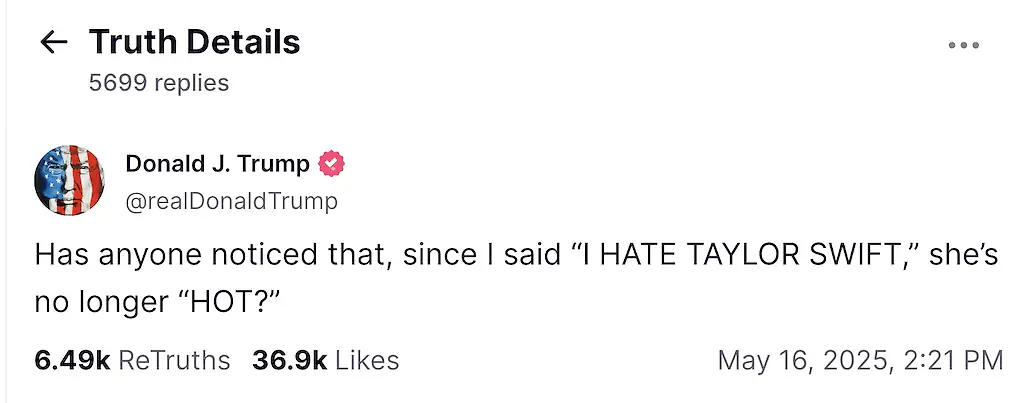
The President of the United States took another bizarre jab at the pop superstar this week, posting yet another bizarre Truth Social post - this time, appearing to attack Swift’s looks.
Now, it looks like Trump believes his comments have had a deeper impact on Swift.
“Has anyone noticed that, since I said ‘I HATE TAYLOR SWIFT,’ she’s no longer ‘HOT?’” the 78-year-old posted Friday (May 16), setting social media ablaze - with critics slamming Trump over the comment.
Trump took yet another shot at Swift. Credit: Truth Social
"Imagine being such a bitter piece of s**t that you feel the need to tweet this out," one X user wrote.
A second echoed: "Really? You’re an 80 year old man concerned about the popularity of someone half your age?"
"No, she's still hot, but you're not," a third tweeted, with another adding: "I love that Taylor lives rent free in your mind!! Taylor sold out arenas around the world!"
It was just the latest in a string of personal insults Trump has hurled Swift’s way — some in speeches, others online — many of them seemingly fueled by his frustration over her increasingly vocal political influence.
From “I HATE TAYLOR SWIFT” to “How did that work out?”
Trump first declared his distaste for Swift in September 2024, blasting her on Truth Social just hours after she announced her support for the Harris/Walz ticket.
Swift previously voiced support for Kamala Harris. Credit: Kevin Mazur / Getty
“I HATE TAYLOR SWIFT,” he wrote in all caps.
At the time, he claimed Swift’s political leanings would damage her brand. “She seems to always endorse a Democrat. And she’ll probably pay a price for it in the marketplace,” he alleged.
Days later, he doubled down during a Fox & Friends appearance, saying: “I was not a Taylor Swift fan. It was just a question of time. ... But she’s a very liberal person.”
By February, his attacks had spilled into public events. During the Eagles' post-Super Bowl visit to the White House, Trump made sure to remind everyone he and Swift were both at the game where the Chiefs — led by Swift’s boyfriend Travis Kelce — were defeated.
“I was there along with Taylor Swift,” he told the crowd, before twisting the knife: “How did that work out?” He repeated the line as the audience laughed. It marked the first time a sitting US president had ever attended a Super Bowl in person.
Obsession on repeat
Swift’s high-profile appearances at Chiefs games throughout the NFL season sparked endless political commentary. Fans questioned why the spotlight was on her rather than the games themselves.
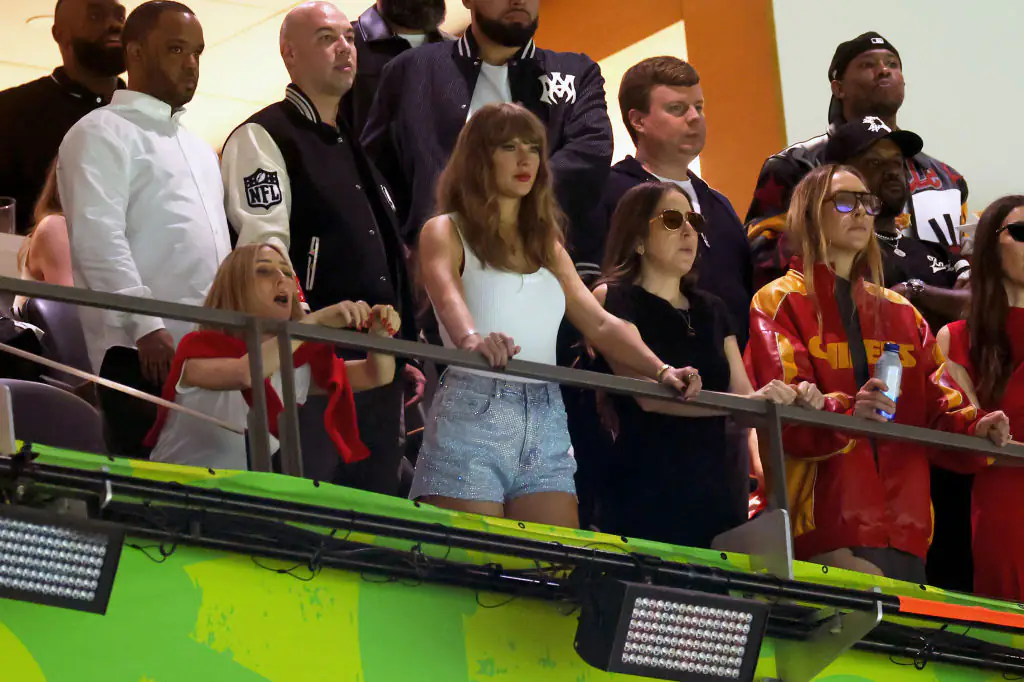
At the 2025 Super Bowl in New Orleans, where both Trump and Swift attended, Eagles fans were seen booing the singer.
Trump wasted no time jumping on the moment. He reposted a screenshot from the Libs of TikTok account showing crowd reactions to both him and Swift, with the caption: “Trump gets massive cheers at the Super Bowl while Taylor Swift gets booed – The world is healing.”
Shortly afterward, he trolled her again — this time with a doctored image showing Swift holding a flag that read: “Trump won, Democrats cheated!”
Taylor Swift was savagely booed as she watched the Chiefs vs the Eagles at the Super Bowl. Credit: Gregory Shamus/Getty Images
Even months into his second term, Trump was still fuming over her influence.
Springsteen Gets Dragged Too
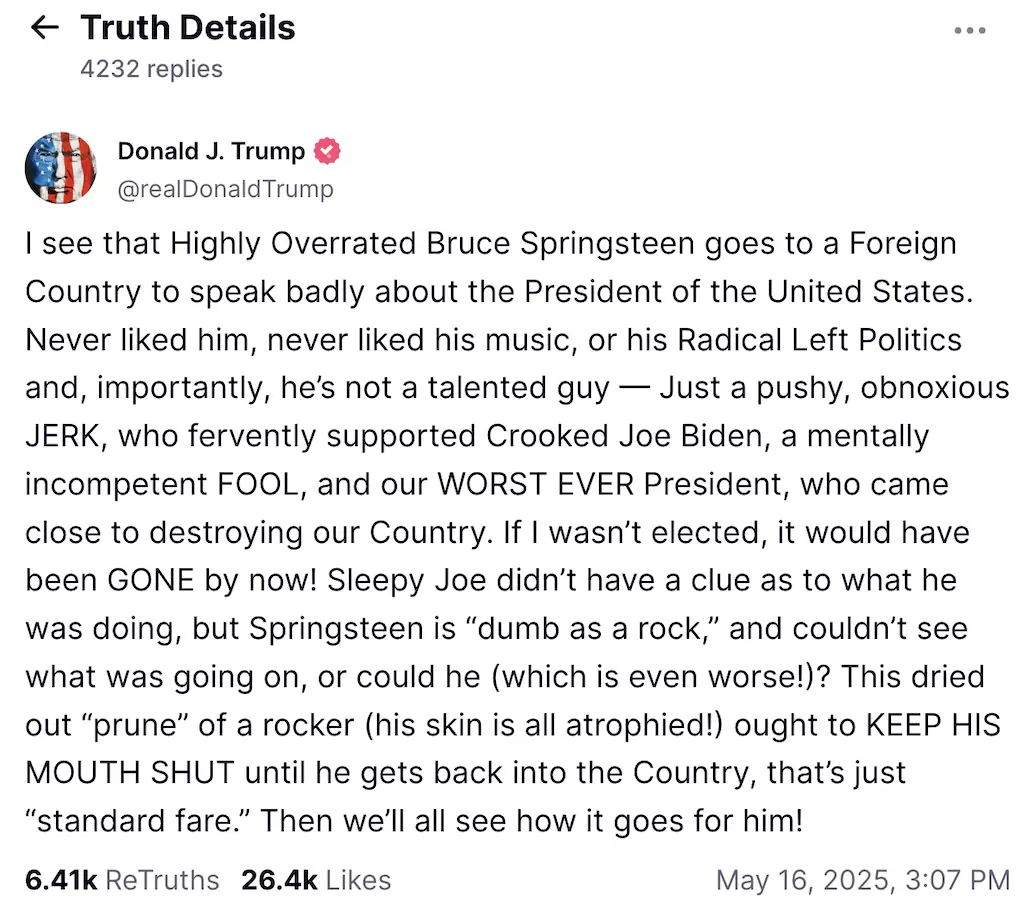
Swift wasn’t the only celebrity in Trump’s firing line this week. Just 40 minutes after his latest jab at her, the President set his sights on Bruce Springsteen, who had recently blasted Trump’s administration during a concert in Manchester, England.
“I see that Highly Overrated Bruce Springsteen goes to a Foreign Country to speak badly about the President of the United States,” Trump wrote.
Trump would also take a shot at Bruce Springsteen. Credit: Truth Social
“This dried out ‘prune’ of a rocker (his skin is all atrophied!) ought to KEEP HIS MOUTH SHUT until he gets back into the Country, that’s just ‘standard fare’. Then we’ll all see how it goes for him!”
Earlier in his post, Trump had also ripped the singer as “a pushy, obnoxious JERK,” “dumb as a rock,” and “not a talented guy.”
He accused Springsteen of backing “Crooked Joe Biden, a mentally incompetent FOOL,” and claimed the U.S. “would have been GONE by now” if he hadn’t won the election.
Springsteen had told the Manchester crowd: “The America I love, the America I've written about, that has been a beacon of hope and liberty for 250 years is currently in the hands of a corrupt, incompetent, and treasonous administration.”
Swiftie Family Ties
Despite Trump’s ongoing attacks, not everyone in the Trump family is anti-Swift. Ivanka Trump and her daughter Arabella are self-declared Swifties. The pair were spotted at a Miami stop of the Eras Tour, and Arabella recently celebrated her 13th birthday with a Taylor Swift-themed party.
Arabella Trump with her Swift-themed birthday cake. Credit: Instagram/IvankaTrump
“Best cake for my favorite Swiftie,” Ivanka posted alongside a heart-shaped cake decorated with lyrics from Swift’s song 'Blank Space'.