ADVERT
Health2 min(s) read
Published 14:25 02 Jul 2026 GMT
Doctors made a horrifying discovery in a woman's brain, years after she returned from a trip to India.
Lowri Denman spent two months traveling in the South Asian country back in 2007, making the conscious decision to stick to a vegetarian diet to reduce her risk of food poisoning.
However, four years after her trip of a lifetime, Lowri experienced a seizure, causing her to be rushed to hospital in an ambulance, unaware of what was happening to her.
From that point on, her life drastically changed. The doctors found that a metre-long tapeworm had left her with 38 parasites in her brain, which were causing seizures, headaches, and psychosis.
Disturbingly, Lowri had experienced no prior symptoms, nor was she given any physical indication that anything was awry.
After her visit to healthcare professionals, she was referred to Neuroradiology, where a scan revealed that she had neurocysticercosis – a parasitic infection of the brain, brought on by the larvae of the pork tapeworm, which develops when the underlying condition goes untreated.
"It looked absolutely disgusting, like Sellotape with like little ridges in it," she told BBC News.
"The doctor sat me down and said, 'right, okay, we've looked at your scans and we've found 38 parasites on your brain'," said Lowri.
"Me and my mum were just jaws on the floor like, 'what on earth, what is that?'
"At that point there's so many questions because you just don't know what's ahead of you with your health," said Lowri.
"The panic of what's next, what am I going to have to deal with, what medication am I going to go on, can I go back to work?"
While doctors sought advice from tropical disease experts, Lowri was being treated for epilepsy.
During that period, the woman from Wales lost her driving license due to increased risk of seizures, before she was forced to quit her job in 2015, subsequently moving back in with her dad.
In 2017, Lowri was discharged from hospital, but admitted that she was still in a ‘bad way’ but was committed to returning to her former life.
"I didn't feel myself at all, I didn't look myself in the slightest, I didn't want to go out," she claimed.
Fortunately, Lowri’s health has steadily improved ever since, with medication helping to manage her seizures and symptoms.
"I've not had any surgery to actually take them out of my brain," she said. "Apparently they just sort of die down and they calcify basically. So at this point they are now calcified."
Having not suffered from a seizure in over a decade, Lowri is now focusing on the future, as she looks to assist others by sharing her story.
weird2 min(s) read
Published 11:31 16 Jun 2025 GMT
If you needed another reason to double-check your meat’s doneness, here it is.
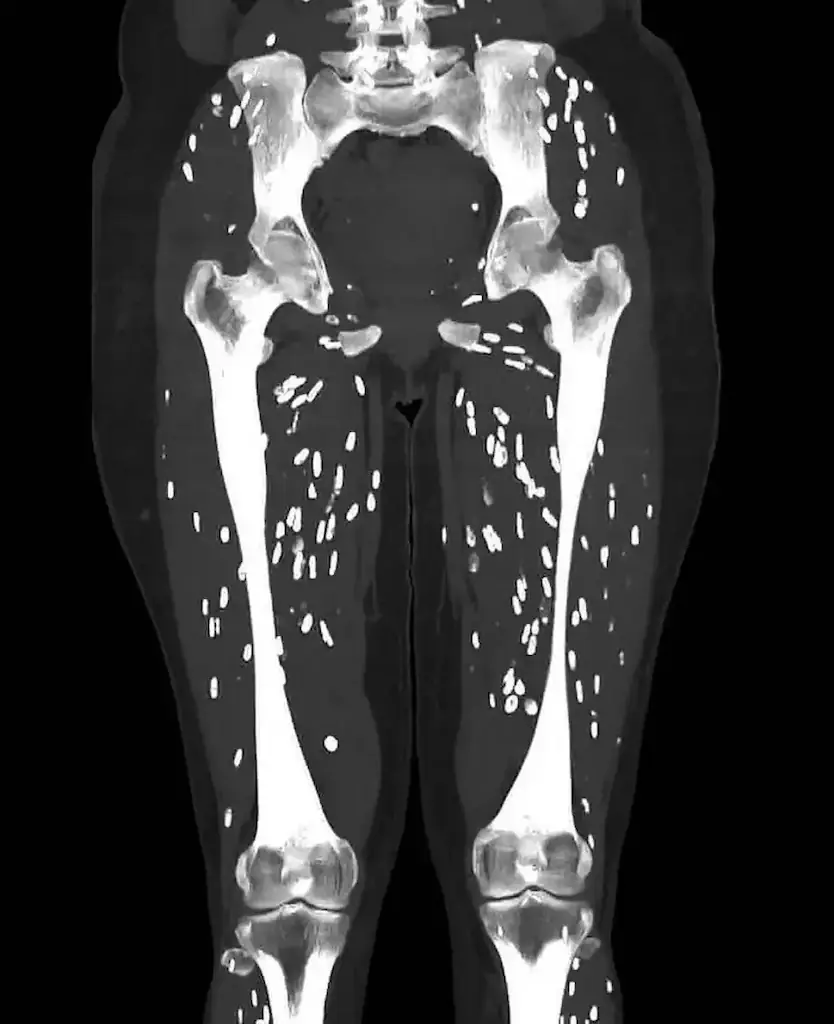
A doctor has gone viral after sharing an alarming CT scan that revealed the consequences of eating contaminated pork, and it's not for the squeamish.
Dr. Sam Ghali, a physician with over 630,000 followers on X, posted what he called “one of the craziest CT scans” he’s ever seen.
The image showed a woman’s legs riddled with small white specks, prompting widespread speculation online.
After giving his followers 24 hours to guess the diagnosis, Dr. Ghali revealed the cause: Cysticercosis, a parasitic infection caused by Taenia solium, commonly known as the pork tapeworm.
“This infection occurs when a person ingests the microscopic eggs of the tapeworm,” Dr. Ghali explained, “usually through fecal-oral contamination, not by eating undercooked pork directly, but by consuming food or water tainted with the parasite’s eggs.”
Once inside the body, the eggs release larvae that can travel through the bloodstream and embed themselves in various tissues, forming fluid-filled cysts called cysticerci, according to the National Organization for Rare Disorders. According to Dr. Ghali, these cysts most commonly appear in the brain, muscles, eyes, and under the skin.
The scan he shared showed calcified cysticerci in the patient’s legs, remnants of the body’s immune system attacking the parasites, leaving behind distinctive "rice grain" shaped scars.
More concerning, however, is when the larvae reach the brain, a condition known as neurocysticercosis. This form of the disease can cause headaches, seizures, confusion, and other neurological issues, and is a leading cause of epilepsy in some parts of the world.
According to the World Health Organization, Taenia solium is responsible for up to 30% of epilepsy cases in certain endemic regions where humans and free-roaming pigs often live in close quarters. In some high-risk communities, that number can climb as high as 70%.
Though many cases of cysticercosis are asymptomatic and require no treatment, those with neurocysticercosis often need a tailored regimen of antiparasitic medications, anti-inflammatory drugs, seizure management, and sometimes surgery.
In his closing advice, Dr. Ghali reminded followers of the basics:
“The takeaway? Wash your hands. Keep your food prep clean. And never eat raw or undercooked pork.”
After seeing that scan, skipping pork entirely doesn’t sound so extreme...
health2 min(s) read
Published 21:04 17 Jul 2018 GMT
FDR once said, "The only thing you have to fear is fear itself." Well, I guess he never heard of tapeworms, because tapeworms are fricken terrifying. These long, ribbon-like parasites attach themselves to the intestines of animals and humans, and steal their food. Since they cannot be destroyed by our immune system, they can survive for up to 30 years in a host. (And no, getting a tapeworm is not a good way to lose weight, so don't even try it!)
In most cases, tapeworms aren't fatal. However, they can cause health problems, since they're robbing you of nutrients. Also, the concept is just gross - like you've been invaded by a little monster. Humans can become infected by tapeworms drinking contaminated water and eating contaminated food. They usually camp in the intestines, but cysts can also settle in the brain, eye, liver and wherever else gives you nightmares.
This week the New England Journal of Medicine published a report of a 35-year-old French woman who got a very nasty scare. She checked herself into the hospital, telling doctors she repeatedly fell down, and felt "electric shocks in both legs." An avid horse rider, she found it difficult to ride for three months. The symptoms seemed to be getting progressively worse.
An MRI of the woman's spine revealed a shocking discovery: A tapeworm commonly found in dogs was lodged in her spinal cord. The woman was shocked, because she claims she only came into contact with her cat, horses and cattle. Doctors were unable to explain how she picked up the parasite, but they verified she had a lesion on one of her vertebrae with an "epidural component."
Fortunately, they successfully removed the creature through surgery. Pathological testing identified the parasite as echinococcus granulosus. The authors state that "infection can cause cystic lesions in the liver and lungs and also in the central nervous system and bones. "After being treated with antiparasitic medication, the woman made a full recovery. Once again, she can walk and ride her horse without difficulty.
It's a good thing the woman didn't wait any longer to see a doctor. Nobody likes going to the hospital, but it's important to catch health problems as soon as possible so they can be treated. The symptoms of tapeworms vary, but may include abdominal pain, vomiting, nausea, general weakness, inflammation of the intestine, diarrhea, weight loss, and eggs, larvae, or segments from the tapeworm in stools.
If you're invaded by a Pepto-pink freeloader, the most common treatment is oral medication. The drugs destroy the tapeworm and it will pass out in your stool. You'll probably be just as thrilled as those parents who evicted their 30-year-old slacker son.
All things considered, there are more dangerous things than tapeworms. But I don't care, they're super gross. To paraphrase FDR, "The only thing you have to fear is dog tapeworms in your spine."
health3 min(s) read
Published 13:01 29 Aug 2025 GMT
A man in the United States recently became the subject of medical intrigue after his unusual cooking habits led to the development of "pork worms" in his brain.
A 52-year-old man sought medical help after experiencing weekly and increasingly severe migraines at the back of his skull.
A CT scan and MRI of his brain revealed numerous cyst-like lesions in the white matter, the area of the brain responsible for nerve connections. This eventually led to the diagnosis of a parasitic infection.
Additional tests confirmed the presence of antibodies against Taenia solium, a parasitic tapeworm typically found in pigs.
This ultimately resulted in a condition called neurocysticercosis, when the parasite's larvae invaded his brain, forming cysts that caused severe headaches, per Live Science.
This condition is more common in areas where Taenia solium is endemic, such as parts of South America, Africa, and Asia, but it is rare in the United States.
Although the man had not traveled to any high-risk areas, he did admit to a longstanding habit of eating lightly cooked and non-crispy bacon.
Doctors concluded that his preference for soft bacon likely led to taeniasis, the intestinal form of the infection, which could then spread through improper hand hygiene.
"Undercooked pork consumption is a theoretical risk factor for neurocysticercosis via autoinoculation, as we suspected in this case," the medical team said, per the outlet. "It is historically very unusual to encounter infected pork in the United States, and our case may have public health implications."
Treatment for the infection involved a combination of anti-parasitic and anti-inflammatory medications, with the patient remaining in intensive care for several weeks.
According to The Mirror, after his condition stabilized, he was released from the hospital and continued to be monitored on an outpatient basis. His doctors noted that the lesions in his brain showed signs of regression, and his headaches improved significantly.
This rare case has sparked public health concerns, particularly about the risks associated with undercooked pork.
Experts recommend cooking pork to at least 145°F (63°C), although it can be difficult to monitor the temperature of bacon due to its thin cut.
The website Food Republic advises letting your bacon "rest at room temperature for approximately 15 minutes before you cook".
"Cold bacon fat does not render as fast as the meat surrounding it takes to crisp up," the website explains. "Depending on when you decide to take your meat out of the pan, this could cause you to either have charred or gummy sections that will not be delicious for anyone.
"Just a few minutes on your kitchen counter will let your bacon warm up thoroughly, allowing it to cook more evenly in the oven or stovetop. However, don't forget about your meat and have it sit at room temperature for over two hours, as harmful bacteria could spread through your food if left out for too long," it concluded.
health3 min(s) read
Published 11:57 23 Jan 2025 GMT
health3 min(s) read
Published 13:58 29 Jan 2025 GMT
Here's a very simple reminder that you may want to leave that pork chop on the grill for a few minutes longer.
A doctor has taken to social media to share a concerning scan photo of a woman's legs, before asking his followers what they thought the diagnosis could be.
Describing the image as "one of the craziest CT scans he's ever seen", Sam Ghali, M.D. - who boasts more than 630,000 followers on X - shared the image of a female patient's legs.
However, white blotches could be seen all over the scan image, leading to concerns from followers.
After giving people 24 hours to guess what they thought the answer could be, Dr. Ghali revealed that the patient in question had been suffering from Cysticercosis, which he explained is the "infamous parasitic infection caused by ingestion of larval cysts of Taenia Solium, also known as: Pork Tapeworm".
The National Organisation for Rare Disorders explains that "cysticercosis arises from the ingestion of the pork tapeworm’s eggs through fecal-oral contamination, and involves the development of cysts throughout the body, but not in the intestinal tract".
Dr. Ghali explained in his follow-up tweet that "after the eggs are ingested (humans or pigs) they release larvae which penetrate the intestinal wall and invade into the bloodstream (via mesenteric venules) and from there can spread to literally anywhere in the entire body."
The most common areas of the body, according to Dr. Ghali, are the "brain, eyes, subcutaneous tissues, and skeletal muscles".
Wherever the larvae end up, they form cysts known as cysticerci.
The scan in the tweet shows the body's natural inflammatory response to the cysticerci - which kills them off and causes calcification, known as "rice grain calcifications" due to their appearance.
What's terrifying is what Dr. Ghali wrote next: "What can be really bad is when the larvae end up traveling up to the brain and form cysts in actual brain tissue. This specific condition is known as neurocysticercosis. It can lead to headaches, confusion, seizures, and other serious neurologic problems."
The NORD adds that the condition "can affect anyone at any age and affects males and females in equal numbers".
The organization adds that, in most cases, cysticercosis is benign and patients won't need treatment. However, there are medications for those who do.
The World Health Organization adds that neurocysticercosis (NCC) can lead to epileptic seizures. According to WHO, Taenia solium is reportedly the cause of "30% of epilepsy cases in many endemic areas where people and roaming pigs live in close proximity."
Additionally, "in high-risk communities, it can be associated with as many as 70% of epilepsy cases."
"The treatment for cysticercosis located within the nervous system (neurocysticercosis) consists of antiparasitic therapy, corticosteroids, antiepileptic drugs, and/or surgery. Treatment is always individualized for each patient," NORD adds.
In a final message to his followers, Dr. Ghali writes: "So the moral of the story here is do your best to keep clean, always wash your hands, and never, ever eat raw or undercooked pork."
I may just be avoiding it altogether.