Uncategorised3 min(s) read
uncategorised3 min(s) read
space3 min(s) read
NASA's new X-59 supersonic jet, which has been nicknamed the 'Son of Concorde' is one step closer to making its first test flight after passing key safety tests.
The X-59 was built by Lockheed Martin as a key part of NASA's Quesst mission, which aims to reduce the sonic booms associated with supersonic planes such as the Concorde.
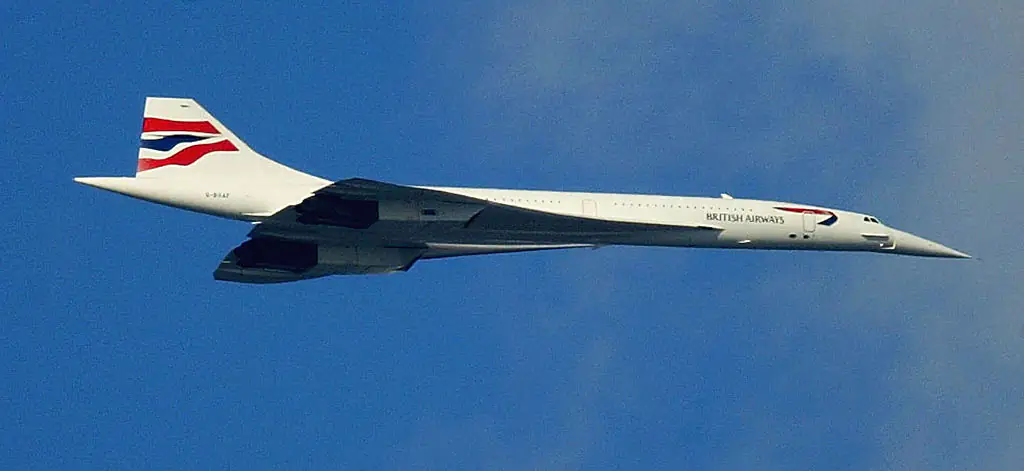
The Concorde flew from 1969 until its last commercial flight in October 2003, with it primarily being operated by British Airways and Air France, with the British Airways Concorde making just under 50,000 flights and flying more than 2.5million passengers supersonically throughout its tenure.
The fastest transatlantic flight on the Concorde was between London Heathrow and JFK airport in New York, which it completed in 2 hours 52 minutes and 59 seconds at a top speed of 1,354mph.
Despite being able to halve the time most commercial aircraft take to fly from the UK to the US, Concorde was eventually retired in 2003 with the reason being cited as low passenger numbers following one of the aircraft being involved in a crash in 2000, as well as a slump in air travel following the 9/11 terror attacks, as well as rising maintenance and repair costs.
The jets were also known for their loud sonic booms as they took off, and supersonic aircraft have been banned from flying over land for over 50 years due to the disruptive vibrations and noise they cause when they exceed the speed of sound.
NASA's Quesst mission aims to reduce the sonic booms, with the x-59 expected to create a quieter "thump", due to its revolutionary and unique geometry.
The X-59 has an elongated nose section measuring 38 feet (11.5 meters), which makes up a large part of the aircraft's 99.7 feet (30 meters) total length.
The aircraft has now successfully completed its Flight Readiness Review, which is a pivotal step towards it taking to the air for the first time.
According to Space.com, the review was conducted by independent experts from across NASA, and evaluated the project team's approach to safety for the public and staff during ground and flight testing, as well as their analysis of hazards that may arise.
The X-59 will face further analysis ahead of its maiden flight, based on insights and recommendations made as part of the review.
Cathy Bahm, NASA's Low Boom Flight Demonstrator project manager, said in a statement: "It's not a pass-fail. We'll be getting actions from the board and will work with them to resolve those and work toward the Airworthiness and Flight Safety Review."
The Flight Readiness Review is the first step in the flight approval process, before the X-59 will undergo an Airworthiness and Flight Safety Review, which assesses the project team's response to the first review.
NASA officials will also have to sign an airworthiness certificate and flight request before the X-59 will officially be allowed to take its first test flight.
The team is also preparing for further ground tests focused on systems integration engine runs and the effects of electromagnetic interference on the aircraft.
Brad Neal, chairman for the X-59 Airworthiness and Flight Safety Review board, added in the statement: "It's a brand-new thing that we are developing, even though they're components that have been on different legacy aircraft.
"As we get into integration testing here, it's going to be a great opportunity to learn."
The X-59 is also reported to be able to cross from London to New York in just three and a half hours.
So while the first commercial flight on an X-59 might be a little way off, the first time it takes to the air is creeping ever closer, meaning supersonic commercial flights could very well be a reality again soon.
tech & innovation3 min(s) read
We live in amazing times. Smartphones, 'Human Ubers,' sex robots - if our ancestors could warp to the present, their minds would be blown by the incredible innovations in technology. And I think they would particularly like the sex robots. But there's something missing. Whenever there's news about a futuristic new product, we all have the same reaction: "Cool, but where are the flying cars?"
Well, get excited, because soon, you'll be able to live out your The Jetsons fantasy. The world's first flying cars are schedule to go on sale next year, with pre-sales beginning in October. No price has been set yet, but I'm guessing it'll be more expensive than a Honda Civic.
Terrafugia, which belongs to the parent company Volvo, manufactured the two-seat, hybrid-electric vehicles. The Transition has fold-out wings, landing gear and can switch between driving mode and flying mode in less than a minute. The pioneering models can fly up to 400 miles, with a top speed of 100mph, and a maximum altitude of 10,000 feet. They weigh roughly 1,300 pounds.
Yeah, the Transition looks more like a plane than a car. Some critics have scoffed the vehicle might not be particularly great at either one. (Geez, such buzzkills.) Recent improvements include a new parachute system, rear-view cameras, and a boost mode for extra speed while flying. The Transition meets TSA standards, but consumers will need a pilot's license and are required to take off and land at airports. So, that's a bummer. I'm not sure who their demographic for this product is (eccentric millionaires?), but hey, flying cars gotta start somewhere.
[[youtubewidget||https://www.youtube.com/watch?v=wHJTZ7k0BXU]]
Terrafugia's planned follow-up, the TF-X, is more exciting. This hybrid has the capacity to fit four people, and it's easier to fly, thanks a computer-controlled system. Passengers input their desired destination, and the aircraft flies and lands by itself. And the best parts, this model is street legal. "The TF-X won't require an airport for takeoff and landing, and it will drive on all roads and highways - providing the convenience of true door-to-door transportation," said the company. An artist's rendering of the TF-X in action is below.
Last July, Terrafugia CEO Chris Jaran said, "Developing this new technology has allowed us to test several different mechanisms and generate process improvements along the way. We are at the critical point where we can implement the best design features based on years of flight and drive testing. This will improve function, safety and aesthetics for the optimal flying and driving experience."
Okay, it's going to be a while before we can cruise around like characters in Blade Runner. But maybe that's a good thing. In the the comments to Terrafugia's TF-X video, one person pointed out, "The majority of people have enough problems driving on the ground, let alone up in the air. IMO For this to work the car will have to be 100% fully automated and left out of human control." And another person pointed out another problem: "Mexicans will be able to fly right over trumps wall." So true.
space2 min(s) read
Footage of a historic piece of fabric being installed by NASA's Ingenuity helicopter engineers has been shared.
Today (Monday, April 19), NASA successfully launched a miniature drone helicopter on Mars, carrying a piece of fabric from the Wright Brothers' historic first flight.
In doing so, the space agency paid tribute to Wilbur and Orville Wright, who conducted the first successful powered heavier-than-air controlled aircraft flight on planet Earth in 1903.
Check out the moment the piece of fabric is installed by NASA's Ingenuity helicopter engineers (at the 0:55 mark)The helicopter, known as Ingenuity, is the very first aircraft to be launched on another plane. It carried the "small swatch of muslin material" from the lower-left wing of the Wright Brothers Flyer under its solar panel.
The fabric had previously been held at the Carillon Historical Park, in Dayton, Ohio, which is also home to the Wright Brothers National Museum.
According to NASA's photojournal, the tiny piece of cotton fabric was originally obtained by the Wright Brothers from a local department store and, at the time, was mostly used to manufacture undergarments for women.
It adds: "In the front parlor of their home, the Wrights cut the material into strips and used the family sewing machine to create wing coverings for their airplane Flyer 1, which achieved the first powered, controlled flight on Earth on Dec. 17, 1903."
The Wright Brothers' first flight may have only lasted 12 seconds, but look where we are today!
From a historic flight at Big Kill Devil Hill, North Carolina, in 1903, to another historic flight on Mars in 2021!
Ingenuity has aided NASA in demonstrating the sort of technology needed for flight on Mars. With its success today, the technology used could be employed to create advanced robotic flying vehicles that would be included in future missions to Mars.
MiMi Aung, Ingenuity’s project manager at JPL said some weeks prior to the historic achievement: "The Ingenuity team has done everything to test the helicopter on Earth, and we are looking forward to flying our experiment in the real environment at Mars.
"We'll be learning all along the way, and it will be the ultimate reward for our team to be able to add another dimension to the way we explore other worlds in the future."
weird2 min(s) read
Earlier this month, a spokesman for the Department of Defense confirmed that it does indeed continue to "pursue research and investigation into unidentified aerial phenomena" - and just a few weeks later it has been reported that unidentified flying objects have been spotted by pilots in the US Navy.
In 2014 and 2015, pilots reported seeing "strange objects" during training procedures that were described as having "no visible engine or infrared exhaust plumes," and now it has been made public by a report by The New York Times.
These aircrafts were said to have reached heights of 30,000 feet, and would fly at hypersonic speeds, the pilots described. "These things would be out there all day," said Lt. Ryan Graves, an F/A-18 Super Hornet pilot. Graves has been with the Navy for a decade, and saw these UFOs as he trained near the aircraft carrier Theodore Roosevelt.
"Keeping an aircraft in the air requires a significant amount of energy. With the speeds we observed, 12 hours in the air is 11 hours longer than we’d expect," Graves added.
The objects seen were said to have been making manoeuvres "beyond the physical limits of a human crew," such as making sudden stops, instant turns or immediate acceleration to hypersonic speeds.
The pilots interviewed in the report initially believed them to be part of a top-secret drone program, but changed their minds because government officials would have known there were fighter pilots in the area and wouldn't have risked the near-collisions.
Graves report was sent to the Pentagon’s Advanced Aerospace Threat Identification Program, but he wasn't the only one. In late 2014, another pilot claimed he almost hit one of the objects, and described it as looking like "a sphere encasing a cube," according to the paper.
Another pilot, Lt. Danny Accoin, said he identified a nearby flying object on his radar, missile system and infrared camera but couldn’t see it in his helmet camera. "I knew I had it, I knew it was not a false hit," he said. But still, "I could not pick it up visually."
A minute-long video was also shared in the article, appearing to show two encounters:
[[jwplayerwidget||https://content.jwplatform.com/videos/lpA1gOZG-dkXnENEs.mp4||lpA1gOZG]]
A spokesman for the Navy, Joseph Gradisher, explained to the Times that it is still not known what caused the sightings. "There were a number of different reports," Gradisher said. "Some cases could have been commercial drones."
However, he did admit that in other cases, "we don’t know who’s doing this, we don’t have enough data to track this," adding that "the intent of the message to the fleet is to provide updated guidance on reporting procedures for suspected intrusions into our airspace.”
While Lt. Graves speculated that the US military had no vehicle which matched the attributes spotted. Lt. Accoin said: "We’re here to do a job, with excellence, not make up myths."
The incidents in the area eventually tapered off, and the Department of Defense has not made any further comment on what the objects could be.