Uncategorised2 min(s) read
health1 min(s) read
It wasn't that long ago that vaping was a pretty rare thing to see. Originally associated with hipsters or tech obsessives jumping on a new craze, it's become so much more than that in 2018. Now there are vaping stores all over the place and half the people you see out in the smoking area are (literally) lighting up one for a variety of reasons.
For some, it's just a cleaner way of smoking, for others it's being able to do it in places where cigarettes are frowned upon, not giving everyone in the immediate vicinity passive smoking to contend with - and then there's the fact that you can get all sorts of different flavours.
However, there are many out there who don't realise that it also provides health benefits too.
Apparently, 44 per cent of smokers in England believe that vaping is just as harmful as smoking cigarettes, but that just isn't true. In fact, according to research carried out by Public Health England earlier this year, vaping is apparently 95 per cent less harmful than smoking.
To combat the public misconceptions, PHE released a video to prove their findings. The agency's filmed experiment demonstrates the damage that smoking does to your body, compared to the damage done by vaping. Smoking experts, Dr Rosemary Leonard and Dr Lion Shahab, explain how much tar can accumulate in the body by smoking cigarettes. You can watch it below:
[[twitterwidget||https://twitter.com/PHE_uk/status/1078546126494748672]]
Vaping has now been proven as a more effective means of quitting smoking (rather than going cold turkey), but some people are put off it for health concerns that Professor John Newton, Director of Health Improvement at Public Health England, believes are unfounded:
"It would be tragic if thousands of smokers who could quit with the help of an e-cigarette are being put off due to false fears about safety. We need to reassure smokers that switching to an e-cigarette would be much less harmful than smoking.
"This demonstration highlights the devastating harms caused by every cigarette and helps people see that vaping is likely to pose only a fraction of the risk.
"We want to encourage more smokers to try and quit completely with the help of an e-cigarette, or by using other nicotine replacement such as patches or gum, as this will significantly improve their chances of success."
These misconceptions may stop non-smokers from trying vaping, but it also prevents regular smokers from switching to e-cigarettes as a potential way to quit entirely.
[[twitterwidget||https://twitter.com/phe_uk/status/960831773558140929]]
"I hope this illustrative experiment helps people see the huge damage caused by smoking that could be avoided by switching to an e-cigarette," Dr. Shahab said. "Research we and others have conducted shows that vaping is much less harmful than smoking and that using e-cigarettes on a long-term basis is relatively safe, similar to using licensed nicotine products, like nicotine patches or gum."
So, it just goes to show: if you're a regular smoker who is looking to quit, your best bet is to use e-cigarettes, or some other form of nicotine replacement (such as gum or patches), rather than trying to stop completely.
health4 min(s) read
A new study has claimed that vaping could cause lung and mouth cancer and is not a safe alternative to smoking.
Despite being initially recommended as a way of quitting smoking, the evidence is starting to stack up against electronic cigarettes.
According to many scientists and medical professionals, vaping is safer than smoking and can be used as a method of breaking the habit.
The idea seems to be that users gradually reduce the level of nicotine in the fluid, weaning themselves off the addiction to the point where they can stop altogether.
However, there have been longstanding concerns about the safety of vaping and reports that it is dangerous to health, to the environment - it accounts for a lot of litter - and is increasingly marketed to children.
It’s become so prevalent that some countries have banned it altogether.
Now, a team from the University of New South Wales in Sydney have published their findings after looking into the available literature on vaping between 2017 and 2025, discovering a worrying link between vaping and DNA change that can cause an increased risk of cell malfunction linked to cancer.
They concluded that vaping is certainly not risk-free, as most people knew or suspected already, and may even increase cancer risk.
It’s too early to make a direct link as there is not enough evidence or research behind the hypothesis, but it might be worth thinking twice about your habit.
As well as the DNA change, vaping can cause tissue damage in the respiratory tract, which has been linked to lung cancer, as well as changing the oral microbiome, which can increase cancer risk in that area.
For those who smoke cigarettes and vape the risk is highest, increasing the risk four-fold.
The study’s lead author Professor Bernard Stewart, said: “The research shows vaping is not an alternative to smoking or illicit drugs.
“It is not an alternative to anything in the context of being safer.
“It's dangerous and that's the message.”
There is growing evidence that vaping is harmful, as many vapes contain toxic chemicals, and it can be linked to inflammatory diseases, among others.
However, it is still widely accepted that it is not as harmful as smoking, given the decrease in exposure to toxins.
It has not yet been proven that there is ‘no doubt’ that vaping causes cancer, as there simply isn’t the evidence yet.
“It took about 100 years for the evidence to be conclusive enough to say that smoking causes lung cancer and the history of events evolved over time as people became more and more exposed to tobacco,” added Professor Freddy Sitas, the co-author of the study.
However, he warned: “We are seeing a similar evolution with e-cigarettes.
“As such, e-cigarettes should not be offered as a pathway to quit smoking to put patients at ease, particularly without strict precautions around minimising dual use.”
He continued: “Delayed findings have played right into the hands of tobacco companies who don't mind whether they make their money though vapes or cigarettes.
“We know that there is a significant group of people who both vape and smoke, despite the former being marketed as an effective means to stop smoking.
“We've always assumed that vapes are safer than cigarettes, but what we're showing is that they might be as safe after all.
“It's like saying that knives are less dangerous than machine guns because they can kill fewer people in a given time.
“That notion is absurd and it's absurd to approach vaping in reference to the safety of smoking.”
“While our understanding of causation has improved, we should not have to wait 100 years to decide what to do.
“There is a window of opportunity now to be able to discern these effects and now is the time to be proactive rather than reactive.”
The scientists are definitive about one thing - you shouldn’t vape as it isn’t the most healthy thing you can do.
You also shouldn’t smoke, as that does have an established causal link and over a century of evidence to support that claim.
For that reason, some countries have offered vapes as a smoking cessation aid, but new evidence seems to suggest that might not be the best option either.
health2 min(s) read
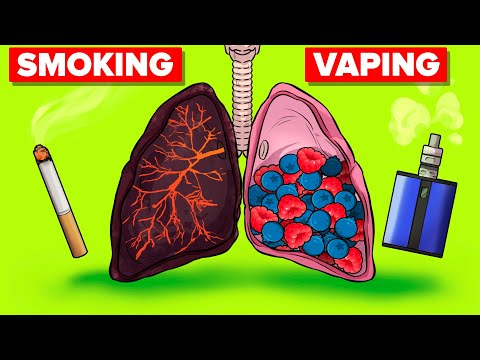
A pretty unsettling simulation has shown what happens to our bodies as we vape... which is something a lot of people do these days.
They may smell like bubblegum and come in sleek packaging - but they can be very harmful to your health.
While millions have swapped out traditional cigarettes in favor of vaping — often marketed as the “healthier” alternative — recent research and eye-opening simulations suggest that e-cigarettes might be more harmful than many think.
A startling visual shared by The Infographics Show has gone viral for showing just how badly vaping can affect your lungs.
The animation illustrates how chemicals in e-cigarettes can cause a build-up of mucus and damage to the alveoli — tiny sacs in the lungs responsible for the crucial exchange of oxygen.
Among the most concerning ingredients highlighted is diacetyl — a chemical commonly found in some foods but not something you’d want settling into your respiratory system.
According to the simulation, inhaling this compound can cause long-term damage that mirrors the effects once only associated with cigarette smoke.
So how did we get here?
Vaping devices are typically made up of a few key components: a mouthpiece, a battery, a microprocessor, a heating element, and a cartridge containing e-liquid.
When the device is activated, the heating element turns the liquid into vapor, which is then inhaled — just like cigarette smoke, but flavored for a smoother experience.
That flavoring is part of the problem. With sweet-smelling options and eye-catching designs, these devices have become especially appealing to younger users. In fact, it’s become a full-blown social trend among teens and college-age adults.
According to Truth Initiative, a 2023 study revealed that 4.6% of middle school students and 10% of high school students — approximately 2.13 million young people — had used e-cigarettes in the past 30 days.
Among them, 11.4% of middle schoolers and nearly 30% of high schoolers reported using e-cigs daily.
An overwhelming 89.4% of these young users reported using flavored brands such as Elf Bars, Lost Mary, and GeekVape — names now common in school bathrooms and college dorm rooms across the country.
While the flavors may mask the harshness, the danger is still very real.
Experts warn that repeatedly inhaling substances like diacetyl and other chemicals found in vapes could have a "paralytic effect" on the lung cilia — the tiny hair-like structures that help keep your airways clear.
The simulation suggests that when these cilia are damaged, it can take weeks for them to recover, leaving your lungs vulnerable to infections and even chronic conditions like cancer.
The verdict? That tiny device might seem harmless — even trendy — but it carries some serious risks.
health1 min(s) read
Cardiologists are warning the general public that E-cigarettes are so dangerous and addictive that governments should consider banning them, and new research suggests that an entire generation risks being hooked on nicotine through them.
Professor Thomas Münzel, a researcher from the Department of Cardiology of the University Medical Centre Mainz in Mainz, has recently examined the effect of vaping on the blood flow and cardiovascular system and discovered some worrying findings.
This North Texas teen believes he was actually hospitalized as a result of vaping:
[[jwplayerwidget||https://content.jwplatform.com/videos/di7lMBEa-Q0L14jDU.mp4||di7lMBEa]]
Münzel examined the arteries in the upper arm in 20 smokers before they vaped, and then analyzed the blood flow 15 minutes later.
Münzel found that one vaping for just a few minutes increased the heart rate of vape-users, and caused the arteries to stiffen. This seems to suggest that vaping oil is damaging endothelium - the inner lining of the arteries - which protects the body from toxic substances. Damage to endothelium can disrupt the blood clotting processes and cause heart disease.
Commenting on his findings, Münzel stated: "Our data may indicate that e-cigarettes are not a healthy alternative to traditional cigarettes, and their perceived 'safety' is not warranted."
He continued: "In addition, we still have no experience about the health side effects of e-cigarettes arising from long-term use. The e-cigarette epidemic in the US and Europe, in particular among our youth, is causing a huge generation of nicotine-addicted people who are being endangered by encouragement to switch from traditional cigarettes to e-cigarettes."
He added, "Research like ours should serve as a warning about their dangers, and aggressive steps should be taken to protect our children from health risks caused by e-cigarettes."
Indeed, a recent x-ray of a vaping teenager shocked doctors, when it was revealed that they had the lungs of a 70-year-old.
world politics1 min(s) read
A recent study carried out by the University of California has discovered that people who vape regularly could be doubling their risk of a heart attack.
In fact, the new research - published in the American Journal of Preventive Medicine - also suggests that those who smoke regular tobacco cigarettes are less likely to have a heart attack than those who vape.
Dr Jonathan Winickoff speaks about the dangers of e-cigs
[[jwplayerwidget||https://content.jwplatform.com/videos/uFsUz0Ec-sKUnNGKf.mp4||uFsUz0Ec]]
The researchers claim that tobacco smokers are three times more likely than non-smokers to have a heart attack whereas vapers are an astonishing five times more likely.
"We're the first people to show a long term impact of e-cigarettes, and given that it's consistent with what we know biologically about how vaping effects the heart, we wanted to get this out there," Stanton Glantz, the lead author of the study told Business Insider.
The study also found that people who vaped and smoked were most at risk. And according to Glantz, most people who vape are also regular tobacco smokers.
"E-cigarettes are widely promoted as a smoking cessation aid but for some, they actually make it harder to quit, so most people end up doing both," Glantz said. "This is the dominant use."
The groundbreaking findings seem to contradict widely-held beliefs that e-cigarette use - which involves inhaling vaporized liquid nicotine - is less harmful than inhaling tobacco smoke.
Puffing on e-cigs means inhaling toxic metals such as lead and potentially becoming addicted to nicotine.
However, there is little evidence to support the idea that smoking marijuana is linked to an increased risk of heart conditions which is why so many people advocate its legalisation. Even celebs like Paris Jackson openly smoke weed:
[[jwplayerwidget||https://content.jwplatform.com/videos/vcqQtLn0-sKUnNGKf.mp4||vcqQtLn0]]
So, while the devices are often marketed as tools to help smokers quit smoking cigarettes, they're not exactly a harm-free alternative.
Ana Rule, a professor of environmental health and engineering at Johns Hopkins University, said that companies responsible for e-cigs fail to address "the increased risk to this huge market they are creating among teenagers and young adults that never have smoked, and would have never even considered smoking" had they not vaped.
Evidently, more research still needs to be conducted into vaping and the health risks it poses.
The findings of this particular study are by no means conclusive. The researchers could not prove that vaping caused heart attacks - just that they were linked.