


US4 min(s) read
Map shows all 33 countries urging citizens to stockpile food as global warnings intensify

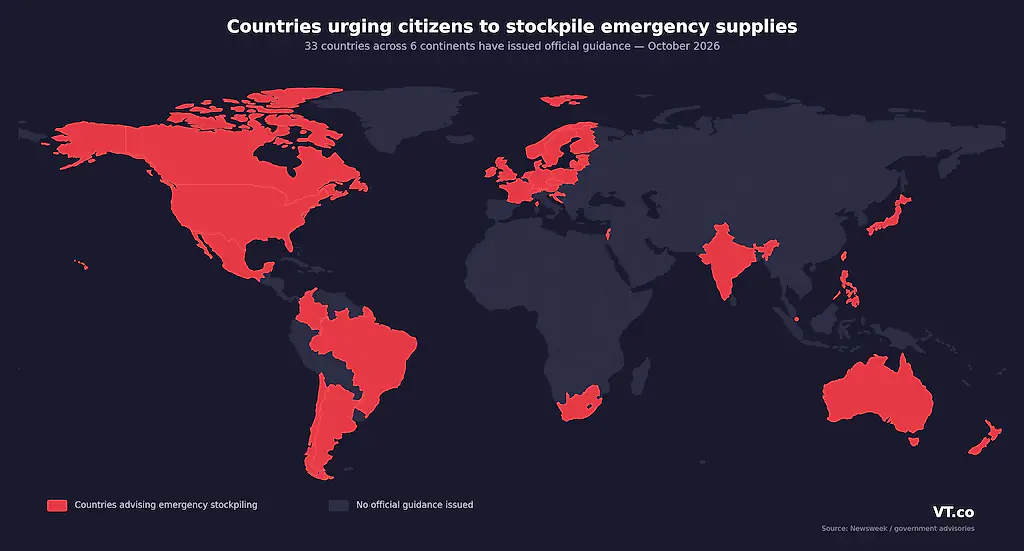
Thirty-three countries across six continents are now actively advising their citizens to stockpile food, water, and emergency supplies, and the list grew again this week.
A map compiled by Newsweek shows just how widespread the warnings have become.
The United States, the United Kingdom, Japan, Germany, Australia, India, Brazil, and two dozen others have all issued some form of official guidance telling households to prepare for emergencies ranging from severe weather and cyberattacks to full-scale military conflict.
The map was published the same week that the Pentagon revealed its FORTRESS plan to keep US military bases running for 90 days without civilian infrastructure, and days after former FBI Deputy Director Dan Bongino urged every American to stockpile immediately.
"Get your stuff today. Please. Do it for your family," Bongino said.
The full list
In North America, the US, Canada, and Mexico have all issued guidance.
The US federal government, through FEMA and Ready.gov, recommends at least three days of supplies and ideally up to two weeks.
Europe has the longest list.
The UK, Ireland, France, Germany, the Netherlands, Denmark, Norway, Sweden, Finland, Estonia, Latvia, Lithuania, Poland, the Czech Republic, Austria, Switzerland, and Croatia have all advised emergency food stockpiling.
The UK is one of the latest to act, with experts saying Britain is 'lightyears behind' its European neighbours.
In Asia, Japan, Taiwan, Israel, India, the Philippines, and Singapore have all issued warnings.
Japan's Disaster Management Minister Goshi Hosono said: "I would like to say at least three days' worth, and a week's worth if possible. Please prepare enough food, toilet supplies and water at home so that you can manage even without public support from the government."
Australia and New Zealand have been told to prepare.
South Africa is the only country on the list from Africa. In South America, Brazil, Chile, Colombia, and Argentina have all issued guidance.
That is 33 countries. Six continents. Every major economy on Earth.
Why so many countries at the same time
Each country has its own reasons.
Japan sits in one of the most seismically active zones on the planet and is preparing for a potential major earthquake.
The Baltic states and Scandinavia are responding to Russian military threats on their borders. The UK is citing severe weather, cyberattacks, and infrastructure disruption.
The US is engaged in a war with Iran.
But the convergence is the thing that makes people nervous.
When one country tells its citizens to prepare, it could be routine caution.
When 33 countries on six continents do it within the same few months, while the Pentagon simultaneously builds a 90-day self-sufficiency plan for its military bases and the US Army trains soldiers to dig mass graves for the first time since the Korean War, the word 'routine' stops applying.
Vladimir Putin added to the mood on Thursday.
"We are ready for war with Europe, but we don't want it," the Russian president said.
"If things go too far, there will be no winners at all."
What you are being told to stockpile
The specific recommendations vary by country but the basics are consistent across nearly all of them.
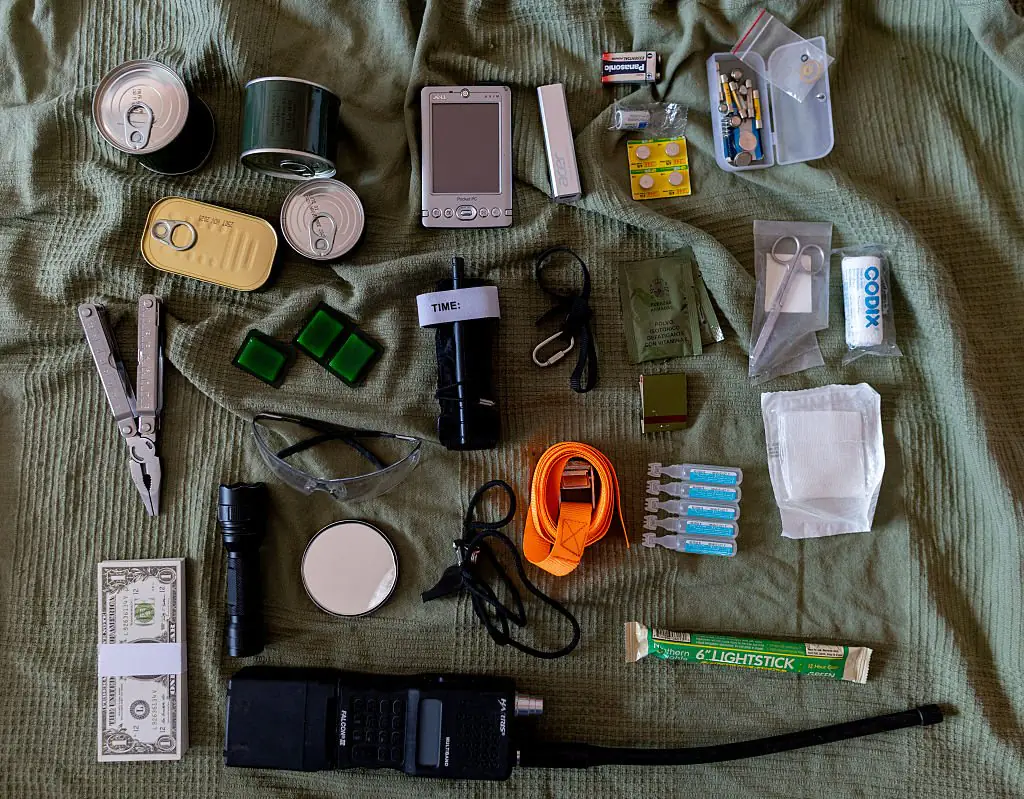
One gallon of water per person per day for at least three days.
Non-perishable food that does not require cooking.
A battery-powered or hand-crank radio, ideally one that picks up emergency weather bands.
Flashlights and extra batteries. A first aid kit. A week's supply of any prescription medication. Phone chargers and power banks. Basic sanitation supplies.
Bongino specifically recommended a rain collection system and water filtration tablets in addition to the standard list, arguing that stored water runs out but the ability to collect and purify it does not.
"Have yourself an emergency radio, have yourself some batteries, get yourself some emergency food, get yourself a rain collection and water filtration, some filtration tablets," he said.
What doomsday maps are showing
Alongside the stockpiling advice, maps showing the safest places to be if a global conflict breaks out have been trending consistently for weeks. A separate doomsday simulation ranking the 10 safest countries has also been widely shared. Most of them point to countries in the southern hemisphere, remote islands, and landlocked nations with no strategic military value as the places least likely to be directly affected.
Whether any of it ever becomes necessary is a question nobody can answer. But 33 governments have decided, independently of each other, that the answer might be yes, and they would rather their citizens had three days of food in the cupboard than not.
Bongino's framing remains the simplest version of the argument: "The best day of your life, you don't need them.
"The worst day in your life is your kids asking where the water is."