


US4 min(s) read
Man simulated 2028 election with AI to find out who will become next president - it gave a clear and eye-opening answer

A simulation utilizing AI has delved into how the 2028 U.S. presidential election result could look, and it was far more nuanced than a simple prediction.
By feeding political trends, polling dynamics, and candidate positioning into an AI model, the YouTube channel, I Ask AI, has attempted to understand not just who might win, but why.
What did the simulation look into?
At the heart of the simulation was a key distinction between two major Republican figures in Marco Rubio and JD Vance. The AI’s reasoning suggested that while both are tied to current President Donald Trump, the extent of that connection could make all the difference in who becomes the 48th leader of the United States.
As the simulation explained: "That's the key distinction. Rubio carries Trump baggage, but not the same amount. He's Secretary of State, not Vice President."
It added: "There's a meaningful difference between I served in the administration and I was the guy standing right next to him for everything."
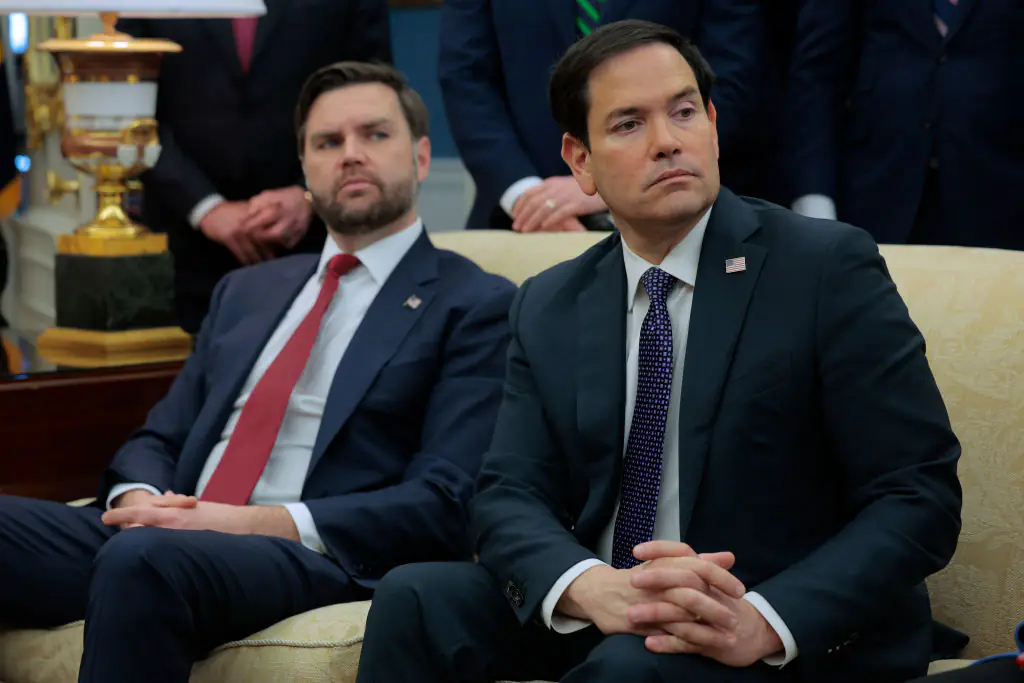
According to the model, Rubio could distance himself from domestic controversies more effectively: "Rubio can credibly say he was focused on foreign policy while the domestic chaos was happening. Vance can't make that argument at all."
However, Rubio’s path to the nomination wouldn’t necessarily come from strength alone. The AI highlighted that his chances depend heavily on Vance faltering:
"Rubio won't overtake Vance by doing anything bold. He'll only get there if Vance stumbles… You're basically waiting for someone else to fail rather than making your own case."
What has the AI simulation predicted for the Democrats and the Republicans?
The simulation suggested a scenario where changing political conditions shift momentum. If Republican performance weakens and Trump’s approval declines, Rubio could emerge as the nominee: "By 2028, Trump's approval will have dragged Vance down too far to recover. The guy standing next to Trump for four years owns every bad decision, every scandal, every economic complaint."
Meanwhile, Rubio’s relative distance becomes an advantage: "Rubio has the crucial advantage of distance. He was doing diplomacy while the domestic mess was happening."
The AI even predicted Trump’s potential role in the outcome: "When Trump sees the writing on the wall and blesses Rubio instead, the primary is over. Republican voters follow Trump's endorsement like gravity."
For vice president, the model identified Elise Stefanik as a strategic pick: "She's a proven MAGA loyalist, so the base trusts her… She's disciplined and she stays on message. That's exactly what Rubio needs."
The reasoning behind a potential shift in Trump’s support was framed as pragmatic rather than personal: "Because Trump doesn't care about loyalty. He cares about winning. If polls show Vance is a liability and Rubio pulls better… Trump switches."
The simulation also pointed to declining approval and voter fatigue as key factors: "Trump's approval is net negative -15 right now and trending worse… Vance is tied to all of it with zero separation."

When the AI ran the full election scenario, it ultimately predicted a narrow Democratic victory, but not an easy one.
"Newsome wins barely. The fundamental reason is exhaustion… Voters are ready to turn the page,” a prediction that ties in with current strain placed on the U.S. and the wider political sphere due to the ongoing war in the Middle East.
Despite Rubio being seen as a strong candidate, the broader political environment weighed heavily: "Rubio doesn't lose because he's a bad candidate. He loses because even a clean Republican can't outrun the weight of what the party became."
The simulation emphasized energy and turnout as decisive factors: "That's not a tantrum. That's a realignment of who's willing to show up."
And in the end, the result was tight but decisive: "Newsome doesn't win big. He wins ugly. He wins tight, but he wins."
While the simulation isn’t a real prediction, it offers insight into how AI interprets political momentum, the sentiment of public opinion, and candidate positioning.
Rather than giving a simple answer, it paints a picture of an election shaped by perception, distance from past leadership, and voter mistrust in the current administration.
Whether or not reality follows a similar path, the experiment highlights just how complex, and unpredictable, the road to the 2028 U.S. election.