ADVERT
Weird4 min(s) read
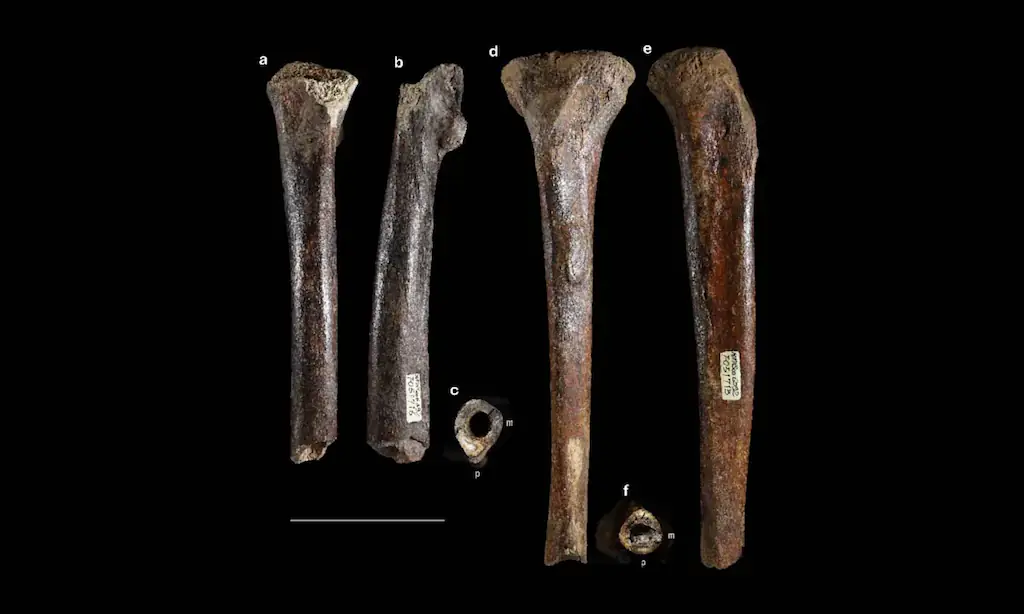
Leg bones belonging to an extinct human species have been pulled from the sea floor off Taiwan and they belonged to individuals who stood up to 6ft 3in tall and weighed over 200 pounds.
The bones are Denisovan, a species of archaic human that lived across a vast stretch of Asia and interbred with Homo sapiens thousands of years ago.
Until now, almost everything known about them came from teeth, a few jaw fragments, and a single finger bone.
These are the first leg bones ever identified.
They change what scientists know about how big Denisovans actually were.
They are also, predictably, being used online as proof that the biblical Nephilim were real - this is the internet, after all.
A femur and a tibia, both recovered from sediment in the Penghu Channel off the coast of Taiwan.
Protein analysis published in the journal Science confirmed the bones belonged to the Denisovan lineage.
Two individuals are represented.
One stood roughly 5ft 11in and weighed about 183 pounds.
The other was approximately 6ft 3in and 200 pounds.
Both were larger than earlier Homo erectus and Late Pleistocene Homo sapiens found in eastern Asia, according to researchers cited by the European Research Council.
The study also suggests the Denisovan lineage more broadly had robust bodies and large brains.
Whether these two individuals were representative of the species as a whole, or whether they happened to be unusually large, is not yet known. More fossils are needed.
The research has not yet been peer-reviewed.
The biological sex of both individuals was inferred rather than directly confirmed.
This is the part that sounds dramatic in a headline but has a perfectly ordinary explanation.
During glacial periods, sea levels were significantly lower than they are today.
Land that is now underwater was once exposed.
The bones ended up on what is now the sea floor because the ground they were originally deposited on is now beneath the Penghu Channel.
It is climate history and geology. It is not evidence of a biblical flood.
Althought that is definitely something that has been argued.
Jimmy Corsetti, the YouTuber behind the Bright Insight channel, posted his interpretation of the discovery and connected the bones to the Nephilim, the giant figures described in the Hebrew Bible.
The Nephilim appear in Genesis 6:4 and Numbers 13:33. They are described as the offspring of divine beings and human women, sometimes translated as 'giants' or 'fallen ones'.
The first Book of Enoch expands on the story further. Mainstream biblical scholarship treats them as mythological.
Corsetti's argument is that the size of the Denisovan bones, combined with the fact that they were found on a sea floor, lines up with ancient accounts of giant beings who lived before a great flood.
The study's authors made no such connection.
The bones are large for an ancient human but not supernaturally so.
A 6ft 3in individual is tall, not a giant. There are people that height in every gym in America right now.
That said, there is something genuinely interesting buried in the speculation.
Ancient communities that encountered unusually large bones, whether Denisovan or otherwise, may well have built stories around them.
It is not difficult to imagine someone in the ancient world digging up a femur significantly larger than anything they had seen before and deciding it belonged to something more than human.
It could be the prehistoric equivalent of a Reddit thread spiraling into mythology.
But 'may have inspired myths' is not the same thing as 'proves myths were true'.
Denisovans are one of the most important pieces of the human story and until this week they were known from almost nothing.
A finger bone found in a Siberian cave in 2008. A jawbone from a cave on the Tibetan Plateau.
Teeth and fragments, but enough to know they existed and that they interbred with Homo sapiens, but not enough to know what they looked like below the neck.
These leg bones change that.
For the first time, scientists can estimate how tall Denisovans were, how heavy, how their bodies were built.
The genetic traces they left behind are still detectable in modern populations across Asia and the Pacific.
Parts of the Denisovan genome live on in people walking around today.
That is a story about real ancient humans whose DNA is still inside living people. It does not need the Nephilim to make it remarkable.
world2 min(s) read
uncategorised2 min(s) read
stories1 min(s) read
uncategorised3 min(s) read
us2 min(s) read
Scientists in the Philippines have this week published a paper on the discovery of a previously unknown species of ancient human.
The specimen, which has been named Homo luzonensis, was found in a cave on Luzon Island in The Philippines - and its discovery has thrown quite the curveball into our previous understanding of human evolution, as it is believed they coexisted with our ancestors.
The remains have been dated to 50,000-67,000 years ago, meaning that this species of human had existed outside of Africa (where our ancestors are believed to have dispersed from) possibly before early Homo sapiens had left the continent.
"We now know that it was a much more complex evolutionary history, with several distinct species contemporaneous with Homo sapiens, interbreeding events, extinctions," said Florent Détroit, one of the paper's authors. "Homo luzonensis is one of those species and we will [increasingly see] that a few thousand years back in time, Homo sapiens was definitely not alone on Earth."
The site did not produce an intact skeleton, but the remains that were found - seven teeth, two hand bones, three foot bones and one thigh bone - are believed to have belonged to two adults and one child, and yielded enough information for scientists to deduce some key information about Homo luzonensis.
The size of the teeth suggest that the early humans would have stood less than four feet in height, and the curved toe bones would indicate that they had an ability to walk upright on two legs, but also that they were adapted to climb trees.
"Maybe the way they were walking was distinct," said Détroit. "This is something we plan to work on in the near future."
Researchers have found that the remnants closely resemble another ancient species, Homo floresiensis (sometimes described as a "Hobbit"), which was also found in south-east Asia and believed to have lived around the same period.
As exciting as the discovery is for researchers, there are a number of questions and mysteries that remain unanswered on account of there being so little evidence to analyse. The most troubling one being: how did these ancient humans arrive on Luzon Island? The land is not believed to have ever been connected to the mainland, which suggests that the ancient species was somehow able to traverse the sea - either deliberately, by some sort of raft, or perhaps accidentally, by a tsunami or some other natural event.
"Arrival by accident … is favoured by many scholars, but this is mainly because of arguments like ‘Homo erectus were not clever enough to cross the sea on purpose,'" said Détroit. "But the fact is that we have now more and more evidence that they successfully settled on several islands in the remote past in south-east Asia, so it was probably not so accidental."
For many in the field, this discovery is not entirely surprising, however.
One scientist, Professor Chris Stringer, from the National History Museum, said: "After the remarkable finds of the diminutive Homo floresiensis were published in 2004, I said that the experiment in human evolution conducted on Flores could have been repeated on many of the other islands in the region.
"That speculation has seemingly been confirmed on the island of Luzon... nearly 3,000km away."
If these recent findings are any indication of what is yet to come, it could be that we are yet to discover key information about our origins as a species - and who knows where those realisations will take us.
In a groundbreaking archeological discovery, a human-sized penguin fossil has been discovered in New Zealand.
The discovery, on New Zealand's South Island, was announced earlier today by scientists. They revealed that the adult penguin came in at 1.6 meters (5ft 2") high and weighed 80 kilograms (176 lbs). This is four times heavier and 40 cm taller than the Emperor Penguin, the BBC has reported.
The giant penguin was a species known as "crossvallia waiparensis", which, 66-56 million years ago, lived on the coast of New Zealand.
While the discovery was announced today, it was made last year by an amateur archeologist, who found the bird's bones. After careful examination, scientists concluded that they belonged to a new species in a study published in Alcheringa: An Australasian Journal of Palaeontology this week.
However, this is not the first time that a giant penguin has been discovered, Canterbury Museum researcher Vanesa De Pietri revealed.
"It further reinforces our theory that penguins attained great size early in their evolution," she said.
Think penguins are cute? Think again! This gang of penguins was taken into custody after causing trouble in a Wellington sushi store:
[[jwplayerwidget||https://content.jwplatform.com/videos/izqK6iw0-dkXnENEs.mp4||izqK6iw0]]
When these giant penguins existed, some of the largest marine mammals known today like toothed whales and seals did not, and scientists have hypothesized that when they came into being, the giant penguins died out as a result.
In an interview with the BBC, Gerald Mayr said: "At the time giant penguins evolved, the large marine reptiles just had become extinct."
"In Antarctica and New Zealand, there were no large marine competitors until the arrival of toothed whales and pinnipeds (seals) many million years later."
The new species has now been dubbed the "Monster Penguin" by Canterbury Museum.
[[twitterwidget||https://twitter.com/EliAllison3/status/1161635559112093696]]
[[twitterwidget||https://twitter.com/curiousmindsnz/status/1161429097911689216]]
Museum curator Paul Scofield told the BBC that the penguin was native to the waters of the Southern hemisphere and "is one of the largest penguin species ever found."
He continued: "We think that at the time, animals were evolving very rapidly. Water temperatures around New Zealand were ideal back then, around 25C (77F) compared to the 8C we have now."
After a 20-year mystery, the identity of body that washed up on a Washington State beach has finally been identified.
The human remains washed ashore in 2006, sparking widespread confusion and a mystery that has only just been solved.
Back in 2006, the skeletal remains of a human washed up on the Pacific coast of the USA.
It has now been finally ascertained that those remains are that of Clarence Edwin ‘Ed’ Asher, a former mayor from Oregon who was presumed to have drowned on a fishing trip.
Asher went missing while out on a trip in Tillamook Bay, a coastal inlet in Oregon.
At the time of his disappearance in 2006, a significant Coast Guard operation took place, but was suspended just a day later, on September 6 of that year.
The former mayor of the town of Fossil was 72 years old at the time of his disappearance.
The authorities presumed that he had drowned after his wife told them that he couldn’t swim and wasn’t in the habit of wearing a life jacket.
Then, in November 2006, some skeletal remains washed ashore at Taholah, a small unincorporated village on a Quinault Indian Reservation some 185 miles to the north of where he went missing.
Grays Harbor Sheriff’s Office and the local coroners tried to identify the remains, but with no success.
So, they were listed with the National Missing and Unidentified Persons System and eventually just became lost the queue of missing persons.
Until a revolutionary DNA testing lab stepped in…
In 2025, some forensic evidence was sent to Othram Labs in Texas, a company that is doing amazing things in DNA work.
They managed to create a profile, which eventually led them to determine that the remains were that of Asher.
Sadly, it was too late for his wife Helen, who died aged 85 in 2018, having had a ‘large hole’ left in her heart by his disappearance.
Asher was a legend in his local area, dedicating his life to the people of Fossil.
After working as a lineman for the local telephone company, as well as owning a variety store and volunteering as a fireman and ambulance driver, he became the mayor of the town before retiring in 1995.
He left behind 21 grandchildren and 17 great-grandchildren, according to his wife’s obituary.