


World4 min(s) read
Chilling footage shows Russia launching 'most powerful missile in the world' as Putin prepares nuclear rollout
.jpg_xKEaT0?tr=cr-0.328.2730.3058,f-webp,q-70,w-100)
New video footage has emerged online, showcasing the latest addition to Russia's arsenal and the potential devastating effects of the weapon in question.
Russia has test-fired its newest intercontinental ballistic missile, as President Vladimir Putin further flexed his muscles with the nation's nuclear-capable Sarmat weapon.
It has been branded as the world’s 'most powerful' missile, with videos of the warhead being launched doing the rounds online.
State television broadcast footage of the commander of Russia’s strategic missile forces, Sergei Karakayev, showed the Kremlin official reporting to Putin on their successful launch on Tuesday (May 12).
The horrifying footage has done no favors in easing the concerns of a potential third World War, as Putin also addressed the progress that Russia has made in military development.
.jpg_VOsXqw?tr=cr-0.0.2410.1244,f-webp,q-70,w-1024)
Putin's claims about the Sarmat missile
The Russian leader claimed the warhead would be in combat service by the year's end, claiming on local TV that 'this is the most powerful missile in the world.'
Putin added that its warhead yield was over four times more powerful than anything in the West, and that it was also capable of suborbital flight, with a range of over 35,000km.
He also said that it had the capability to 'penetrate all existing and future anti-missile defence systems'.
It has been called 'Satan II' in the West, with the warhead set to replace around 40 Soviet-built Voyevoda missiles.
Putin claimed that Sarmat is as powerful as the Voyevoda, but with better precision.
Development of the missile began in 2011, with the missile only having one previously known successful test and a massive explosion during an abortive test in 2024.

Global concern over arms control
The latest test of the Sarmat missile comes after the collapse of the arms control agreement, which was in place between the two nuclear arsenals of the United States and Russia for decades.
New START, which was the last treaty between Russia and the US that capped strategic warheads and delivery systems, officially expired in February, leaving the world's two nuclear superpowers with no formal constraints.
This is the first time that has happened in over 50 years.
While the Kremlin and the US have agreed to start discussions over a potential new treaty, there have been no signs of progress.
Each side has consistently accused the other of non-compliance with New START's provisions, while Trump has also pushed for any new treaty to include China, despite its arsenal being far smaller than that of Russia or the US.
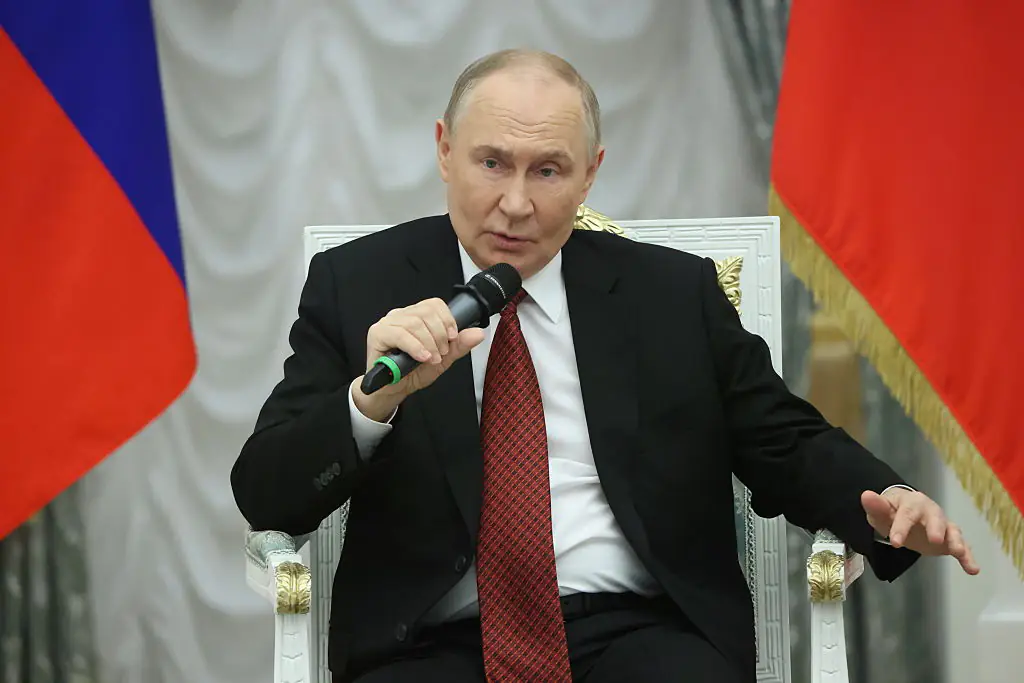
Putin's focus on upgrading Russia's arsenal
Since coming to power in 2000, the Russian President has led efforts to improve on the Soviet-built components of the nuclear triad.
This has included deploying hundreds of intercontinental ballistic missiles, commissioning new nuclear submarines, and modernizing nuclear-capable bombers.
Putin unveiled the Sarmat in 2018 along with several new weapons systems, including the Avangard hypersonic glide vehicle, which can fly at 27 times the speed of sound.
Other military-grade vehicles have also been introduced, such as the nuclear-capable Oreshnik intermediate-range ballistic missile, and used its conventionally-armed version to strike Ukraine.
Putin also said that the nation was in its 'final stages' of developing the nuclear-armed Poseidon underwater drone and the Burevestnik cruise missile.
He claimed that these new weapons were developed in response to the US missile shield developed after it withdrew from a Cold War-era US-Soviet Union pact in 2001, which limited missile defences.
"We were forced to consider ensuring our strategic security in the face of the new reality and the need to maintain a strategic balance of power and parity,” Putin said of Russia's development of military weapons.