Three innocent US women and six children have allegedly been slaughtered by a drug cartel while traveling to Mexico for a wedding, the New York Post has reported.
The attack was a highway ambush in the Mexican border state of Sonora on Monday, November 4, in the town of Bavispe, approximately 100 miles south of the Arizona border.
Kendra Lee Miller, a relative of the victims, told NBC News that the dead included 29-year-old Christina Marie Langford Johnson, 43-year-old Dawna Langford, 11-year-old Trevor Langford, two-year-old Rogan Langford, 30-year-old Rhonita Miller, 12-year-old Howard Miller, 10-year-old Krystal Miller, eight-month-old twins, Titus and Tiana Miller.
The family were all members of a Mormon community living in a settlement known as La Mora - a community founded by The Church of Jesus Christ of Latter-day Saints.
Another relative of the victims, Jhon LeBaron, also took to Facebook to share images of the dead. He captioned the post: "Just got word both my Aunt Dawna and Christina have been killed, the Cartel murdered them and several of their babies ? They left 6 of Dawnas kids on the side of the road and took off. [sic]"
He added: "My aunt Dawnas son Devon hid some of his shot and wounded siblings in the bushes and ran all the way back to town for help. Please pray that the murderers are caught & brought to justice. [sic]"
Meanwhile, another survivor of the attack, who goes by the name Lafe Langford Jr, shared a video of the burned-out fuselage of one of the cars on social media.
Commenting on the tragic news, US Ambassador Christopher Landau tweeted in Spanish that: "The safety of our fellow citizens is our top priority. I am closely following the situation in the mountains between Sonora and Chihuahua."
A North Dakota Judge has ordered a Mexican drug cartel to pay $1.5 billion to the families of nine women and children who they are accused of killing.
In November 2019, the Juarez cartel allegedly attacked and killed family members from an offshoot Mormon community as retribution for publicly criticizing their activity.
Now, US Magistrate Judge Clare Hochhalter has ordered them to pay damages to the victim's family members, who filed a civil lawsuit against the cartel in 2020.
According to a report by The Bismark Tribune, the women and children were attacked near the U.S. border in Mexico on November 4, 2019.
After firing hundreds of rounds of ammunition into their vehicles, cartel members surrounded the victims and set fire to them in what court documents refer to as their "signature move".
There were no survivors of the attack, which claimed the lives of nine people: Maria Rhonita LeBaron and four of her children (ages 12, 10, and 8-month-old twins), Dawna Langford and her children (ages 11 and 2,) and Christina Langford.
In 2020, the families of the victims (including LeBaron’s husband, Howard Miller, and Christina Langford’s husband, Tyler Johnson) filed a lawsuit against the cartel under the Anti-Terrorism Act. The cartel was served notice of the pending trial through publication in Mexico newspapers, and a weeklong trial was held in February during which Judge Hochhalter heard harrowing testimonies from witnesses and experts.
Hochhalter's $1.5 billion award will be automatically tripled because it was brought under the federal Anti-Terrorism Act. This will bring the total the cartel is ordered to pay to $4.6 billion.
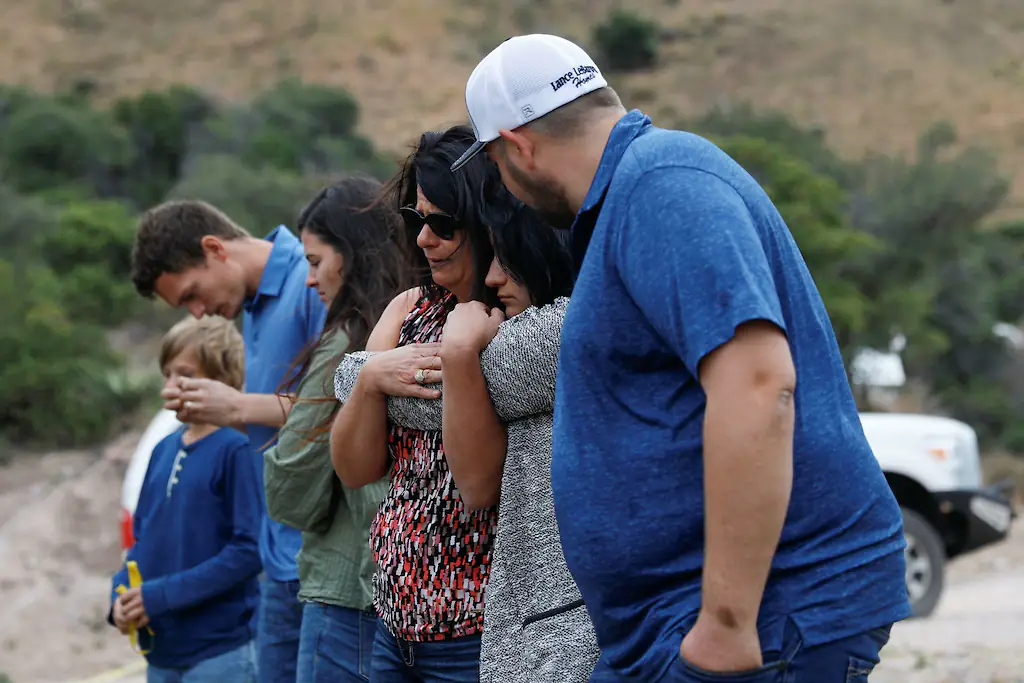
Family members mourn at the scene of the attack. Credit: REUTERS / Alamy
Per The Bismark Tribune, the cartel did not respond to summons or attend the trial in North Dakota. It is unclear whether the US government will be able to freeze their assets or force them to pay the damages.
David Langford said that the court had given his family a "measure of justice."
"The horror that my children experienced and my entire family has been through as the result of the Nov. 4, 2019, killing of [wife] Dawna Langford and my two children by the Juarez cartel will never, ever be made right," he said.
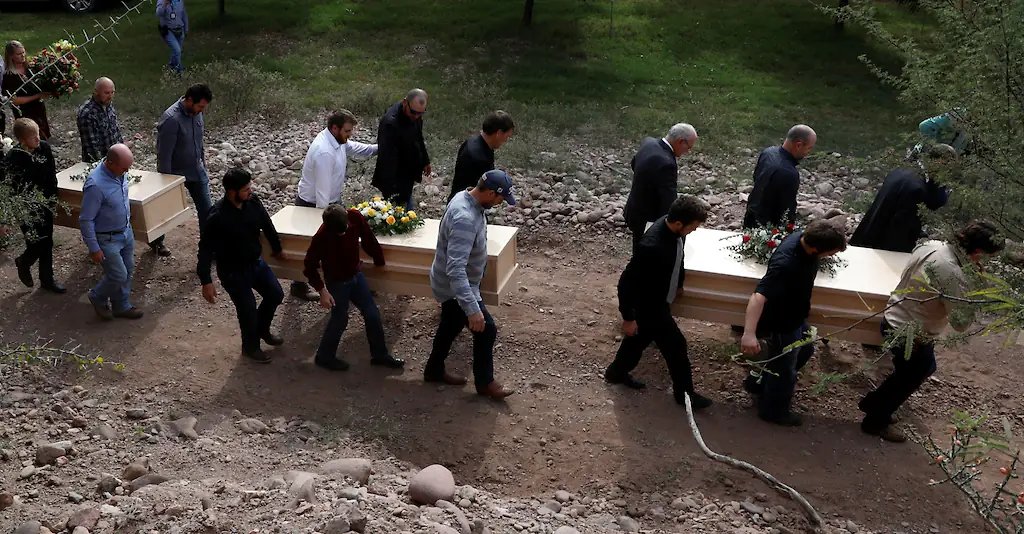
Family members at the victims' funeral. Credit: REUTERS / Alamy
"We went into a United States courtroom in North Dakota seeking some acknowledgment of and measure of justice for the trauma inflicted on our family and we received it," the grieving husband and father added.
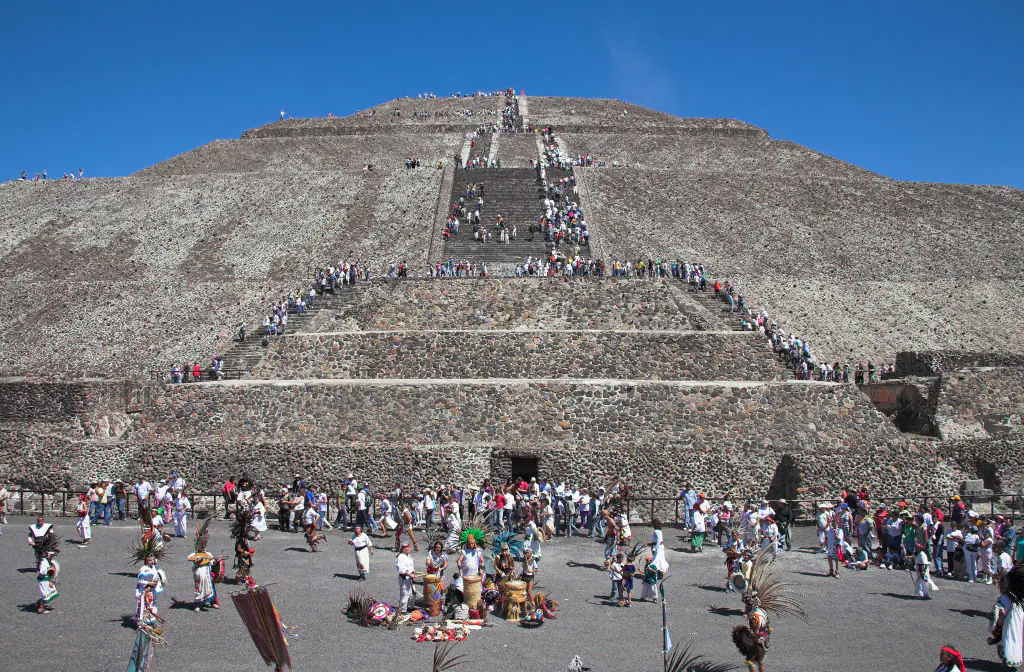
Disturbing footage shows the moment a gunman opened fire at the Teotihuacán pyramids.
The attack unfolded on Monday (April 20) at the ancient archaeological site near Mexico City.
In a video circulating online, believed to have been filmed by a tourist, the suspect can be seen moving around with a mask and backpack before crouching down and reaching inside.
The clip then cuts to visitors descending the steps, moments before two gunshots ring out, sending people running for cover among the stone structures.
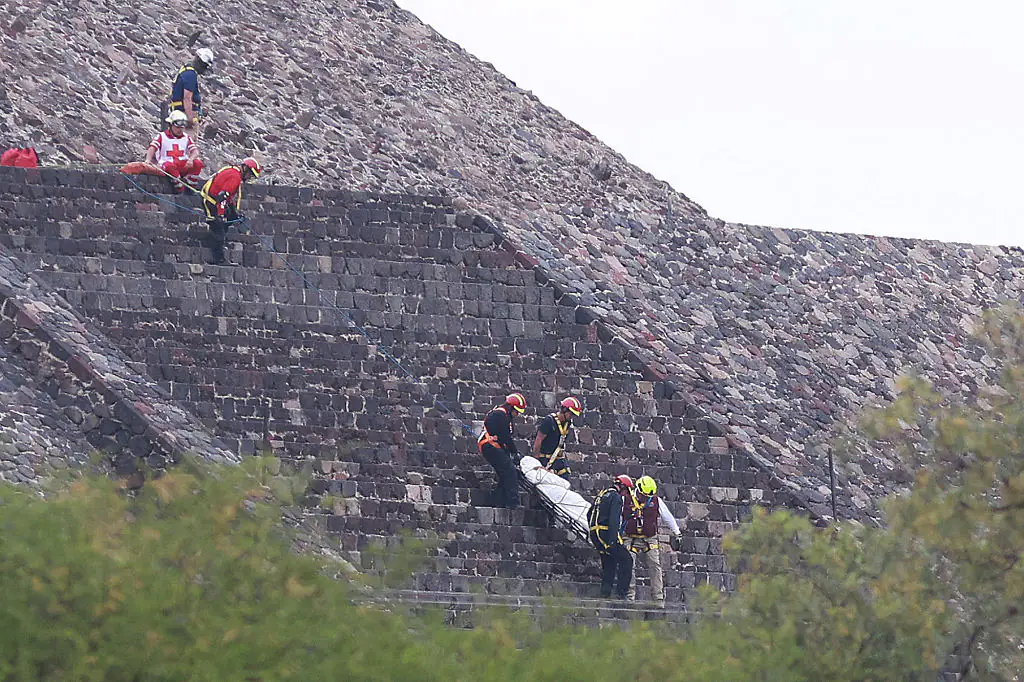
Police confirmed that a 32-year-old Canadian woman was killed in the attack, while at least six others were wounded by gunfire, including tourists from Colombia, Brazil, and the United States.
Seven more people were injured in the rush to escape, with victims from Russia, Colombia, Brazil, and the US treated at the scene, per BBC News.
Witness Laura Torres described the terrifying moment the shooting began, saying she heard more than 20 shots.
"First it was sporadic, then one shot after another, then sporadic again," she told La Jornada, adding she believed the attacker used a handgun, per The Guardian.
The gunman later died from a self-inflicted gunshot wound. Officials identified him as 27-year-old Julio César Jasso Ramírez, a Mexican citizen from Mexico City.
There was a shooting at the Teotihuacan pyramids in Mexico on Monday. Credit: VW Pics / Getty
Lone Attacker With Disturbing Influences
Investigators say the attacker acted alone, with no links to cartel violence.
"The aggressor planned and carried out the attack on his own and there is absolutely no indication at this point that he had any external help or that any other individuals were involved in this incident," Attorney-General José Luis Cervantes Martínez said.
Police recovered a handgun, a knife, ammunition, and disturbing materials that included "literature, images, manuscripts apparently related to acts of violence which are known may have occurred in the United States in April 1999".
A witness also claimed the attacker referenced Columbine, the 1999 US school shooting, during the incident.
Prosecutors say the evidence points to "a psychopathic profile of the attacker, characterised by a tendency to imitate situations that occurred in other places, at other times, and involving other individuals - this tendency can be referred to as copycat behavior".
A Canadian tourist was killed and several people were injured during a shooting at the Teotihuacan archaeological site. Credit: Anadolu / Getty
The attack has sent shockwaves through Mexico and beyond, particularly as the country prepares to co-host the football World Cup in June.
Canada’s foreign minister Anita Anand described the incident as "a horrific act of gun violence," while President Claudia Sheinbaum said on X: "What happened today in Teotihuacán deeply pains us. I express my most sincere solidarity with the affected individuals and their families. We are in contact with the Canadian embassy."
Travel advice has been handed to U.S. nationals after it was reported that a serial killer may be on the loose in a popular Mexican tourist town.
Authorities had determined that there might be a serial killer on the loose in Mexico, after the discovery of three bodies in the same region.
They have continued to gather evidence, such as surveillance footage, as they search for any connections between the deaths of the women, whose bodies were all found in tourist hotspot Puerto Vallarta, Mexico.
Investigators say that these women were aged from their early-to-mid thirties.
These deaths have come just weeks before the 2026 FIFA World Cup is set to kick off in Mexico City, Guadalajara and Monterrey are also hosting games.
Now, advice has been given to traveling Americans.
One of the reported victims could be missing 22-year-old Elizabeth Martínez. Credit: Facebook
Advice to American tourists
Americans looking to head to Mexico have been told to reconsider trips to a certain region south of the border.
As police continue to investigate the murder cases, a State Department spokesperson told Newsweek of the risks associated with the State of Jalisco, which includes Puerto Vallarta.
The risk level currently sits at a Level 3, which means that the government is advising travelers to "reconsider travel due to terrorism, crime, and kidnapping."
The Department of State website further reads: "There is a risk of violence in the state from terrorist groups, cartels, gangs and criminal organizations.
"In Guadalajara, battles between criminal groups have happened in tourist areas. Shootings between these groups have injured or killed innocent bystanders.
"U.S. citizens and lawful permanent residents have been kidnapped. There are no restrictions on travel in the Guadalajara Metropolitan area, Puerto Vallarta (including neighboring Riviera Nayarit), Chapala, and Ajijic," they explain.
The spokesperson also told the publication that the department "routinely updates our travel advisories and destination information pages for all countries based on a comprehensive review of all available safety information and ongoing developments."
They have also advised Americans to enrol in the Smart Traveler Enrolment Program, in order to receive safety and security updates.
Americans have been warned of visiting Mexico by the Department of State. Credit: grandriver / Getty
Latest on the investigation
Puerto Vallarta is a popular tourist town, known for its beaches, nightlife and sunny weather, with approximately two million Americans visiting annually.
It makes the murder investigation a serious cause for concern on the eve of the FIFA World Cup.
The first female victim was found on May 10, near the well-known viewpoint of Rancho El Piruli, in Chimborazo.
The second victim's remains would be found just five days later, at a roadside stop along a highway, with the third body being uncovered on a dirt road in the Parque Las Palmas neighbourhood.
All the victims were found partially undressed, and all had tattoos, as police believe that this may indicate a pattern.
The bodies were found in isolated areas of the tourist town, but none of the women have been officially identified so far.
However, the third body discovered had tattoos around her neck, hand, and forearm.
These were some distinctive designs, including a skull, a woman with horns covering her mouth, and a woman's name, all of which could help identify the victim.
Local publication Mexico News Daily reports that her body showed signs of violence.
Reports suggest that the victim might be the missing 22-year-old Elizabeth Martinez, but these claims have not been confirmed yet.
Mexican national Martinez had mysteriously vanished in April, with authorities noticing that some of her ink matched that of the victim, according to a missing person report.
It has been reported that a serial killer may be on the loose in a popular tourist town in Mexico, weeks ahead of the start of the 2026 FIFA World Cup.
Officials have been warned of the murders of three women, as police have been gathering evidence and observing surveillance footage as they search for connections between the deaths, which took place in Puerto Vallarta, Mexico.
The first female victim was discovered on May 10, near a well-known viewpoint known as Rancho El Piruli, in Chimborazo.
Within five days of this discovery, the second body would be found at a roadside stop along a highway.
Later, the third and latest body was found on a dirt road located in the Parque Las Palmas neighbourhood.
All three women were in their early-to-mid thirties, and all of them had tattoos.
The reported serial killer is on the loose in Mexico. Credit: grandriver / Getty
Latest information on the investigation
The victims' bodies were discovered in isolated areas of the town, and all three of them were partially undressed.
None of the women have been identified thus far.
The third body was found with tattoos around her neck, hand, and forearm, featuring some distinctive designs.
This included a skull, a woman with horns covering her mouth, and a woman's name, all of which could help to identify the victim.
Her body also showed signs of violence, according to Mexico News Daily.
The fact that all the victims were partially undressed and inked up had led investigators to explore the possibility that the killings were following a pattern.
Reports on social media suggest that the latest victim could be missing 22-year-old Elizabeth Martinez, though these remain unconfirmed.
Martinez, a Mexican national, had vanished in April, and authorities noticed that some of her tattoos match the ink on the victim, a missing person report detailed.
The investigation is still ongoing, as police have also looked at the possibility of these bodies being transported to Puerto Vallarta after being murdered in different locations.
One of the reported victims could be Elizabeth Martínez. Credit: Facebook
Puerto Vallarta's issues with the cartel
The murders of the three women pile onto the tourist town's problems, as just months ago, there was an outburst of cartel violence.
This was primarily caused by members of the Jalisco New Generation Cartel, who set buses on fire and looted shops after they found out about the death of their leader, El Mencho, following a military operation.
Tourists could be seen fleeing through Guadalajara airport, as cartel members made their way through the building while firing off shots.
Gangs formed roadblocks, shutting down the city in protest of El Mencho's death, as some even set cars alight, causing thick clouds of smoke to cover the sky.
Due to this, many have feared for the safety of football fans ahead of the World Cup, though Mexico stated that almost 100,000 police, soldiers, and guards will be deployed to protect soccer fans.
The tournament, which kicks off on June 11, will have games hosted in three stadiums in the North American nation - one in Mexico City, one in Monterrey, and one in Guadalajara.
Maria del Rosario Rodriguez watched her son and her brother-in-law burn to death on Facebook Live. She was 4,000 kilometres away from the scene but helplessly watched the events unfold on the screen in front of her. The two men, entirely innocent of the crimes of which they were accused, died as the result of a rumour on WhatsApp.
While this sounds like the plot to an episode of Black Mirror, this is the reality that one family is living through. “Please everyone be alert because a plague of child kidnappers has entered the country,” said the message which spread like wildfire around the Mexican town of Acatlán.
“It appears that these criminals are involved in organ trafficking... In the past few days, children aged four, eight and 14 have disappeared and some of these kids have been found dead with signs that their organs were removed,” the prankster added. “Their abdomens had been cut open and were empty.”
On August 29, 21-year-old Ricardo Flores and his uncle Alberto Flores had gone to buy building supplies. Alberto had moved to Xalapa, 250 kilometres away - in order to study law. He had returned to see relatives and help his uncle on a building project.
They were spotted near an elementary school in a nearby community called San Vicente Boqueron and, to the locals who had fallen prey to the hoax, became the kidnappers in the story. As they were accosted, the police arrived and the two men were arrested for “disturbing the peace”.
The town of Acatlán came alive with activity. Shopkeeper Maura Cordero stated that only on days of national celebration had she seen so many people on Reforma Street. Francisco “El Tecuanito” Martinez, a renowned resident of the town, is said to have helped stir the town into a mob mentality.
He used WhatsApp and Facebook to draw a crowd in the town centre. “People of Acatlán de Osorio, Puebla, please come give your support, give your support,” he said during a livestream. “Believe me, the kidnappers are now here.” Petronilo “El Paisa” Castelan used a loudspeaker to call for contributions towards petrol money - to set the men on fire.
The police repeatedly explained that the two men were not kidnappers and weren’t being investigated for any related crimes. However, as this news spread, the message became that the men were being released, rather than that they were innocent.
The town was buzzing with vengeful anticipation when a man identified by police only as “Manuel” climbed onto the roof of the town hall building next to the police station and rang the bells of the government office to alert everyone to the fact that the police were planning to release the men.
More than 100 people had gathered and, aware of the drama outside, the police had no intention to surrender the men to the baying mob. But the gates to the station were stormed and the men found themselves in the hands of the angry crowd.
A sea of camera phones recorded what was believed to be vigilante justice served in the street. Eyewitnesses believe Ricardo was already dead from the beating however, his uncle Alberto was still alive when they were set on fire. Harrowing footage shows his limbs moving as the fire engulfed him.
Today, few people in the town are prepared to speak about what happened. Ricardo’s parents, Maria and Jose Guadalupe, had moved to Baltimore, Maryland when he was younger. Here, they were able to earn a far better wage and provide for their family remotely. Ricardo and his brother stayed with their grandmother.
It had been 10 years since Ricardo’s parents had returned but they flew down on the same day. However, when they asked about what had happened, they were met with a wall of silence. People said they were out of town or hadn’t seen who was actually responsible.
A funeral service was held the next day and, even here, Maria believed there were reliable witnesses who were staying quiet. “Look how you killed them!” she shouted, choking back tears, as local and national television stations filmed. “You all have children! And I want justice for my loved ones!”
Alberto Flores was 43 when he died. For decades, he had lived in a small community just outside Acatlán. An unfinished house, intended as a gift to his wife and three children, stands as a lasting testament to his devotion and a sombre reminder of his absence.
Alberto’s widow, Jazmin Sanchez, also watched the events unfold on Facebook. The bodies subsequently sat in the street for two hours while state prosecutors travelled from Puebla City. Petra Elia Garcia, still in shock, had to identify the charred remains of her grandson.
“It was one of the most horrific things that ever happened in Acatlán,” local man Carlos Fuentes told BBC. “The columns of smoke could be seen from every point in the town.” Fuentes is a taxi driver who works from a taxi stand near the station. “No one wants to talk about it,” he says of the incident. “And the people who were directly involved are already gone.”
Four people have now been charged with murder while a further five have been charged with instigating the crime, according to state authorities. Those five include Castelan, who called for petrol money, Martinez, who broadcast the livestream, and the man identified as “Manuel”, who rang the bells.
While this sounds like a freak occurrence, it’s actually shockingly common. In the same country on the same day, two men were beaten and burned to death in Tula having been accused of being child abductors. The next day, two men were almost lynched in San Martin Tilcajete when they were accused of the same crime. Luckily, in this case, the police were able to step in.
In Ecuador, on 16 October, two men and a woman were killed by a mob after eyewitnesses spread news of their arrest. Again, they were accused of kidnapping children when, in reality, their only crime was allegedly stealing 200 US dollars.
On 26 October, a mob killed a man in Colombia's capital of Bogota. Again, he was falsely accused of kidnapping a child and the rumours had spread on WhatsApp. However, the issue isn’t exclusive to South America.
In India, where there are more than 200 million WhatsApp users, there are dozens of these incidents every year. As was seen in Acatlán, loudspeakers are often used to stir the crowds into action and spark a mob takeover.
WhatsApp has taken steps to try and prevent the spread of false news by limiting the number of groups messages can be forwarded to to 20 worldwide and to five in India. It now also marks these messages as having been forwarded.
Meanwhile, Nigerian authorities have stated that, in just one region, more than a dozen people have died recently due to these mobs. The rumours are usually spread on Facebook, which provides just four full-time fact-checkers for a country where there are 24 million users on the platform.
Scams, chain mail and urban legends are all things which, in many cultures, are something we grow up with and learn to be suspicious of. However, in developing and newly industrialised countries, false news has the potential to be incredibly dangerous. While readily available, many people are new to the technology and this “digital illiteracy” makes them more susceptible to the malicious rumours.
For the families of Ricardo and Alberto Flores, it will be little comfort that these mobs are seen by other cultures as bizarre. Furthermore, irrespective of the cause, it sparks a degree of barbarism which remains inherent in all of us. As any psychologist will tell you, mob rule is hard to resist. But in the town of Acatlán, the power of mob rule - and its effects - are even harder to forget.


.jpg_I4Ebof?tr=cr-0.338.2730.3068,f-webp,q-70,w-100)



.jpg_xKEaT0?tr=cr-0.328.2730.3058,f-webp,q-70,w-100)




.jpg_xKEaT0?tr=cr-0.328.2730.3058,f-webp,q-70,w-1024)


.jpg_I4Ebof?tr=cr-0.338.2730.3068,f-webp,q-70,w-1024)