


Space3 min(s) read
NASA makes major discovery about potential alien life on dwarf planet close to Earth with 'big implications'

Shocking new research could prove that alien life is closer to our planet than ever thought.
NASA has revealed that Ceres, the dwarf planet in the asteroid belt between Mars and Jupiter, has a climate that could keep extraterrestrial life thriving.
What makes a planet habitable for extraterrestrial life?
According to a study published in Science Advances, a chemical energy source was confirmed on the small planet.
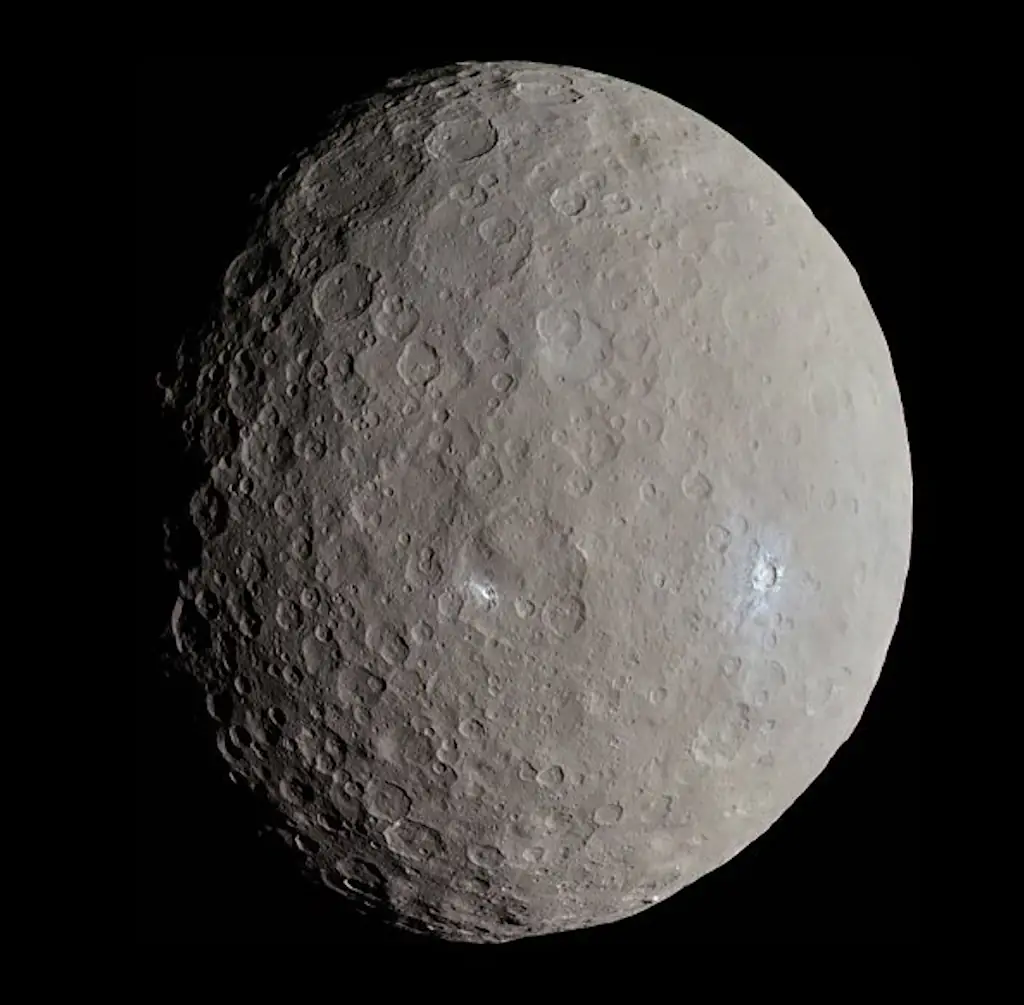
Although there is no evidence to prove that life has ever actually existed on the planet, the new research shows that, at some point, Ceres had the right conditions to support it.
These days, the dwarf planet is a frozen, salty wasteland with few natural resources, but experts claim that for a long time it had an internal heat source and the crucial chemical “fuel” required for life to survive.
Ceres is the only dwarf planet in the solar system, measuring roughly 590 miles across; the size of the planet discovered in 1801 could be a major reason as to why it was once habitable.
NASA’s Dawn mission, which orbited Ceres between 2015 and 2018, investigated the planet more extensively than ever before, and the data it collated has raised fresh questions about extraterrestrial life.
Scientists discovered the planet had the right conditions to support life
During the mission, the spacecraft spotted bright, reflective patches on the surface. They were discovered to be residues of salt left behind by ancient, rising brine, because the surface was a now-frozen subsurface ocean of salty water with organic molecules.

Researchers led by PhD candidate at Arizona State University, Sam Courville, used thermal and chemical modeling to simulate how Ceres’ interior worked over billions of years.
Through this experiment, they discovered that roughly 2.5 to 4 billion years ago, radioactive decay inside Ceres’ rocky core produced enough heat to send hydrothermal fluids into its subsurface ocean.
Similar environments have been found on Earth, in deep-sea hydrothermal vents, which are hotspots for chemotrophic microbes that derive energy from chemical reactions rather than sunlight.
Courville explained in a statement: “On Earth, when hot water from deep underground mixes with the ocean, the result is often a buffet for microbes - a feast of chemical energy. So it could have big implications if we could determine whether Ceres’ ocean had an influx of hydrothermal fluid in the past.”
So, while no evidence of life outside Earth has been discovered, scientists are now one step closer as they have discovered that a planet has all the necessary components required for extraterrestrial life: water, organic molecules, and energy.