


Health5 min(s) read
Viral 10-second 'dementia test' has people freaking out after failing simple hand movements
.jpg_I4Ebof?tr=cr-0.338.2730.3068,f-webp,q-70,w-100)
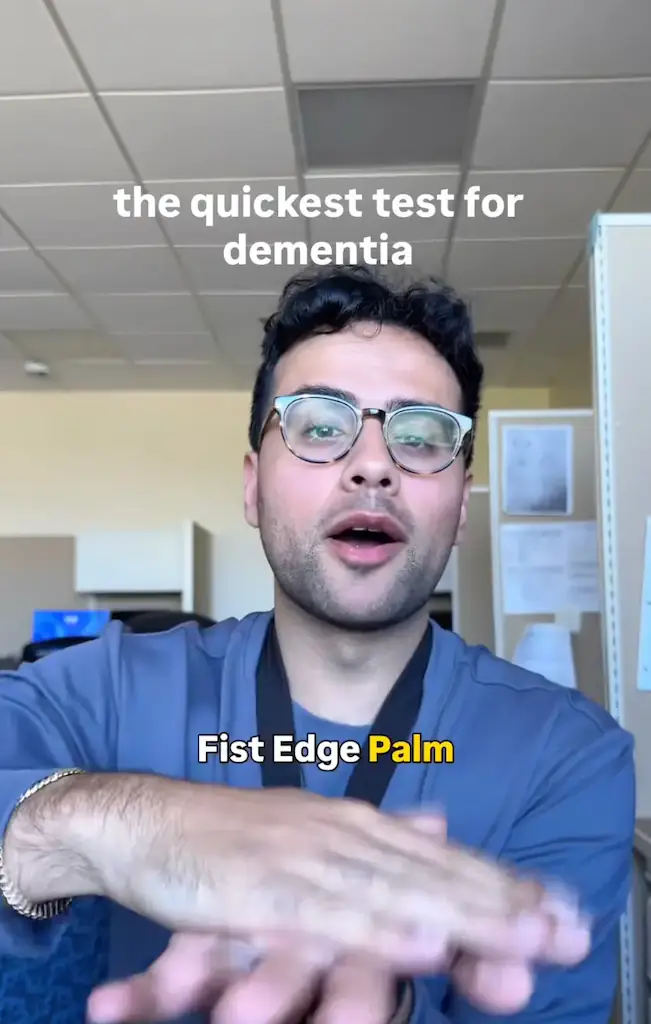
A neurologist posted a 10-second hand test on TikTok that he said was 'the quickest test for dementia' and the internet has been trying it ever since, with a lot of people not liking the results.
The video, posted by Dr Adnan Husein, shows three simple hand movements done in sequence.
Fist. Edge. Palm. That's it.
Do it smoothly, repeatedly, without stumbling over the order or getting stuck on the same movement twice.
If that sounds easy, just give it a quick try - it isn't.
The clip has been shared millions of times across TikTok and X, with people filming themselves attempting the test and panicking when they can't get through it without tripping up.
How the test works
It is called the Luria Test, or the Fist-Edge-Palm test.
It was originally developed as a clinical tool for assessing frontal lobe function.
Step one: make a fist with one hand and place it on your other palm.
Step two: open that hand and turn it sideways, placing the little finger edge down on the opposite palm like a karate chop.
Step three: turn the hand flat, palm down, resting on the opposite palm.
Then repeat. Fist, edge, palm. Fist, edge, palm. Over and over, smoothly, without hesitating or repeating the same step twice.
Dr Husein explained what the movements are actually testing: "Hands can display subtle clues about brain health.
"Certain changes in movement, tone, dexterity, or behaviour of the hands may point clinicians toward conditions such as Alzheimer's disease, frontotemporal dementia, or other neurological disorders."
The three motions test motor function, executive function, and sequencing, all of which are controlled by the frontal lobe.
Why people are freaking out
Because a lot of them can't do it.
The test looks absurdly simple when someone else does it.
Then you try it yourself and your hand goes fist, edge, edge, fist, palm, fist, and you start googling care homes.
Comments under the viral posts range from genuinely worried to darkly funny.
Some people said they tried it five times and couldn't get it right.
Others said they showed it to family members who also failed. A handful said they were now convinced they have early-onset dementia at 28.
"Great I have dementia," one person wrote after trying it.
"I couldn't do it right. I'm really not in the mood for this today."
"Not me trying this while stoned and freaking out now," said another.
"Lol I failed this," a third said.
One simply wrote: "Well I'm screwed."
Luckily, this isn't a diagnosis - it's a quick screening test.
So, if you didn't get it right, you don't need to be seriously concerned about your brain and motor functions.
Should you actually be worried?
According to Dr Husein, only about 2% of people with normal cognition struggle with the Luria Test.
In Alzheimer's patients, that figure jumps to over 50%. In frontotemporal dementia, almost 70%.
That 2% number is the one nobody is paying attention to.
It means 98% of healthy people can do it without a problem.
If you are in your 20s or 30s and you fumbled it on your first attempt, you are almost certainly not in the 2%.
You are in the much larger group of people who tried something unfamiliar while anxious about the result and tripped over their own hands.
Dr Husein was clear about this in his original video: "Not every change in the hands means dementia.
"However, when hand changes occur alongside memory loss, personality shifts, language difficulties, or problems with planning and judgment, they strengthen the case for neurological assessment."
The key part of that sentence is 'alongside'.
The test is one piece of a much bigger clinical picture.
On its own, in your living room, it tells you almost nothing.
What the test is actually designed for
In a clinical setting, the Luria Test is used alongside a full neurological evaluation.
Doctors look at it in combination with memory assessments, language tests, behavioural observations, and brain imaging.
Nobody is diagnosed with dementia because they fumbled a hand sequence once.
The test was developed by Soviet neuropsychologist Alexander Luria as part of a broader battery of assessments for frontal lobe damage.
It has been used in clinical practice for decades.
It was never designed to be performed alone at home by someone who just saw it on TikTok and is now spiral-texting their friends about it.
That said, if you genuinely cannot complete the sequence after multiple attempts and you have also been noticing memory problems, difficulty with planning, personality changes, or trouble finding words, it is worth speaking to a doctor.
Not because the hand test proved anything, but because those other symptoms might.
What doctors keep saying about viral health tests
This is not the first time a clinical screening tool has gone viral and caused mass panic.
A 10-second finger flexibility test made the rounds earlier this year with the same result: millions of people tried it, most of them failed, and doctors had to spend the following week explaining that failing a screening test on TikTok is not the same as receiving a clinical diagnosis.
The Luria Test is a legitimate clinical tool.
It has genuine diagnostic value when used properly.
What it is not is a 10-second verdict on whether you are developing dementia because you couldn't do a hand movement you had never tried before while filming yourself for social media.
Try it again tomorrow morning when you are rested and not anxious about it. You will probably be fine.