ADVERT
US3 min(s) read
President Donald Trump is celebrating after the US Supreme Court ruled that states can ban transgender athletes from competing in girls' and women's sports.
The court voted 6 to 3 to overturn lower court decisions that had sided with transgender students challenging laws in Idaho and West Virginia.
The justices ruled that the state laws do not violate the Constitution, while unanimously agreeing that the restrictions also do not breach the federal anti-discrimination law known as Title IX, which prohibits sex discrimination in education.
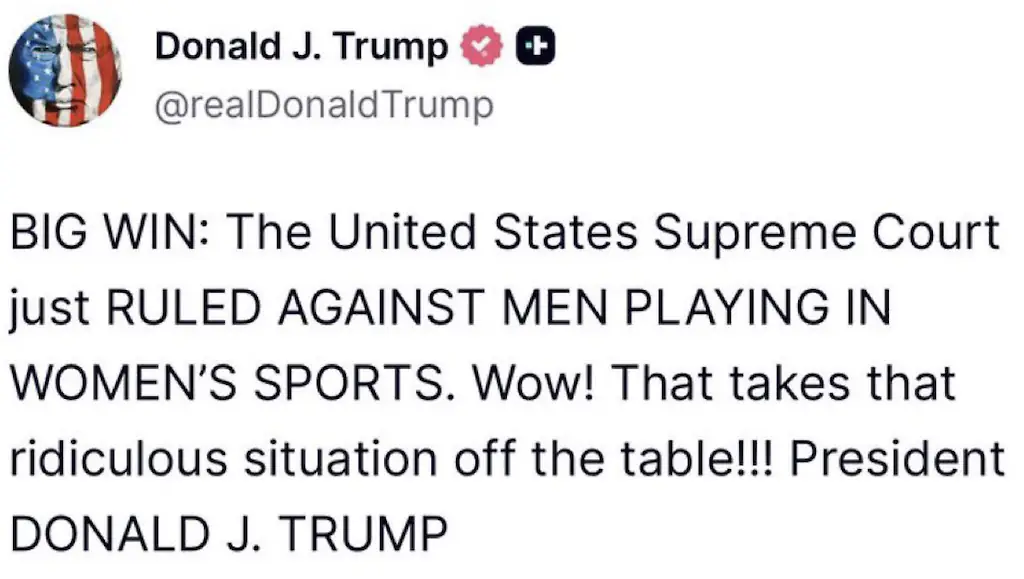
Reacting to the decision, Trump wrote on Truth Social: "The United States Supreme Court just ruled against men playing in women's sports. Wow! That takes that ridiculous situation off the table!"
Justice Brett Kavanaugh wrote in the majority opinion that "states may maintain women’s and girls’ sports for biological females."
The ruling allows schools in Idaho and West Virginia to determine eligibility for girls' and women's sports teams based on a person's sex assigned at birth. The decision is also expected to influence similar laws across the country.
The legal battle centered on Idaho's Fairness in Women's Sports Act, passed in 2020, and West Virginia's Save Women's Sports Act, passed in 2021. Lower courts had previously blocked both laws after finding they violated constitutional protections and Title IX, leading the Republican led states to appeal to the Supreme Court.
Trump made transgender issues a major part of his 2024 presidential campaign, including running advertisements criticizing then Democratic nominee Kamala Harris' policies.
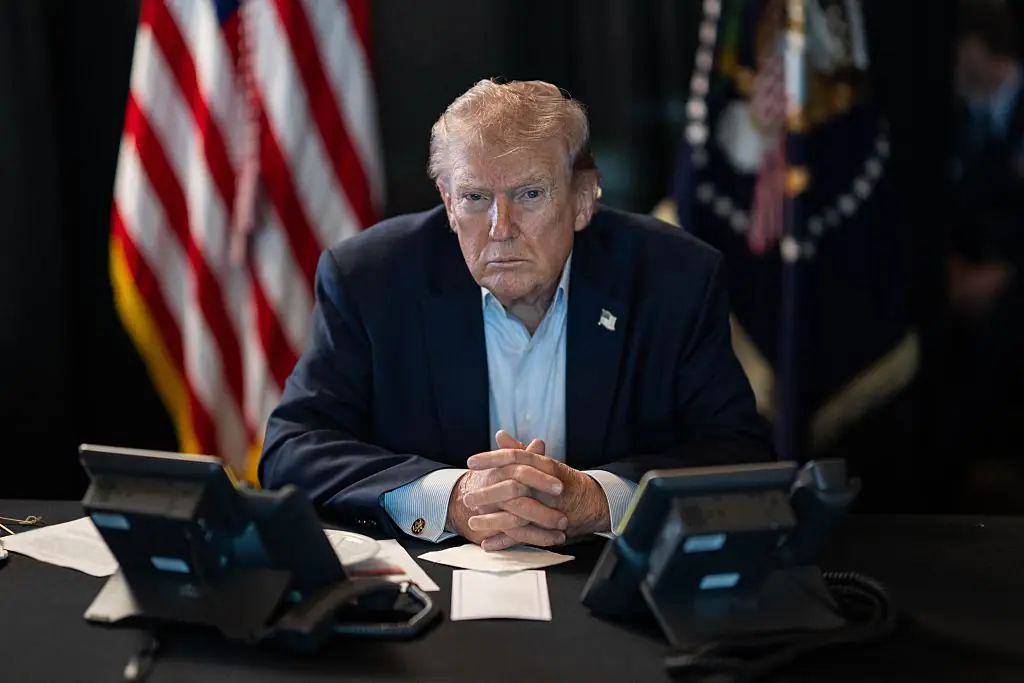
Ahead of the election, Trump also said in a Truth Social video: "The left-wing gender insanity being pushed at our children is an act of child abuse."
He continued: "Very simple. Here's my plan to stop the chemical, physical and emotional mutilation of our youth."
The issue has remained one of the most closely watched cultural and legal debates in the United States.
Former University of Pennsylvania swimmer Lia Thomas, who competed on the women's team after previously swimming on the men's team, became one of the most recognizable figures in the debate.
Thomas previously responded to critics in an interview with WHYY: "You don't get to pick and choose when you see me as a woman. You don't get to say, 'You can be a woman in these situations, but not in these' because you would never do that to a cis woman."
More recently, California high school athlete AB Hernandez drew national attention after winning the girls' high jump, long jump and triple jump events at the California Interscholastic Federation Southern Section Track and Field Masters meet, adding fresh attention to the discussion over transgender participation in girls' and women's sports.
us2 min(s) read
us2 min(s) read
us3 min(s) read
us2 min(s) read
us2 min(s) read
A bill has been signed into law prohibiting transgender girls from taking part in female sports in schools, Reuters reports.
The bill, set to take effect on January 18, was signed into law on Monday, October 25, by Texas Governor Greg Abbott and bans trans girls in public schools from playing sports alongside cisgender girls.
Those in favor of the bill say that it is supposed to ensure there is fairness in school sports. They believe trans girls have an inherent physical advantage over their cisgender peers.
Equal rights advocates, however, have branded such measures as discriminatory. They argue there is little to no evidence that transgender girls have an innate advantage.
This certainly isn't the first bill of this nature - similar measures have been taken in other conservative parts of the US. In fact, seven other states have seen the passage of similar laws just this year, per Reuters.
In March 2020, Idaho prohibited athletes who were assigned male at birth from competing on sports teams against athletes who were assigned female at birth in public schools or colleges.
However, the enforcement of the law has been blocked by a federal court as it awaits the outcome of a legal challenge against the ban.
Other states whose legislation has mirrored the Idaho law include Alabama, Arkansas, Florida, Mississippi, Montana, Tennessee, and West Virginia. South Dakota's governor, however, acted by executive order. Some of these states are also experiencing a challenge by the courts.
At least 35 bills with the aim of barring transgender youngsters from the world of sport have been put forward in 31 states this year - an increase from 29 in 2020 and two in 2019, according to statistics by the National Conference of State Legislatures.
The Texas law has been condemned by trans activists online, with LGBTQ writer Charlotte Clymer tweeting: "Greg Abbott just signed a bill in Texas this evening that bans trans children and student-athletes from competing on sports teams that align with their authentic gender identity.
"Overruling medical experts and iconic women athletes like Megan Rapinoe and Billie Jean King."
Another wrote: "Texas is so broken by hatred I don't know if it'll ever be a normal state. For shame."
West Virginia has become the subject of a federal lawsuit after the state's new anti-trans sports bill was signed into law.
The governor of West Virginia, Republican Jim Justice, signed the controversial legislation into law in May in spite of the backlash similar laws have received in other states.
Per CNN, civil rights groups sued the state on Wednesday, June 2, arguing in court documents that a ban on transgender women and girls in sports unconstitutionally "discriminates on the basis of sex and transgender status."
The suit objects to a measure that bans transgender girls and women in the state from playing on sports teams at "any public secondary school or state institution of higher education."
The American Civil Liberties Union of West Virginia, LGBTQ advocacy group Lambda Legal and Cooley LLP filed the lawsuit on behalf of an 11-year-old trans girl named Becky Pepper-Jackson.
As per the lawsuit, Becky, an elementary school student, was on the cheerleading team at her school and "wants to continue playing sports in middle school by participating on the girls' cross country and track teams".
Under the new law, the youngster can legally be excluded from playing sports in middle school "simply because she is transgender".
While Becky is referred to as B.P.J. in the lawsuit, she has been named and quoted in an ACLU press release.
She said in the release, per CNN: "I just want to run, I come from a family of runners. I know how hurtful a law like this is to all kids like me who just want to play sports with their classmates, and I'm doing this for them. Trans kids deserve better."
The lawsuit is seeking declaratory and injunctive relief to give Becky a chance "to experience the benefits of athletic participation consistent with her gender identity and without being singled out from other girls for different treatment simply because she is transgender."
"We look forward to showing in court that this law should be enjoined as unlawful and that Becky should have the same opportunity to play sports as any other child," said Kathleen Hartnett of Cooley LLP, per the outlet.
The International Olympic Committee has confirmed that transgender women athletes will be banned from competing in all female events at the Olympic Games, starting with the 2028 Games in Los Angeles. The decision applies across both individual and team competitions and forms part of a wider eligibility policy overhaul.
According to the IOC, the new rules are designed to ensure fairness in women’s sport. The policy will not be applied retroactively and will not affect grassroots or recreational sports programs. Instead, it focuses solely on elite Olympic competition and related IOC events.
The move has quickly drawn global attention, including a response from US President Donald Trump, who took to Truth Social to react to the announcement. He wrote: "Congratulations to the International Olympic Committee on their decision to ban Men from Women’s Sports. This is only happening because of my powerful Executive Order, standing up for Women and Girls!"
The International Olympic Committee stated that eligibility for female categories will now be limited to biological females. This will be determined through a one-time test for the SRY gene, which the IOC says is fixed throughout life and provides evidence of male sex development.
The organization said the policy "protects fairness, safety, and integrity in the female category" and pointed to scientific findings that males retain physical advantages in strength, power, and endurance.
The restriction will also apply to athletes with differences in sex development, including competitors like Caster Semenya, as part of a broader tightening of eligibility rules.
IOC president Kirsty Coventry said the policy had been a priority before Trump returned to office. She stated via Sky Sports: "The policy was a priority for me way before President Trump came into his second term, so there has not been any pressure from us to deliver anything from anybody outside the Olympic movement."
She added that the IOC worked with more than 1,000 athletes while developing the framework and emphasized the importance of safeguarding and support systems during implementation.
The decision marks a shift from the IOC’s earlier stance, where individual sports were responsible for setting their own rules. Coventry began pushing for a unified policy after taking over leadership in 2025.
Pressure had been building from multiple sides, including political influence from the United States ahead of the Los Angeles Olympics.
The new policy will take effect in July 2028, with the IOC now working alongside international federations and national Olympic committees to finalize how the rules will be implemented.
Florida has banned transgender girls from taking part in female sports at public schools and colleges, BBC News reports.
Ron DeSantis, the Republican governor of Florida, signed the bill - known as The Fairness in Women’s Sports Act - into law on Tuesday, June 1, making the Sunshine State the eighth one to bring in such a measure.
The new legislation states that only women and girls who were assigned female at birth can play in female sports teams.
Trans students will not be able to compete in sports without a birth certificate that specifies their sex. The law also allows students to take legal action against a school if the institution allows a trans athlete to compete alongside cisgender female teammates.
DeSantis said as he signed the law at Trinity Christian Academy in Jacksonville city, per BBC News: "We believe that is very important that the integrity of these competitions are preserved. We're going to go based on biology, not based on ideology when we're doing sports."
Florida joins Alabama, Arkansas, Mississippi, Montana, Tennessee, West Virginia, and South Dakota in excluding transgender girls from playing with their cisgender female teammates.
The governor of South Dakota, Kristi Noem, also signed an executive order on the matter.
After signing the bill into law, DeSantis tweeted: "The Fairness in Women’s Sports Act will empower Florida women & girls to be able to compete on a level playing field.
"This will help ensure that opportunities for things like college scholarships will be protected for female athletes for years to come."
The new law has widely been criticized by transgender advocates and allies, with Democratic Senator Shevrin Jones saying in a statement: "This is yet another hate-driven attack from the governor and Republican legislators, and it's insulting that they've staged this morning's photo-op on the first day of Pride Month. At the end of the day, transgender kids are just kids."
Human Rights Campaign President Alphonso David added: "All Floridians will have to face the consequences of this anti-transgender legislation - including economic harm, expensive taxpayer-funded legal battles, and a tarnished reputation."
Donald Trump has slammed the inclusion of transgender women competing in women's sports, claiming that records "are now being smashed with ease" and that women's sports "as we know it will die".
Delivering his first major speech since exiting the White House back in January, the former president appeared at the 2021 Conservative Political Action Conference in Florida on Sunday (February 28).
And after teasing a third presidential run - telling the crowd "I may even decide to beat [the Democrats] for a third time" - Trump turned his attention to transgender athletes, focusing primarily on trans women in sports.
Addressing the applauding audience, the 74-year-old slammed Biden's policies and said: "A lot of new records are being broken in women’s sports, I hate to say that ladies, but you have got a lot of new records that are being shattered."
Watch Trump's address below:Trump added: "Young girls and women are incensed that they are now being forced to compete against those who are biological males. That is not good for women.
"That is not good for women’s sports, which worked so long and so hard to get to where they were.
"The records that stood for years and decades are now being smashed with ease, smashed. If this is not changed women’s sports as we know it will die and end."
During his speech, Trump also mimicked female powerlifters, earning him laughs from the crowd.
Concluding his point, Trump told those in attendance: "I think it's crazy what is happening, we must protect the integrity of women’s sports.
"And I don’t even know, is that controversial? Someone said, 'Well that’s going to be very controversial', and I said, 'That’s okay, you have not heard anything yet.'"
After making his point, many of those in the crowd stood to give the former president a standing ovation.
Trump's speech comes days after the House passed a historic gay and transgender reform bill aimed at safeguarding the equalities of the community.
Additionally, Trump would take aim at his successor, President Joe Biden, describing these early days in Biden's reign as "the most disastrous first month of any president in modern history".