


US4 min(s) read
US soldiers put through 'mass grave' training as WW3 fears intensify

The US Army has trained soldiers to dig temporary mass graves on the battlefield for the first time since the Korean War, preparing for the possibility that a future conflict produces casualties on a scale the military has not dealt with in over 70 years.
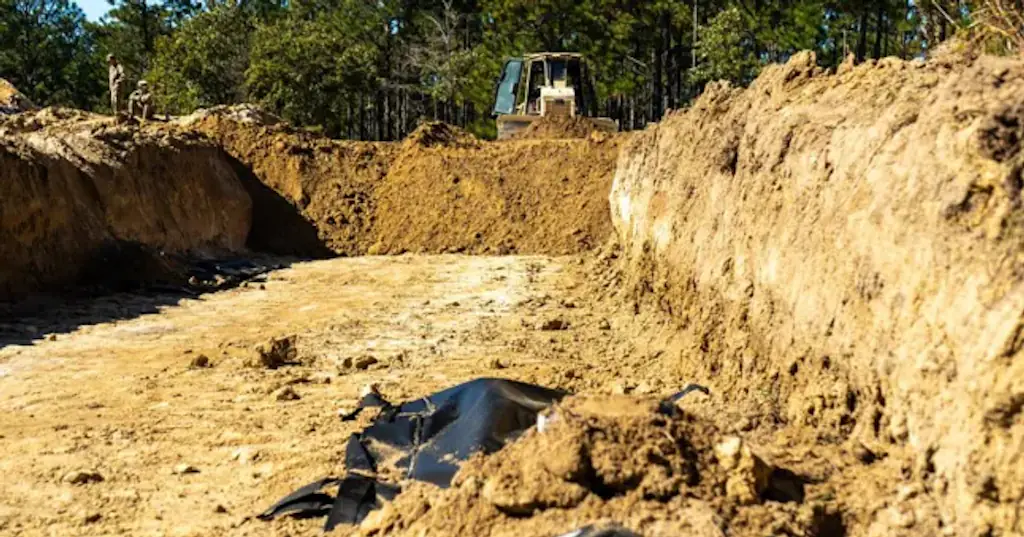
The exercise, called Operation Dragon Covenant, took place on October 20 at Fort Liberty in North Carolina. Soldiers from the 3rd Corps Sustainment Command and the 20th Engineer Brigade used bulldozers and excavators to establish temporary burial sites while mortuary affairs personnel practiced identification and preservation procedures beside them.
It comes weeks after the Pentagon revealed its FORTRESS programme, a plan to keep US military bases self-sufficient for 90 days if civilian infrastructure collapses, and days after former FBI Deputy Director Dan Bongino urged every American household to stockpile food, water, and emergency supplies.
The numbers
The exercise tested how quickly military engineers could establish burial capacity from nothing.
Each temporary burial plot was designed to hold 100 casualties.
Soldiers averaged 75 minutes to prepare each one. According to the Army, eight bulldozers and four military excavators working together could create enough burial capacity for 2,400 soldiers in a single 24-hour period.
That number is the one that has people paying attention.
The US lost 2,401 service members during the entire 20-year war in Afghanistan. The Army is now training to bury that many in a single day.
Why they are training for this now
Because recent wars did not require it.
In Iraq and Afghanistan, the number of American casualties, while significant, was manageable through the military's existing mortuary affairs system.
Remains were recovered, transported to Dover Air Force Base in Delaware, identified, and returned to families in a process that was dignified, controlled, and relatively swift.
That system works when casualties arrive in the dozens or hundreds. It does not work when they arrive in the thousands.
A large-scale ground conflict with Iran, which the US has been engaged with since February, or a broader confrontation involving a major military power, could produce casualty numbers that overwhelm the conventional repatriation pipeline completely.
When that happens, bodies need to go somewhere.
The Army is making sure its soldiers know how to put them there respectfully and in a way that allows for future identification and recovery.
Sergeant 1st Class Delbert Ruede, who oversaw the exercise, told Army Times: "This exercise allowed us to take a critical look at how we respect, honor, and systematically manage our fallen in a high-intensity conflict."
"What we are doing here is taking a scientific, field-tested approach so that we can maintain positive control and respectfully care for our fallen."
Chaplains are back in the field
The exercise also included Army chaplains and religious affairs personnel for the first time in more than 20 years.
Their role is to support respectful temporary burials and to provide spiritual care for the soldiers doing the digging, a job that military psychologists have long identified as one of the most psychologically damaging tasks a soldier can be asked to perform.
The inclusion of chaplains in the training is not symbolic.
It is an acknowledgment that if these procedures are ever used for real, the soldiers carrying them out will need support that goes beyond logistics.
The pattern
This is the latest in a series of moves that suggest the US military is actively preparing for something significantly larger than anything it has faced since 2001.
The FORTRESS programme is building independent power supplies, ammunition stockpiles, and self-sustaining infrastructure across military bases.
The Army is training soldiers to bury 2,400 of their own in 24 hours. Governments across Europe and Asia are telling civilians to stockpile food and water.
The Doomsday Clock sits at 85 seconds to midnight.
Maps showing the safest places to be if WW3 breaks out are trending every week.
Individually, each of these could be explained as routine preparedness or media hype.
Together, they paint a picture that is harder to dismiss.
The last time the Army trained for mass battlefield burials, it was preparing for a war in Korea that killed over 36,000 Americans.
The fact that it is doing so again, 73 years later, while already engaged in a conflict with Iran, tells you something about what the people who plan for the worst-case scenario think might be coming.