ADVERT
World2 min(s) read
Published 15:15 09 Jul 2026 GMT
Authorities have unveiled new details of the K2 cargo aircraft's horrifying nosedive and crash into the Arabian Sea.
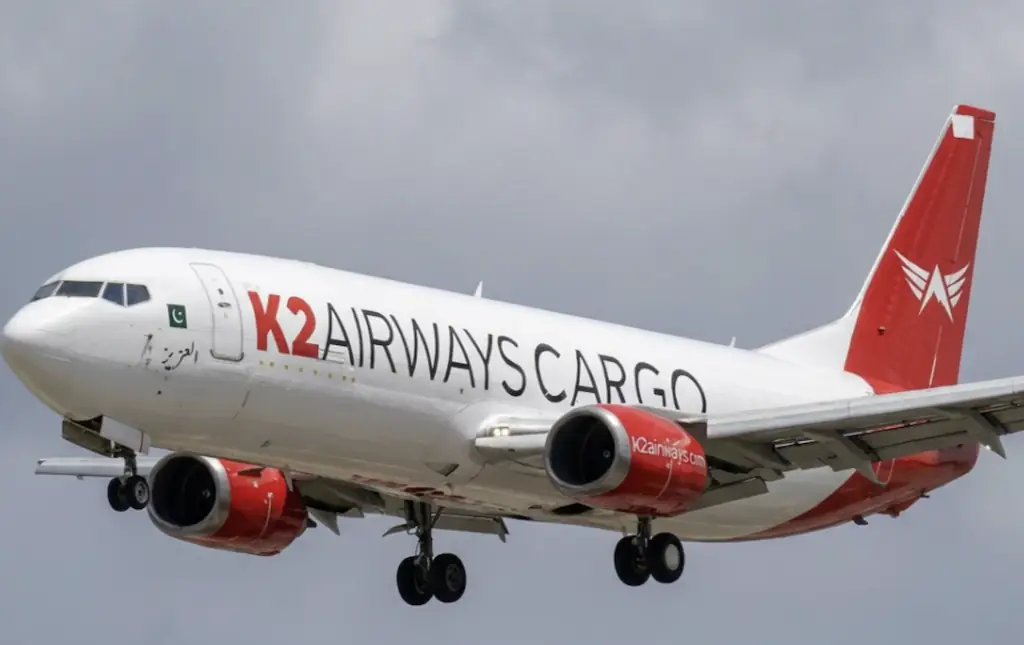
The Boeing 737 departed Sharjah, United Arab Emirates, on Tuesday (July 7) and was bound for Karachi in Pakistan.
One day later, Pakistani authorities discovered the wreckage of a Boeing plane in the Arabian Sea yesterday (July 8), though all five crew members are feared dead.
The plane had lost contact with air traffic control and vanished after rapidly descending 5,000ft in a matter of seconds off the coast of Pakistan, climbing 6,000ft, and then nosediving to its end.
After 12 hours of searching for debris, the Pakistani navy and search teams discovered debris, managing to lift large parts of the aircraft out of the sea.
Authorities reported rough conditions during the search, and noted that the main wreckage may be harder to find as it disappeared in an area where the sea was approximately 9,800ft deep.
Now, new information about the lost aircraft has surfaced.
NBC News reported that while emergency teams were still searching for the five missing crew members, pilots noticed that something wasn't right before nosediving.
The news outlet said that Pakistani authorities revealed that pilots reported an issue with their navigation system before controllers lost radio contact.
The flight was sitting at 34,000ft before dropping and climbing suddenly, followed by a "very steep descent" until it crashed into the Arabian Sea.
The Boeing aircraft had flown over the Strait of Hormuz, though US sources said there was no indication that this was a hostile act, pointing towards a mechanical failure.
Investigators are still searching for the black boxes to learn more, with the NTSB and FAA working to find out more about the plane's disappearance.
The airline stated: “We continue to pray earnestly for the safety of our colleagues.”
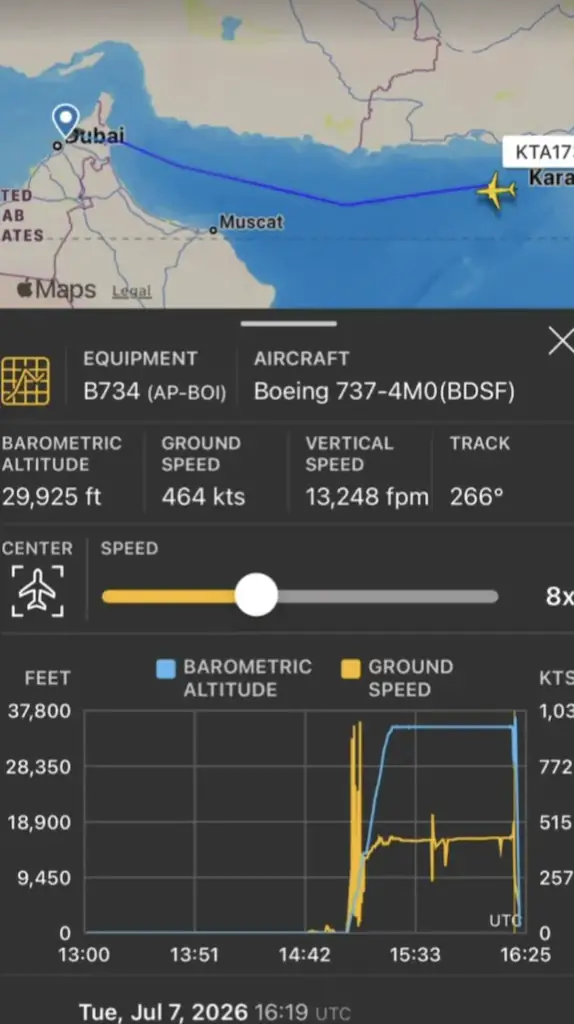
Tracking data from Flightradar24 revealed the aircraft’s final moments, with the plane falling by around 5,000ft in less than a minute.
This was then followed up by a terrifying dive from 36,550ft at a speed of 240mph.
A graph showed the cargo plane's “barometric altitude” appear to drop suddenly, with the plane remaining in the same place on the map.
Pakistan's airport authority explained that the Karachi-bound K2 Airways aircraft took off from Sharjah, UAE.
The final transmission came as the pilot raised an alarm signalling that the plane was “rolling or floating”.
Rolling is a phase of flight, but floating refers to a landing error.
It's said that the plane experienced navigation system interference prior to its descent.
Pakistan Airport Authority said in a statement: “K2 Airways B 737 of Pakistan Cargo Flight enroute from Sharjah to Karachi reported a navigational system issue and was promptly guided by KARACHI ACC.”
Radar systems indicated a “sudden and dramatic loss of altitude” before communication was cut off entirely.
Its last transmitted data point was around 155 nautical miles west of Karachi, above the Arabian Sea.
world3 min(s) read
Published 12:58 09 Jul 2026 GMT
Flight radar data has revealed the true extent of the K2 aircraft's nosedive and subsequent crash into the Arabian Sea on Tuesday (July 7).
Pakistani authorities discovered wreckage of a Boeing plane in the Arabian Sea yesterday (July 8), though all five crew members are feared dead.
The aircraft lost contact with air traffic control and vanished after rapidly descending 5,000ft in a matter of seconds off the coast of Pakistan.
After searching for 12 hours on Wednesday, Pakistani navy and search teams found debris, with large parts of the aircraft being lifted out of the water.
It may be more difficult to find the main wreckage of the plane, as the plane disappeared in an area where the sea was approximately 9,800ft deep. More specialized equipment would be needed.
The airline stated: “We continue to pray earnestly for the safety of our colleagues.”
Tracking data from Flightradar24 revealed the aircraft’s final moments, with the plane falling by around 5,000ft in less than a minute.
This was then followed up by a terrifying dive from 36,550ft at a speed of 240mph.
A graph showed the cargo plane's “barometric altitude” appear to drop suddenly, with the plane remaining in the same place on the map.
Pakistan's airport authority explained that the Karachi-bound K2 Airways aircraft took off from Sharjah, UAE.
The final transmission played as the pilot raised an alarm signalling that the plane was “rolling or floating”.
Rolling is a phase of flight, but floating refers to a landing error.
It's said that the plane experienced navigation system interference prior to its descent.
Pakistan Airport’s Authority said in a statement: “K2 Airways B 737 of Pakistan Cargo Flight enroute from Sharjah to Karachi reported Navigational system issue and was promptly guided by KARACHI ACC.”
Radar systems indicated a “sudden and dramatic loss of altitude” before communication was cut off entirely.
Its last transmitted data point was around 155 nautical miles west of Karachi, above the Arabian Sea.
Authorities explained that rough conditions were making search efforts more difficult, with the main wreckage of the aircraft still missing.
K2 Airways has since named the missing crew as Capt. Muhammad Rizwan Idris, First Officer Faisal Jatoi, flight engineers Muhammad Hamid and Muhammad Arif Siddiqui, and aircraft loader Muhammad Taufiq Khan.
If fatalities are confirmed, it would be Pakistan's first fatal air crash since 2020, when a passenger jet crashed into a residential neighborhood near Karachi Airport.
world2 min(s) read
Published 16:12 08 Jul 2026 GMT
Pakistani authorities have discovered wreckage of a Boeing plane in the Arabian Sea just one day after it suddenly nosedived 5,000ft in seconds and crashed into the sea.
All five crew members are feared dead.
Parts of the K2 aircraft have been found by authorities after the plane lost contact with traffic control and disappeared on Tuesday (July 7).
The Boeing 737 with five crew on board had rapidly descended off the coast of Pakistan after losing contact with aviation authorities.
Pakistani navy and search teams found debris after searching for around 12 hours in the Arabian Sea, with images revealing that large pieces of the aircraft were being lifted out of the water.
Authorities explained that rough conditions were making search efforts more difficult, with the main wreckage of the aircraft still missing.
It may be more difficult to find, given that the plane disappeared in an area where the sea was approximately 9,800ft deep, with more specialized equipment needed.
The airline stated: “We continue to pray earnestly for the safety of our colleagues.”
Pakistan's Airport Authority said the K2 Airways flight departed from Sharjah in the United Arab Emirates and was heading to Karachi when the crew reported technical problems.
“K2 Airways B 737 of Pakistan Cargo Flight en route from Sharjah to Karachi reported Navigational system issue and was promptly guided by KARACHI ACC,” Pakistan’s Airport Authority said in a statement.
Just three minutes later, radar systems detected what officials described as a "sudden and dramatic loss of altitude" before contact with the aircraft was completely lost.
The last transmitted data placed the Boeing 737 about 155 nautical miles west of Karachi over the Arabian Sea.
Flight tracking data showed the aircraft dropping about 5,000 feet in less than a minute before entering a catastrophic dive from 36,550 feet at a reported speed of 240 mph.
K2 Airways, a private cargo airline based in Karachi, confirmed the identities of the five crew members on board in a statement released Wednesday.
The airline said it was “fully cooperating with the Pakistan Civil Aviation Authority and other government agencies”.
“We continue to pray, earnestly, for the safety of our colleagues,” the statement said.
The Boeing 737 is the only aircraft operated by K2 Airways and entered service with the airline in 2024.
If fatalities are confirmed, it would be Pakistan's first fatal air crash since 2020, when a passenger jet crashed into a residential neighborhood near Karachi Airport.
Government investigators later concluded that the accident was caused by human error after determining the pilots had been distracted by discussing the COVID pandemic before a failed landing attempt.
world2 min(s) read
Published 15:30 08 Jul 2026 GMT
A major search operation is underway after a Boeing 737 cargo plane disappeared from radar off the coast of Pakistan following a rapid descent during a flight from the United Arab Emirates.
The Karachi-bound aircraft, operated by K2 Airways, lost contact with air traffic control on Tuesday after reporting problems with its navigation system. Flight tracking data showed the plane descending sharply before all communication stopped, leaving authorities racing to locate the aircraft and its five crew members.
The pilot's final transmission has added to the mystery after reporting the aircraft was "rolling or floating" shortly before it vanished. Pakistan's airport authority said the aircraft experienced navigation system interference before radar recorded a sudden loss of altitude.
Pakistan's Airport Authority said the K2 Airways flight departed from Sharjah in the United Arab Emirates and was heading to Karachi when the crew reported technical problems.
“K2 Airways B 737 of Pakistan Cargo Flight enroute from Sharjah to Karachi reported Navigational system issue and was promptly guided by KARACHI ACC,” Pakistan’s Airport Authority said in a statement.
Just three minutes later, radar systems detected what officials described as a "sudden and dramatic loss of altitude" before contact with the aircraft was completely lost.
The last transmitted data placed the Boeing 737 about 155 nautical miles west of Karachi over the Arabian Sea.
Flight tracking data showed the aircraft dropping about 5,000 feet in less than a minute before entering a catastrophic dive from 36,550 feet at a reported speed of 240 mph.
Pakistan has launched a large-scale search effort involving both the navy and air force.
The Pakistan Navy frigate PNS Zulfiqar was diverted to the area where the aircraft was last detected as crews searched for any sign of the missing cargo jet.
The aircraft's sudden descent has left aviation experts searching for answers.
Imran Aslam told ARY News: “I still cannot understand how the plane went down so abruptly instead of gliding.”
According to local media, one aviation specialist said the aircraft's rapid descent does not match the pattern typically seen during an engine failure.
K2 Airways, a private cargo airline based in Karachi, confirmed the identities of the five crew members on board in a statement released Wednesday.
The airline said it was “fully cooperating with the Pakistan Civil Aviation Authority and other government agencies”.
“We continue to pray, earnestly, for the safety of our colleagues,” the statement said.
The Boeing 737 is the only aircraft operated by K2 Airways and entered service with the airline in 2024.
If fatalities are confirmed, it would be Pakistan's first fatal air crash since 2020, when a passenger jet crashed into a residential neighborhood near Karachi Airport. Government investigators later concluded that accident was caused by human error after determining the pilots had been distracted discussing the COVID pandemic before a failed landing attempt.
world2 min(s) read
Published 10:37 22 Mar 2022 GMT
No survivors have been found following the Boeing 737 plane crash in southern China, AP News reports.
The aircraft was carrying 132 people when it plummeted into hills in the Guangxi province and burst into a ball of flames yesterday.
Rescuers continue to search the wreckage, but China's state broadcaster reports that there is no sign of anyone having survived the hellish crash.
Meanwhile, relatives have gathered at Baiyun Airport in Guangzhou, waiting anxiously to hear any news of their lost family members.
The cause of the crash remains a mystery. Witnesses describe how the Boeing 737-800 dropped out of the sky shortly before it began its descent to Guangzhou airport, falling 30,000 ft in two minutes before exploding on impact.
Chen Weihao - who saw the plane fall out of the sky - told Xinhua News Agency that it hit a gap in the mountainside where nobody lived, leaving behind a deep pit.
"The plane looked to be in one piece when it nosedived. Within seconds, it crashed," they said.
Rescuers continue to search for the plane's black boxes, which hold the flight data and cockpit voice recorders essential to understanding why the aircraft went down. The search is being conducted using a combination of drones and manual search. A base of operations has also been set up near the crash site for rescue vehicles, ambulances, and emergency power supply trucks, while soldiers and rescue workers search through the dense vegetation for survivors or remains.
China's Transport Ministry reports that China Eastern has grounded their entire Boeing 737-800 fleet. The airline has over 600 planes, 109 of which are the Boeing 737-800 model. Domestic travel in China is expected to be severely disrupted in the immediate future.
The crash is one of the worst in China's history. BBC News reports that there has not been a major incident with a Chinese airline for 12 years. It was then that a flight from Harbin crashed in Yichun in August 2010. Forty-two people died in the incident.
Our thoughts are with the family and loved ones of all of those onboard.
world4 min(s) read
Published 14:39 08 Apr 2026 GMT
Over 12 years ago, Malaysia Airlines flight MH370 vanished on its planned route from Kuala Lumpur to the Chinese capital of Beijing.
The Boeing 777 had 227 passengers and 12 crew members onboard, all of whom have been presumed dead since the aircraft disappeared on March 8, 2014.
It still remains a mystery, as crew onboard didn't send any distress calls despite losing contact with air traffic control at 1:19AM over the South China Sea on that fateful day, before veering off-course and flying an an unknown path for seven hours before vanishing.
People continue to theorise about the airplane's disappearance and while many think that the truth can be uncovered through the discovery of its black box flight recorders, they remain missing.
But back in 2024, investigators believed that an underwater pressure monitor may help to find the wreckage of the lost aircraft.
Despite it still remaining unconfirmed, the Malaysian government claimed that the flight had "ended in the Southern Indian Ocean."
Hundreds of pieces of underwater audio data were analysed by researchers at Cardiff University from previous aircraft accidents and a submarine disappearance, finding that an underwater signal could have been caused by the impact of the Boeing plane hitting the waves when crashing.
Dr. Usama Kadri, a mathematician and engineer, claimed that a network of hydrophones, which have been used to keep tabs on pressure changes in the ocean as part of a nuclear explosion detection system, could be the key.
After he and his team went through large volumes of data from the time the aircraft was said to have disappeared, the doctor discovered an unidentified event in an area called the Seventh Arc.
Speaking to The Conversation, Dr. Kadri explained: "A 200-tonne aircraft crashing at a speed of 200 metres per second would release the kinetic energy equivalent to a small earthquake. It would be large enough to be recorded by hydrophones thousands of kilometres away.
"Given the sensitivity of the hydrophones, it’s highly unlikely that a large aircraft impacting the ocean surface wouldn’t leave a detectable pressure signature, particularly on nearby hydrophones."
He noted that "unfavourable" ocean conditions could still affect a signal this large though.
The engineer believed that the search would have to be approached with this method to see if these signals were linked to the missing plane, as researchers suggested that a number of controlled underwater explosions be carried out so search teams can finally find the elusive wreckage.
Over the years, many theories have been put forward, whether it be a possible hijacking or the near-impossible chance that the plane was flown into a 'black hole'.
Ocean Infinity, a UK-based marine robotics firm, carried out searches for the airplane in both March 25–28 last year and in December 31 to January 23 this year.
Unfortunately, no wreckage was found apart from numerous pieces of marine debris.
The firm splashed $67.2 million on advanced technology and resources, with the search taking place over 7,571 square kilometers on the seabed of the Indian Ocean.
They carried the search out on a no-find, no-fee basis, as Malaysia's Transport Minister, Anthony Loke, had claimed they would have been awarded $70 million if they found the missing aircraft.
Ocean Infinity said in a statement this year: “The search activities undertaken have not yielded any findings that confirm the location of the aircraft wreckage.
“The government pays nothing unless the aircraft is found. Any request by Ocean Infinity to extend the search contract should therefore be granted without hesitation,” they added.
The firm then urged the government to offer the same deal to other "capable deep sea exploration companies.”