ADVERT
Health5 min(s) read
Published 14:17 01 Jul 2026 GMT
A man who was born without a penis revealed the difficulties he faced having sex were caused by factors other than his missing appendage.
Andrew Wardle was born with bladder exstrophy, a rare condition which occurs when the bladder of an unborn baby forms outside of the stomach area during pregnancy, per the Mayo Clinic.
The exposed bladder can't store urine or work as it should and the condition can also affect the genitals, stomach muscles, pelvic bones, intestines and reproductive organs, and surgery is needed to close the bladder and repair any other affected body parts.
It is a rare condition affecting between one in 30,000 to one in 50,000 live births, and in Andrew's case, he was born without a penis.
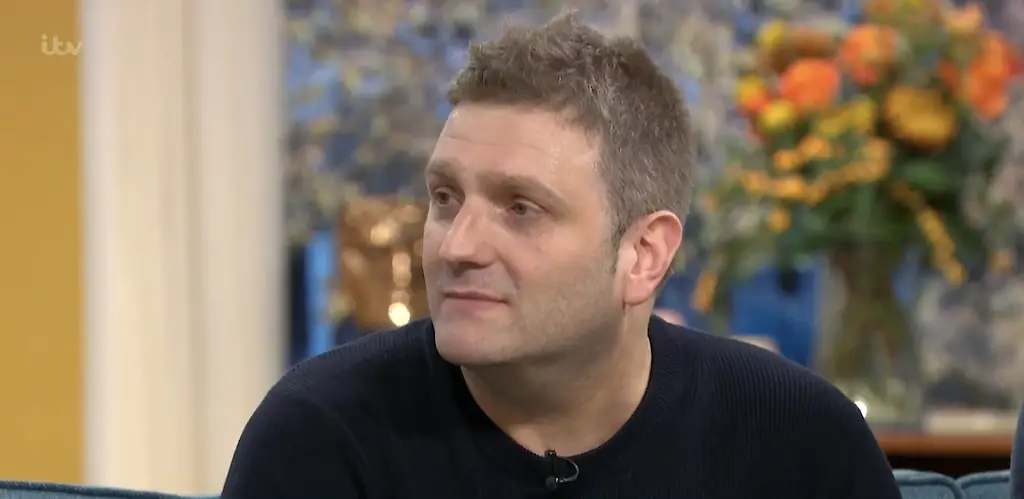
Throughout most of his life, Andrew associated his genitalia with pain - from the physical, requiring many trips to the hospital, to the mental anguish of being different from his peers.
This in turn led to him turning to drugs at the age of 18, using them for 10 years as a way of distracting himself from his physiological problems.
However, hope came in the form of a £70,000 ($93,000) surgery to create a "bionic" penis for him, which functions just like the real thing.
Andrew explained during an appearance on This Morning in 2018 that the discussion around his phalloplasty started in 2010, and the surgeries to create his bionic penis began in 2015.
He revealed: "It's taken a long, long time. They had to build me a new bladder, new penis, new everything, basically. Honestly, it's fantastic what they've done.
"The skin comes from your arm, with muscle. They take nerves and veins, and nerves from your back and all over the place, really.
"You'd be completely shocked to see what they can build. It's shocking. It completely surprised me, I just never thought anything like that was possible."

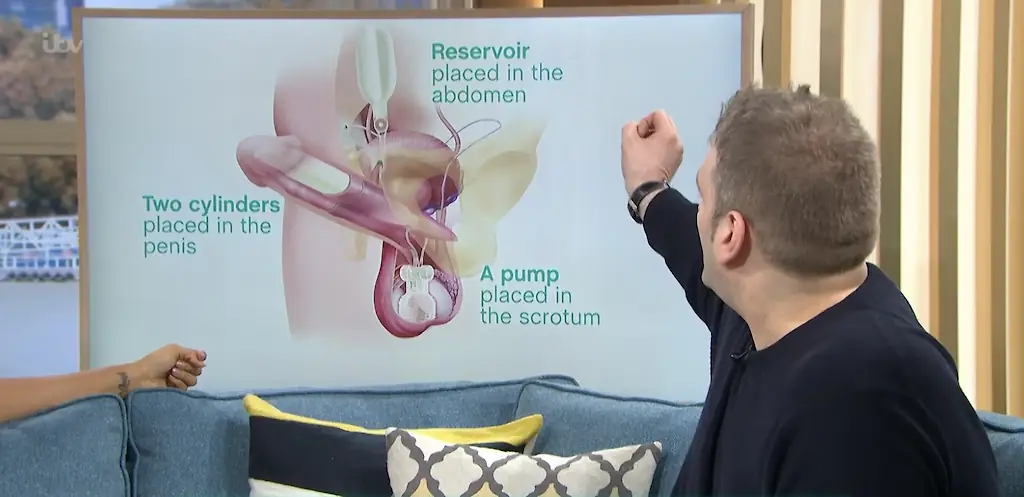
The newly constructed penis consists of a reservoir filled with liquid placed inside the abdomen, which connects to two cylinders within the shaft of the penis, and a pump button within the testicles, which pushes the fluid from the reservoir into the penis to make it erect.
As if the mechanism wasn't impressive enough, the penis has been constructed so he also has sensation in it, as Andrew added: "They put nerves in which is completely mind-boggling."
While he is enjoying his new appendage, the road to recovery was not an easy one, as Andrew was forced to live with a permanent erection for three weeks in order to stretch the skin out.
He added: "It was very uncomfortable as well, I had to stay in basically for three weeks. They had to do it to stretch everything out, so it's very normal."
Once the recovery period was over, Andrew and his long-time partner, Fedra Fabian, were excited to explore intimacy together, but he admitted the main issue around sex was not so much the physical side but rather the mental aspect.
He explained that he'd compartmentalized sex so far in the back of his mind he'd have to "unlock it with a psychologist", adding: "It's still not quite there yet.
"They say it'll take about two years to link it, because when I used to think of it as a child it's just bullying, pure physical pain, mental pain.
"So to link it with pleasure, I think, is near impossible but I will get there."
Andrew previously revealed that most of his past girlfriends had been understanding about his condition, but one even reacted with violence.
He admitted: "It's very difficult to explain, but when you do explain it, some of them are really nice, and my first girlfriend - I was so lucky, she was really nice.
"I've actually been punched in the face once when I told a girl, that was a real shock."
When he and Fedra finally managed intercourse and he lost his virginity at the age of 45, Fedra revealed what it was like, explaining: "It was really natural, it only lasted around 30 minutes.
"I was really nervous not to cause any pain, which is usually the other way around, isn't it. And it was just really magical because we know each other so well, that was just the cherry on the top. It was lovely to make the next step and open that door as well."
As well as finally being able to experience penetrative sex, the phalloplasty has changed Andrew's life in a deeper way, as he told the hosts: "I can see a future now, and before that's why I used to take drugs - because I couldn't see a future."
Looking to the future, Andrew and Fedra were planning to start a family together, but if they are unable to, then they wish to adopt instead.
uk3 min(s) read
Published 10:13 01 Jul 2026 GMT
Andrew Wardle has made a name for himself over the years after publicly revealing what life is like without a real penis.
The Brit was born with a rare condition which left him without a penis, and this is how he lived for much of his life.
However, after receiving a £70,000 ($92,725) bionic penis aged 45, he has spoken about how it has improved his physical and emotional wellbeing.
He appeared on ITV's This Morning several times throughout the 2010s, providing updates on his situation, with one in 2018 featuring his partner, Fedra.
The couple opened up on how Andrew's surgery has allowed him to have penetrative sex for the first time, breaking down the physical barrier.
However, he admitted that his biggest issue lies within the psychological aspects of his rare health condition.
Fedra explained that their relationship wasn't built on sex, instead being built on friendship and companionship.
This went on for over six years, before intimacy became possible and the couple could consummate their love.
Andrew reflected on the experience of losing his virginity as 'natural' and 'magical', and highlighted that it wasn't his relationship's defining moment, instead marking a step in their relationship.
When asked about how the experience was, Andrew said that it was 'natural,' adding: "It was just really magical."
After spending his whole life with medical limitations, he is now starting to associate that part of his body with pleasure instead of trauma.
Andrew admitted that sharing his story has helped others born with similar conditions, highlighting that there have been advances in reconstructive surgery, pointing towards a positive future.
Andrew's medical condition affects one in 20 million people, as he admitted that it led to years of depression and drug abuse.
Reflecting on how it has felt, he admitted: "It's still quite not there yet... it's just bullying, pure physical pain, mental pain.
"So to link it with pleasure, I think it's nearly impossible. But I will get there."
The reconstructive surgery took numerous years by specialists in London, as Andrew explained: "They've had to build me a new bladder, new penis, new everything, basically."
He even said that they managed to fit nerves into his bionic penis, which was 'mind-boggling.'
This, along with tissue and blood vessels, was taken from his arm and other parts of his body, and a pump concealed in his penis works by pressing a button implanted in his testicle.
Speaking about her partner, Fedra described him as "my best friend" and "partner in crime," while saying that their first sexual experience was "just the cherry on the top."
health3 min(s) read
Published 16:29 16 Oct 2024 GMT
health3 min(s) read
Published 13:16 13 Jan 2026 GMT
Viewers of UK mid-morning TV show This Morning were left stunned when a man who claims to have the 'world’s smallest penis' appeared on the sofa to share his deeply personal story.
Michael Phillips, 38, from North Carolina, revealed that his manhood measures just 0.38 inches — significantly below the average of 5.5 inches — and it's a reality that has impacted every aspect of his life.
Speaking candidly to hosts Cat Deeley and Ben Shephard, Michael shared that he first became aware of his condition during his teenage years but held on to hope that things would change.
"I was probably in high school, and dealing with girlfriends and stuff like that, I thought I was a late bloomer, maybe one day it would be normal size. But it never happened."
When asked whether it was something he could talk about with his family, Michael — who also revealed he was adopted — admitted he struggled to open up about his condition.
"I kept it to myself, when I was in my teens and twenties, I was always single even though I had friends.
"They wondered why I wasn't dating and I didn't want to go through that."
For years, he kept his condition a secret, choosing to avoid the subject altogether.
As a result, no one around him suspected anything.
“I didn’t get picked on because nobody knew,” he said.
But in adulthood, the hidden burden became much harder to manage.
Michael revealed that his condition has brought unexpected daily challenges, far beyond just dating.
"I can't go out and have a one night stand but it also affects my ability to use a restroom, my confidence.
Even sitting down can be tricky with the clean up and everything. I've tried everything possible. You can be upfront, you can try to talk to somebody, sometimes you don't say nothing at all."
As Michael's story unfolded on live TV, This Morning viewers rushed to social media to share their reactions — ranging from sympathy to outright confusion.
"Suppose it’s easy to slag the bloke with the smallest penis. Must be horrible for him," one person said.
Others questioned the motivation behind going public: "Why would you go on #thismorning and tell everyone you have a micropenis?"
One viewer poked fun at part of the segment: "When Ben asked the man with the micro penis how it affects his day to day life, he replied that he can't go on one night stands!
"Is that day to day life? I must have had a very boring life if it is."
health4 min(s) read
Published 16:30 18 Jun 2026 GMT
A man who donated his body to science following his death left researchers in shock after they discovered that he had a rare health condition.
Following his death, the 78-year-old British man was dissected by medical students who couldn't believe what they found in the pelvis.
A report was made in the Journal of Medical Case Reports back in October 2024, documenting a "serendipitous discovery" once they made their way below the belt.
After cutting into the cadaver, they made their way down to the skin of the scrotal sac and discovered that inside, adjacent to a regular external penis, were two smaller penile structures.
But yet, only the primary penis was externally visible, though all three penises had a commonality.
They all included a bulbous structure called a glans, as well as a chamber of spongy tissue that would fill with blood to cause an erection, known as the corpus cavernosum.
They measured the three penises, with the external one standing at around 3 inches (7.7 centimeters) long and 0.9 inches (2.4 cm) wide.
His second penis measured shorter, at 1.49 inches (3.8 cm) long and was 0.51 inches (1.3 cm) wide, while the third penis was similar, at 1.45 inches (3.7 cm) long with a width of 0.47 inches (1.2 cm).
Doctors discovered that there was just one urethra, which is the tube that transports urine from the bladder.
However, a "meandering course" was found through the secondary penis and into the primary penis, which then terminates in the external penis' urethral orifice.
Authors suggested that the urethra originated in the secondary penis, but changed course and redirected into the primary penis when the secondary one didn't fully develop.
No branches were found in the tunnel, with no urethral tubes in the third and smallest penis.
The report noted that a structure known as the genital tubercle usually arises and eventually develops into external genitalia, forming a clitoris or a penis - but this didn't happen with this man.
During his fetal development, "there may have been triplication of the genital tubercle," resulting in three penises, the medical report details.
It should be noted that the more common occurrence of this anomaly is called diphallia, referring to two penises.
Neither the students nor the instructors at the medical school knew the man's identity, nor did they know about his medical history or have access to his records.
Due to this, they didn't know if the man knew about his condition, though they doubted that his triphallia went unnoticed.
If the man needed a urinary catheter insertion, it would have been very challenging because of "the tortuous nature of the urethra," which went through his second penis.
The medical experts noted that there was scarring in the man's groin as a result of an inguinal hernia, where abdominal tissue goes through an opening in the abdominal wall.
Pressure or friction from the two extra penises could have weakened the man's lower abdominal wall and contributed to the hernia, which may have led doctors to discover the additional penile structures.
The development of more than one penis only appears in approximately one in five to six million live births, according to a 2010 review of case reports.
But these are mostly diphallia, with the man's case becoming the first discovery of a triple penis in a cadaver, and only the second known case in scientific literature.
While this can affect sexual dysfunction, fertility problems, and urinary tract infections, the authors suggested that the man may have known about it and chosen to avoid removing it "due to the apparent lack of symptoms," and its "benign nature."
lifestyle2 min(s) read
Published 16:44 22 Sep 2021 GMT
A man sought medical help after he started to experience a bizarre phenomenon with his bum and genitals.
The man, 33, realized that something was seriously wrong when he began to defecate from his penis and ejaculate from his anus, Indy100 reports.
However, it took two years for the man to seek out medical help.
News of the man's condition was revealed in the research article titled "A Curious Case of Rectal Ejaculation", which was published by US scientists last month.
It reads: "A 33-year-old male with a history of illicit drug use presented with five days of testicular pain. He also noted a substantial amount of urine and sperm passage from his rectum in addition to pneumaturia and fecaluria for the past two years."
Pneumaturia and fecaluria are conditions that cause gas and feces in urine.
To begin with, doctors had to rule out a number of other conditions including tuberculosis and inflammatory bowel disease.
When the man's urine was examined, it was revealed that he had a UTI, and a CT scan showed swelling in his left testicular tube and a "gas-filled structure" in his prostate, which was responsible for his rectal issues.
Scientists concluded that the gas-filled structure was "chronic appearing rectal-prostate fistula", and they were able to confirm their hypothesis with a voiding cystourethrogram (VCUG), a special type of x-ray.
The article revealed that the man had been in a three-week comatose state as a result of intoxication with cocaine and phencyclidine, a hallucinogenic drug.
The researchers explained that they had to use a catheter when he was hospitalized and this caused "significant trauma".
But despite the extreme symptoms experienced by the man, all that was required to solve the problem was a simple surgical procedure known as a "joint colorectal and urologic surgical fistula repair."
The man "recovered with only mildly reduced antegrade ejaculatory volume over several months."
The article said that rectourethral fistulas are incredibly rare, and they affect just 0.5 in every 100,000 people every year.
"The majority of adult cases are acquired, while most pediatric cases are due to congenital abnormalities," it explained.