ADVERT
US4 min(s) read
Donald Trump has seemingly suggested breaking the law after the Supreme Court ruled against him.
One of the first executive orders the 80-year-old president signed after returning to office in January 2025 was to end automatic US citizenship for children born to people who are in the country illegally or temporarily.
Birthright citizenship has been protected under the 14th Amendment of the US Constitution since 1868, when it was adopted in the aftermath of the Civil War.
Originally intended to guarantee citizenship to formerly enslaved people, the amendment states that "all persons born or naturalized, and subject to the jurisdiction thereof, are citizens of the United States".
As the American Immigration Council explains: "Birthright citizenship is the principle that people born in the United States are Americans - full members of our society from the moment they are born.
"It reflects a simple and powerful idea: if you’re born here, you belong here."
Trump argued that children born to undocumented immigrants and some temporary visitors were not "subject to the jurisdiction thereof" and therefore should not automatically become US citizens.
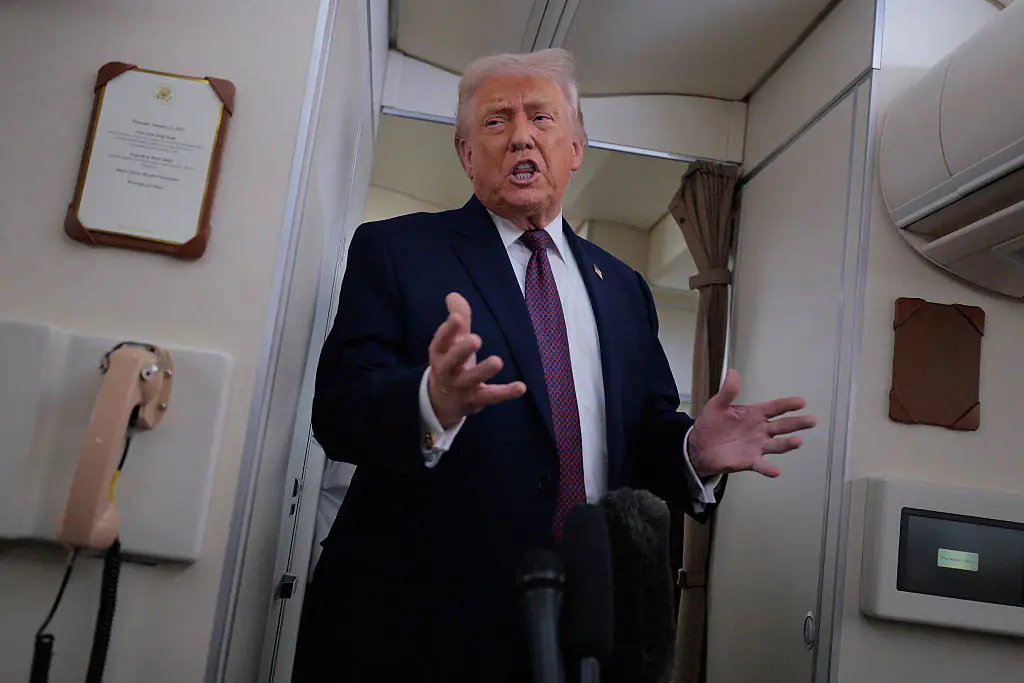
On June 30, the Supreme Court ruled 6-3 against Trump's executive order, concluding that it violates the Constitution.
Five justices, in a majority opinion written by Chief Justice John Roberts, found that the long-established understanding of the 14th Amendment makes almost everyone born in the United States a citizen.
"Citizenship, then and now, was the right to have rights - to freely participate in our political community. The framers of the fourteenth amendment extended that promise to 'every free-born person in this land'," Roberts wrote, per BBC News. "We keep that promise today."
Justice Brett Kavanaugh also wrote separately to say he believes the executive order violates federal law.
The ruling means children born in the United States to parents who are "unlawfully or temporarily present" remain "citizens at birth" under the Constitution.
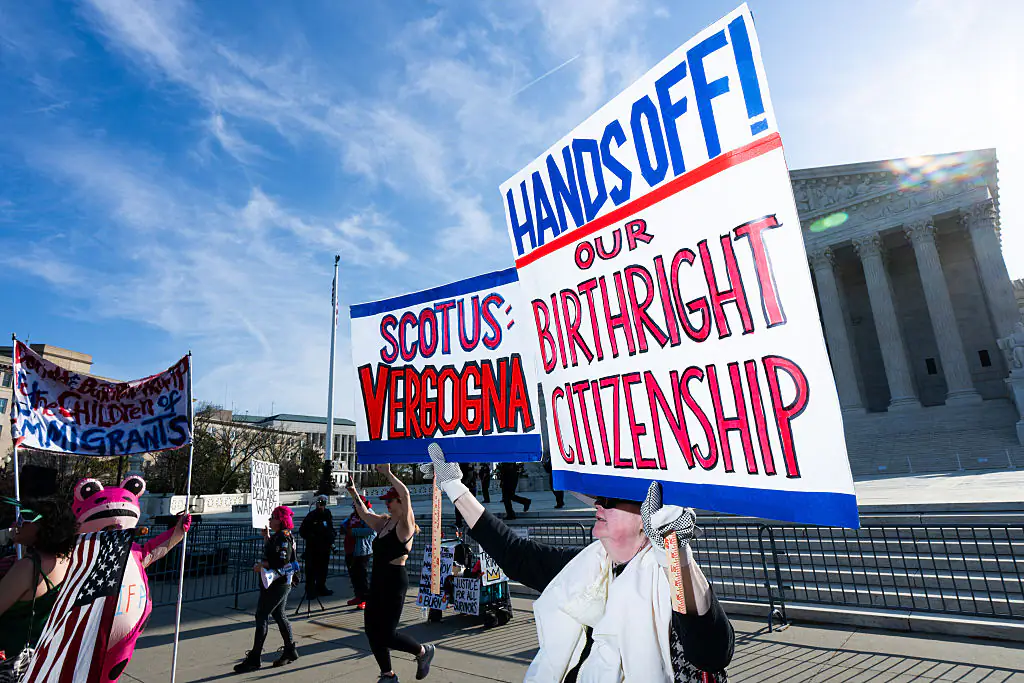
The president slammed the decision on Truth Social and claimed Congress could end birthright citizenship without changing the Constitution.
He wrote: "The Supreme Court upheld Birthright Citizenship, which is too bad for our Country, but we can easily make it up in Congress through Legislation, with the support of the President, that has now been determined during this process.
"No long and unwieldy Constitutional Amendment is necessary! Congress should start TODAY to work on ending expensive and unfair to our Country, Birthright Citizenship. They will have my Complete and Total Support!"
However, Congress cannot amend the Constitution through ordinary legislation as the New Republic explained: "A constitutional amendment requires a supermajority - two-thirds of both the House and Senate - to pass."
"Alternatively, the issue could technically be put to a constitutional convention, though two-thirds of states would need to support the motion to have one at all, and any proposed changes to an amendment would still require ratification by three-fourths of the states."
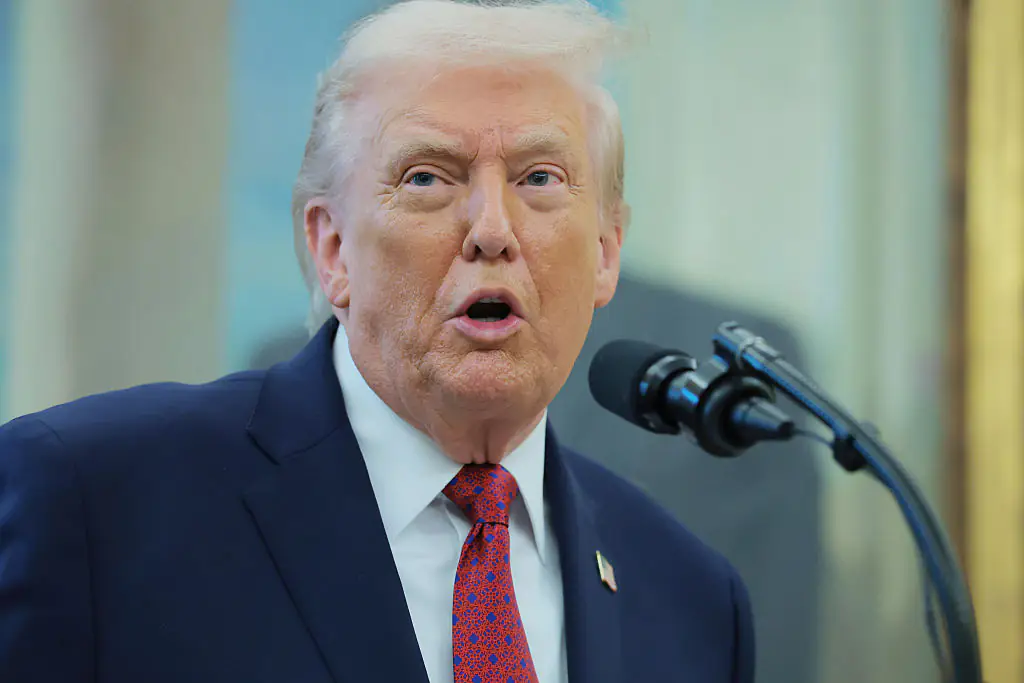
The Supreme Court's ruling prompted mixed reactions across the political spectrum.
White House Chief of Staff Stephen Miller, a long-time advocate of stricter immigration policies, called it "one of the most destructive and outrageous decisions" in the Supreme Court's history.
"American citizenship is not the birthright of the world," he said.
"No provision of the Constitution can be read to require our national self-obliteration."
Meanwhile, Hakeem Jeffries, the Democratic leader in the House of Representatives, said the Supreme Court had "finally affirmed that all persons born in the United States are American citizens," adding: "There is, and shall be, no question."
Dariely Rodriguez, chief counsel at the Lawyers' Committee for Civil Rights Under Law, also celebrated the outcome.
"The ruling solidifies what we have known to be true for over a hundred years," she said.
"Anyone born on American soil, regardless of the legal status of their parents, is born an American citizen.
"We have endured an incredible test of our collective will as a nation and have prevailed," she added.
us4 min(s) read
us4 min(s) read
us1 min(s) read
us4 min(s) read
us3 min(s) read
If Donald Trump ends birthright citizenship, it won't just affect illegal immigrants.
After taking office as the 47th president, the 79-year-old signed an executive order aimed at ending birthright citizenship.
Under the new order, children born to parents who are "unlawfully present" in the country or on temporary visas - such as tourist, student, or work visas - would no longer be eligible for US citizenship, Al Jazeera reported.
This is a major shift from the 14th Amendment, which has guaranteed automatic citizenship to children born in the U.S. since its ratification in 1868.
The most obvious group affected by this change would be children born to undocumented immigrants.
According to Pew Research, in 2022, approximately 1.2 million U.S. citizens were born to undocumented parents, but under the proposed order, these children would no longer automatically receive citizenship.
This could leave them unable to claim citizenship and possibly facing deportation with their parents.
Another group affected is children born to legal immigrants on temporary visas, including H-1B visa holders, tourists, students, and workers.
These children would also lose their birthright citizenship, denying them a benefit many families expect.
While this change would not directly impact children of US citizens born abroad - as they can claim citizenship through their parents - it adds to the ongoing debate about who should be considered a legitimate American citizen.
Critics worry this policy could lead to future restrictions on citizenship for children of U.S. citizens living outside the country.
Attorneys general from 22 U.S. states, many of them led by Democrats, have filed lawsuits to stop the order.
They have argued that birthright citizenship is enshrined in the U.S. Constitution and cannot be undone by presidential decree. "The president cannot, with a stroke of a pen, write the 14th Amendment out of existence," New Jersey Attorney General Matt Platkin said.
Connecticut Attorney General William Tong, a US citizen by birthright and the first Chinese American elected attorney general, added: "The 14th Amendment says what it means, and it means what it says - if you are born on American soil, you are an American. Period. Full stop.
"There is no legitimate legal debate on this question. But the fact that Trump is dead wrong will not prevent him from inflicting serious harm right now on American families like my own," he said.
The lawsuits also argue that the change would affect families who are already vulnerable.
The Supreme Court began hearing arguments in the birthright citizenship case on Wednesday (April 1).
According to The Independent, Trump attended the hearing and left in the middle of oral arguments. This marks the first time a sitting president has participated in Supreme Court arguments.
The justices will decide whether Trump can change who qualifies for American citizenship after he signed an executive order attempting to deny automatic citizenship to children born to certain immigrant parents.
Before attending the hearing, the president made his stance clear on Truth Social: "Birthright Citizenship is not about rich people from China, and the rest of the World, who want their children, and hundreds of thousands more, FOR PAY, to ridiculously become citizens of the United States of America. It is about the BABIES OF SLAVES!
"We are the only Country in the World that dignifies this subject with even discussion. Look at the dates of this long ago legislation - THE EXACT END OF THE CIVIL WAR!
"The World is getting rich selling citizenships to our Country, while at the same time laughing at how STUPID our U.S. Court System has become (TARIFFS!). 'Dumb Judges and Justices will not a great Country make!'" he added.
President Donald Trump’s aggressive deportation policy has hit a major legal wall after the Supreme Court ruled to uphold a block on his administration’s use of a centuries-old law not seen since World War II.
In a controversial move earlier this year, Trump relied on the Alien Enemies Act of 1798 — a law crafted when the US feared war with France — to deport over 200 individuals allegedly tied to the Venezuelan gang Tren de Aragua.
But on Friday (May 16), the Supreme Court delivered a crushing blow to the strategy, denying a request to clear a legal barrier stopping further deportations.
The Alien Enemies Act allows the president to detain or deport individuals from a nation considered hostile — but only if there’s a declared war or hostile incursion against the US.
Historically, it’s been used just three times: during the War of 1812, World War I, and World War II.
Trump invoked it to deport 238 Venezuelan nationals to El Salvador in March, where they were jailed in the notoriously harsh CECOT mega-prison. Despite a federal judge ruling against the order, the deportation flight went ahead. It has since emerged that some of those deported had not committed the crimes they were accused of, leaving them trapped in brutal conditions abroad.
The Supreme Court’s 7-2 decision keeps a temporary block in place, effectively preventing further deportations under the act for now.
In its ruling, per ABC News, the court slammed the administration’s rushed approach: "Under these circumstances, notice roughly 24 hours before removal, devoid of information about how to exercise due process rights to contest that removal, surely does not pass muster."
The decision marks the second time the court has sided against the Trump administration’s emergency deportation efforts. The case was brought forward by two unnamed Venezuelan migrants held in a Texas detention center. Trump had accused them — and others — of being members of Tren de Aragua, calling their presence an "invasion" linked to foreign terrorism, per Al Jazeera. But a recently declassified intelligence memo disputes that the gang is backed by the Venezuelan government.
In a separate opinion, Justice Brett Kavanaugh argued the issue requires urgent and final resolution:
"The circumstances call for a prompt and final resolution, which likely can be provided only by this Court."
Only Justices Clarence Thomas and Samuel Alito dissented, suggesting the court should have waited for a lower court decision before intervening.
The majority, however, emphasized the urgency: the government had already begun to move migrants to an airport in preparation for deportation on April 18, before returning them. The justices warned this risked "irreparable harm" and could place individuals "beyond [the Court's] reach" if deported prematurely.
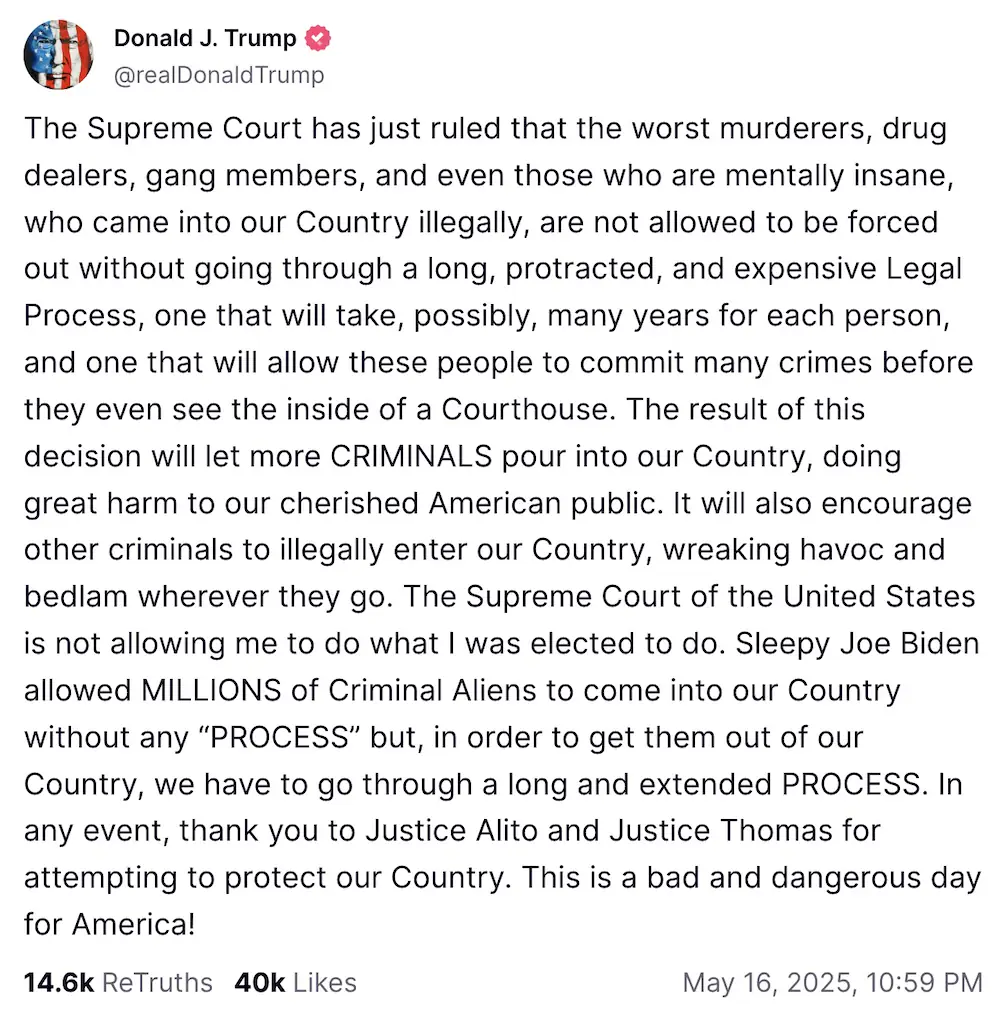
Trump didn’t hold back in his response, posting a pair of angry statements on Truth Social.
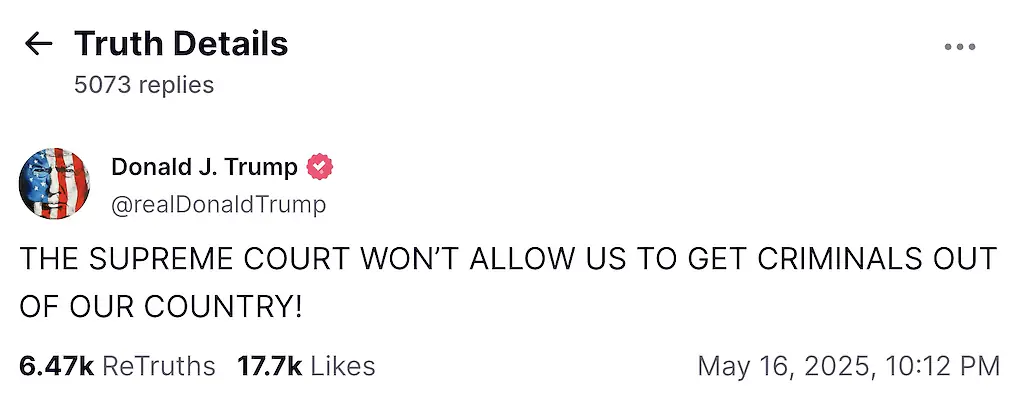
"THE SUPREME COURT WON’T ALLOW US TO GET CRIMINALS OUT OF OUR COUNTRY!" he fumed.
In a follow-up post, he blasted the decision as a threat to national security:
"The Supreme Court of the United States is not allowing me to do what I was elected to do," Trump wrote, claiming the ruling meant "the worst murderers, drug dealers, gang members, and even those who are mentally insane" couldn’t be removed without a drawn-out legal battle.
He warned the decision would trigger "a long, protracted, and expensive Legal Process, one that will take, possibly, many years for each person" and predicted “bedlam” as a result.
In contrast, the ACLU called the court’s move a necessary defense of due process and human rights.
"The court’s decision to stay removals is a powerful rebuke to the government’s attempt to hurry people away to a Gulag-type prison in El Salvador," said Lee Gelernt, deputy director of the ACLU’s Immigrants’ Rights Project.
He added: "The use of a wartime authority during peacetime, without even affording due process, raises issues of profound importance."
The US Supreme Court has ruled on Thursday (June 18), that the Trump administration cannot execute its plan to end the Deferred Action for Childhood Arrivals program (DACA), and has stated that it will remain in place.
The DACA program has allowed nearly 800,000 young people - referred to as "Dreamers" - to avoid deportation and remain in the United States.
Per NBC, the decision was autored mostly by Chief Justice John Roberts, and has been described as a huge legal defeat for President Donald Trump and his focus surrounding immigration.
Upwards of 652,800 people, including doctors who are fighting coronavirus on the front line, could be affected by the decision to remove the program, Deferred Action for Childhood Arrivals (DACA), the Guardian reports.
While the program did not present a pathway to citizenship, it did allow young people who grew up in the US without legal immigration status to obtain renewable two-year authorizations to live and work there.
The program was implemented by Barack Obama in 2012.
It's a popular policy and a Marquette University law school poll found that 53% of voters would oppose a decision by the supreme court to end DACA.
A Pew Research survey this month found that 74% of Americans were in favor of a law that would give legal status to undocumented immigrants who enter the country as children.
Trump appeared to be one of the most powerful Dreamer supporters.
Days after ending the program in 2017, he tweeted: "Does anybody really want to throw out good, educated and accomplished young people who have jobs, some serving in the military? Really!"
The Trump administration justified its decision to shut down the DACA because they claimed it was implemented illegally by Obama in 2012, forcing the courts to debate its legality.
President Donald Trump has planned to ban specific passports, and here's what you need to know about it.
Since reclaiming the presidency on January 20, Trump has wasted no time signing off on a storm of executive orders - about 200 of them - touching on everything from climate change and immigration to the LGBTQ+ community.
And one of those orders just sparked a serious legal showdown.
Titled “Defending Women From Gender Ideology Extremism and Restoring Biological Truth to the Federal Government,” the executive order declared that only two genders - male and female - would be recognized under U.S. law, per ABC News.
That means, according to Trump’s administration, trans and non-binary identities no longer legally exist.
And the ripple effects? They hit hard, especially for non-binary folks whose gender identity had previously been recognized on federal documents - most notably, passports.
Under President Joe Biden, non-binary Americans were able to mark an “X” on their passports starting in October 2021. But under Trump’s order, those “X” applications were frozen. In short: no more gender-neutral passports.
In an email obtained by The Guardian, Secretary of State Marco Rubio doubled down on the change: “The policy of the United States is that an individual’s sex is not changeable.” He added that documents like passports and consular reports of birth abroad must now reflect sex, not gender.
So, what’s new?
Here's the update that just turned everything on its head: A federal judge has officially blocked the ban.
US District Judge Julia Kobick didn’t hold back. According to The Independent, she ruled: “The Executive Order and the Passport Policy on their face classify passport applicants on the basis of sex and thus must be reviewed under intermediate judicial scrutiny.”
In short, if the government wants to enforce something like this, it has to prove that the policy is closely tied to an important governmental interest. According to Kobick, they failed to do that.
She continued, stating that the plaintiffs in the case have shown that the new rules “are based on irrational prejudice toward transgender Americans and therefore offend our Nation’s constitutional commitment to equal protection for all Americans.”
The lawsuit was spearheaded by the American Civil Liberties Union (ACLU), representing five transgender individuals and two non-binary plaintiffs.
Their legal argument is that the policy would prevent them from getting accurate identity documents.
Sruti Swaminathan, a lawyer for the ACLU, said: “We all have a right to accurate identity documents, and this policy invites harassment, discrimination, and violence against transgender Americans who can no longer obtain or renew a passport that matches who they are.”
But the Trump administration pushed back, claiming the policy “does not violate the equal protection guarantees of the Constitution.”
Their stance is that affected individuals can still apply for and use passports - they just have to use sex markers (male or female) instead of gender-neutral ones.
According to Trump’s team, the plaintiffs wouldn't be harmed by the gender restriction and could “travel freely.” Just not with a passport that reflects their gender identity.