On a side street in Brooklyn, the giant face of a woman looms over her surroundings. Covering the whole height of the building, she stares down, dignified and unflinching. Next to her is a simple message delivered in block capitals: “DO THE WORK TO UNLEARN YOUR SEXISM”. Her's is just one of hundreds of posters around the city and beyond, each featuring a real woman, each with a message reflecting her experience of street harassment: “You can keep your thoughts on my body to yourself”, or “Not your exotic fantasy”, and “I am not outside for your entertainment."The posters are part of a street art project, Stop Telling Women To Smile, which targets gender-based street harassment by allowing women to talk back to their abusers in a very public way. It was kickstarted in 2012, when Tatyana Fazlalizadeh, a New York-based artist, glued one poster to one wall in Brooklyn: “I started [the project] because I wanted to talk about my experiences with street harassment. It was my way of speaking back to my harassers,” she explained of the self-portrait adorned with the caption that would later become the project’s name.
[caption id="attachment_12346862" align="aligncenter" width="1280"]
Credit: Tumblr/Stoptellingwomentosmile[/caption]
In order to create her illustrations, Fazlalizadeh sits down and talks with women who have experienced street harassment - and there’s a pretty big pool to choose from, given that up to 85 per cent of American women and 90 per cent of British women say that they have experienced some kind of unwanted sexual attention in public by the time they are aged 17. After asking them what they would say to the people that harass them, she shoots their picture, draws their portrait and attaches the all-important message, which is sometimes a direct quote, sometimes inspired by the conversation. Usually pasting her creations in an area where the woman in question lives or has been harassed, the posters are unapologetically bold and intentionally public: “I thought it was important to talk about street harassment where it actually happens, in the environment. I put it outside in the street so I’m putting a face to these words. It’s not just ‘hey street harassment is bad’, you actually get to see this person’s face, this woman’s face who goes through this daily, and what she wants to say about it.” Five years after its inception, the project has extended to other cities across America including Chicago and Boston, as a result of a hugely successful Kickstarter campaign which saw the artist raise over $34,500. It has even reached beyond US borders, with visits to Paris and Mexico City to tell the stories of women in these locations. While still predominantly focused on women, it has grown to cover the experiences of transgender, queer and disabled individuals too, as well as discussing wider expectations of what it means to be "American".
[caption id="attachment_12346864" align="aligncenter" width="1280"]
Credit: Tumblr/Stoptellingwomentosmile[/caption]
Stop Telling Women To Smile has not been without some controversy, however. Many of the posters have been vandalised; defaced with penises, scrawled with messages such as "#deathtofeminism" or “Men Too”, or torn down completely. This is not unexpected or surprising - let’s be honest, none of these are exactly witty or new - because those who do speak out against sexual harassment are often met with criticism from those who perpetrate or tolerate such actions. Fortunately, Fazlalizadeh has little time for these attitudes: “Most of the backlash does not come in the form of critical analysis of how this work can be better. It comes in the form of people calling me a man-hater and drawing d*cks on the faces of the posters. When people deface these pieces with gendered insults and phallic imagery, it’s only reinforcing the point of the work - abuse against women - thereby fuelling the cause,” she said on the project’s official Tumblr blog.Others have also expressed discomfort with the fact that a key feature of the project is that it heavily features black women and, by extension of the placing of the posters, has been seen as critical and criminalising of black men. Writing again on Tumblr, Fazlalizadeh remained defiant, explaining that the reasons behind this are feminist - about giving a voice to black women - rather than racial: “As a black woman who runs this project, I have a particular view on this. The truth is that I am mostly harassed by black and brown men ... To think that black men are the only ones who participate in this is ridiculous. But they do participate. And here’s what happens when black women say that we receive harassment from black men: we’re accused of betraying the race and contributing to a society that already criminalises black men. Surely black women can talk about how black men are criminalised in many ways in society while also being honest about our own reality?"
[caption id="attachment_12346913" align="aligncenter" width="800"]
Credit: Tumblr/Stoptellingwomentosmile[/caption]
With an ever-growing following, Stop Telling Women To Smile now has a small army of volunteers and partner projects to collaborate with. And major media networks are getting in on the act too. In November 2015, Netflix created their own version, where women from around the world upload photos of themselves to the project’s website, each with their own “My Name Isn’t” message reflecting the catcalls they’ve received in the street; the gallery features everything from “My Name Isn’t 'B*tch'” to “My Name Isn’t 'Big Girl'”.No matter the controversy of the project, its following and support only serves to highlight that there is truth to it: how often do guys get told to “give us a smile” in the street? It might seem like a small, innocuous comment, especially compared to some of the more “choice” catcalls or rape threats, but it’s ultimately about the ownership of actions and of bodies. As Fazlalizadeh puts it in the online caption to the UNLEARN YOUR SEXISM illustration: “Choose to see women as subjects, not as objects”.
Nearly every woman I have spoken to – myself included – has experienced street harassment. The catcalls, jeers and prolonged stares have become something we expect while carrying out simple, everyday tasks, such as commuting to work and doing the grocery shop.
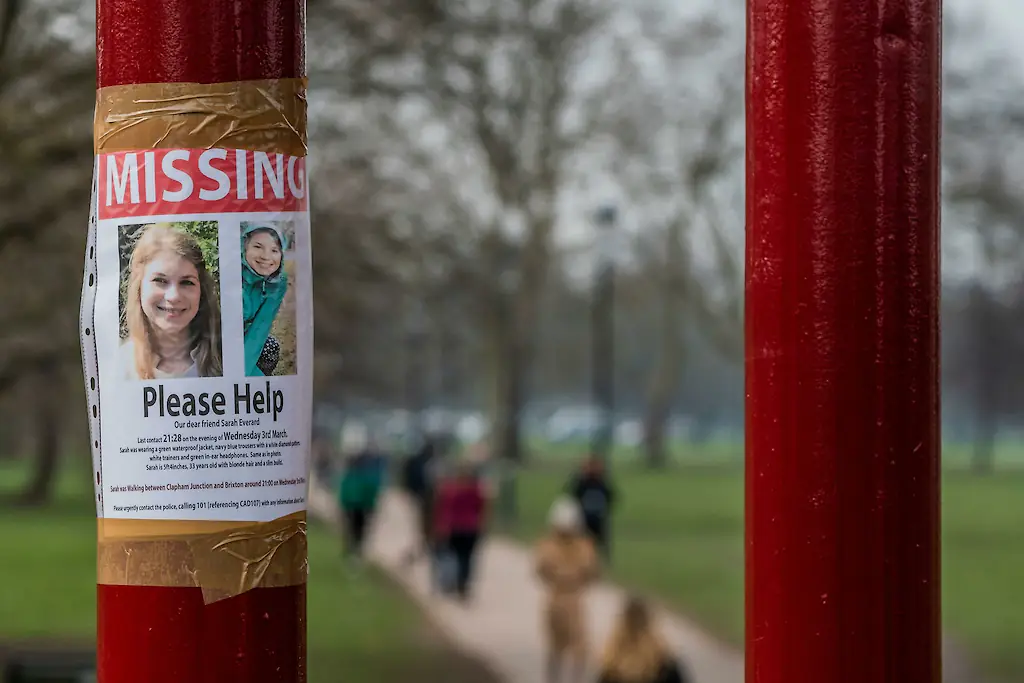
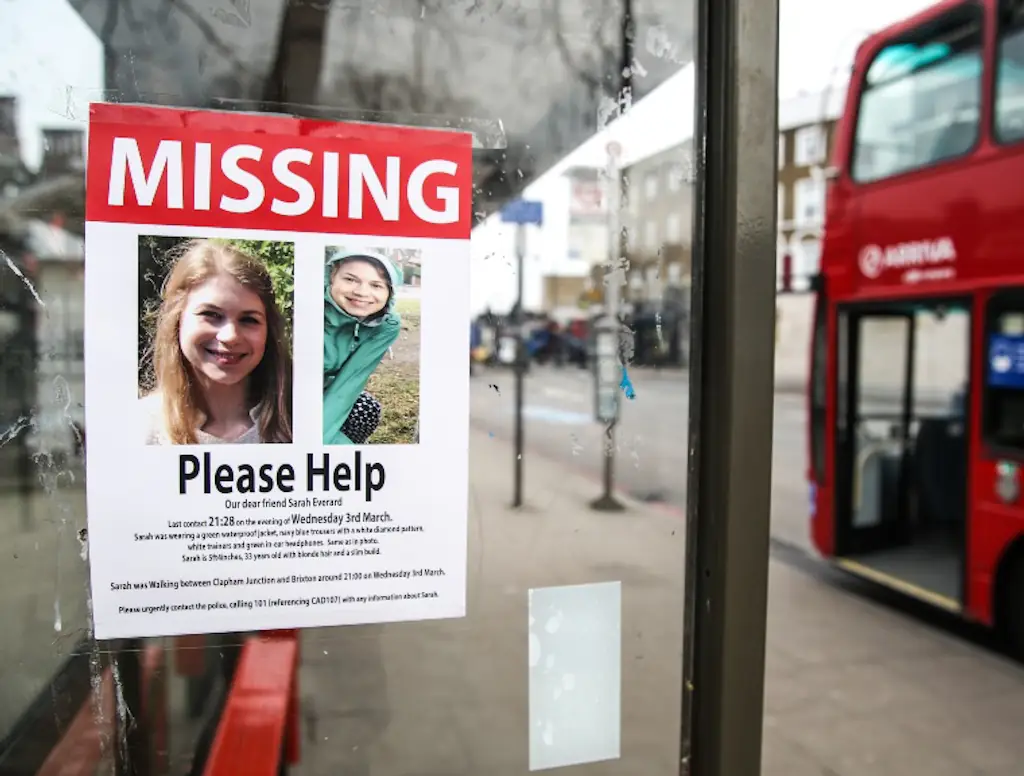
Recently, one woman was murdered while attempting the most ubiquitous of activities; walking home from a friend's house. Since the disappearance of Sarah Everard on March 3, a spotlight has been shone on women's safety in public – or the lack thereof.
The impact that this continued harassment from such an early age can have on women is concerning. "When we are attacked, shouted at, or abused, we can then shame ourselves," psychotherapist, Abi Jude, BA (Hons) MBACP, tells VT.
Pictured are signs in Clapham Common, London, for Sarah Everard, who went missing on March 3rd (Credit: Alamy)
Young girls, especially, can grow into women who "form themselves bodily to not take up space," she continues. "If you're walking past a group of men who are particularly noisy, you may shrink a bit, and look at the floor.
"This will also affect your self-esteem – it sends a message that you need to alter yourself to fit into a male world. You're literally squashing yourself, instead of being expansive and feeling confident as a woman."
On the same day that Everard's body was found, U.N. Women U.K. released a damning survey that revealed that 97 per cent of women said they had been sexually harassed in public. It's a sobering statistic, but one that doesn't become fully humanised until you listen to the lived experiences of women, and the impact it can have on everything from their mental wellbeing to the places they choose to live.
Here, to raise awareness of this growing issue, three women bravely share their experiences of street harassment with VT, and how it's affected their mental health.
Street harassment can have a devastating impact on women's mental health (Credit: Pexels)
Meriem's story
Mariem Mahdhi – who spends her time living between Italy and England – has experienced street harassment in both countries. Opening up about her experience in London, she tells me she was forced to move to a different area of the city because of the continued harassment she would endure while travelling home after working late nights.
Recalling two instances, the 22-year-old says: "There was a man who tried to speak to me every morning, and when I stopped replying he would just shout at me until my neighbour would come outside. Another time, when I was leaving work around 2 AM, a man started harassing me, and all I could hear was the word 'blowjob'.
"I try to have a strong reaction or ignore them, but sometimes, when it happens more than once, I just go home and cry – because it's a lot. It's not just London where women are being followed at night – it's a worldwide emergency. Before, I used to enjoy going outside for walks at night, but I don't like it anymore. Nobody is stopping these people, so why would I risk my life for a stroll?"
Meriem's experiences began young, when she was seven-years-old. The second incident coincided with the first time she was allowed outside alone. "There was an old man, he was whistling and shouting stuff at me. And from that time, I stopped counting. It became normal – something that you would just try to erase from your brain."
Pictured is 22-year-old Mariem Mahdhi who currently lives in Italy
Ez's story
The same goes for Ez Dyer who tells me that an older man attempted to "entice" her when she was eight. "It's been constant since then," the now-41-year-old says.
When Ez was in her early twenties, a group of middle-aged men got physical with her and her girlfriends in a bar. "We were just dancing and having a good time, and these men, who must have been over 50 with wives and kids, decided they could harass and grope us," she says.
"I confronted them but they did it again – so we went at them. They didn't care, and started attacking and pushing us. It went out onto the street before a few people jumped in. They later came and apologised, saying, 'we thought you were out of towners, so we could try it'."
Until there is a tangible change, Ez says that she's going to ensure that her young nieces receive self-defence training. "I'm forever telling my brothers and sisters to get their girls prepared for the future, because it won't be going away soon, despite all the progress we're making. I still feel like I need to get the next generation prepared. It's really sad."
Street harassment must, of course, be put into its appropriate context, Abi stresses, as it's systemic, and affected by class and race. She does, however, encourage all women to share their experiences with someone they trust, whether it be female friends, a trusted family member or a significant other. "It can be incredibly empowering and affirming."
Ez Dyer, 41, is the founder of Ez Dyer Skincare (Credit: Supplied)
Eleanor's story
Just before our conversation, 25-year-old Eleanor* tells me that she had a man in a van beep at her as she was walking past. She was wearing a t-shirt, jeans and a jacket. "I know it's terrible that I even need to bring up what I'm wearing because I shouldn't have to justify that," she tells me.
Between the ages of 16-19, this treatment – which began while she was still in school uniform – made Eleanor "very insecure" about her sartorial choices. "Going out became a real issue as I'd be overthinking about what I was wearing in case I got comments," she says.
"There are so many stories like that between me and my friends, and it's continued till today. Sometimes it will be shouting out the car window, or a guy stopping his car, and saying things, which can be intimidating. I've started fighting back, but that's normally met with laughter. One time two guys got really angry. It was scary afterwards as I was worried they would drive around and find me. I even considered changing my route home, as it wasn't far away from where I lived. I'm just always so hyper-aware."
Anyone can contact Samaritans FREE any time from any phone on 116 123, even a mobile without credit. This number won’t show up on your phone bill. Or you can email [email protected].
A woman has gone viral on TikTok for her response to getting "catcalled" in New York City.
TikTok user Beki - who goes by the handle @rebekahlindsayyyy on the social media platform - posted a video of herself walking in NYC.
On her stroll, a man tells her: "I hope you have a good day at work, miss." She pretends to not hear him and says: "What?"
The man repeats his initial statement and then she responds: "Oh, I thought you were begging for money or something." As she walks off, his friends can be heard laughing in the background.
Check out her TikTok below:
Beki captioned the video: "Gotta protect yourself on the streets of NY." She has garnered a lot of attention from users on the platform. The video has been viewed over 4.8 million times and currently has 876.6K likes.
After posting the video on the social media platform, users loved Beki's excellently timed clap back and quickly flooded her comment section with praise.
One person said: "This is iconic."
While another added: "She knows how to NY."
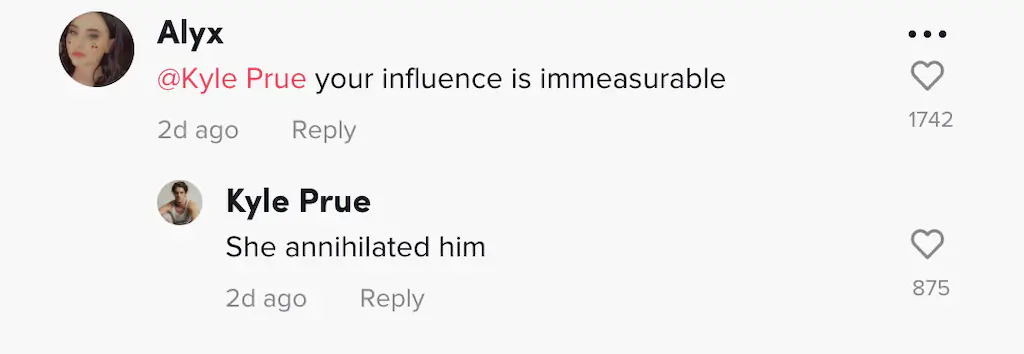
Kyle Prue, a TikToker known for his series of videos on things you can say to "upset" men, was tagged in a comment that said: "I don’t know you but I’m proud of you."
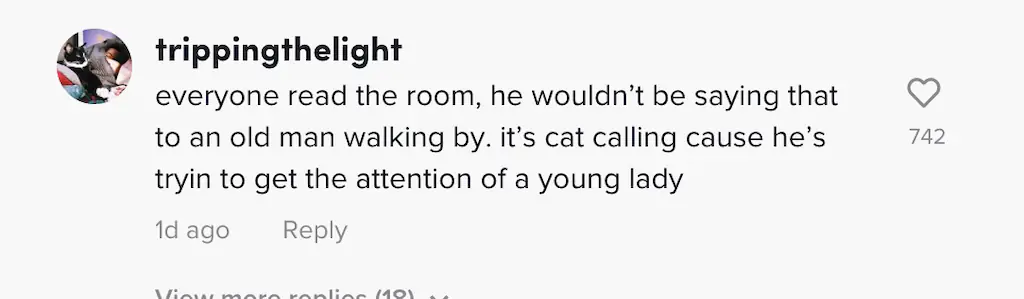
One person explained why it's still catcalling - even if he was being nice: "Everyone read the room, he wouldn’t be saying that to an old man walking by. it’s catcalling cause he’s [trying] to get the attention of a young lady."
Credit: TikTok
Credit: TikTok
Credit: TikTok
Credit: TikTok
Credit: TikTok
While this lighthearted video made many people laugh, it also brought attention to an important issue known as street harassment.
According to a study done by Stop Street Harassment, 99% of women have reported experiencing harassment on the street in their lifetime. This study deemed behaviors such as leering, honking, whistling, and verbal harassment as examples of street harassment - alongside more dangerous ones, like being followed, assaulted, or physically touched.
So heads up, next time you consider catcalling a woman, just remember these points: they probably don't want to be spoken to and they might film the moment and go viral.
A woman has shared the bizarre technique she uses to deter unwanted male attention in public.
TikTok user @gabin.sarah took to the social media site to share how she keeps herself safe from any potential predators.
At the time of writing, the unusual technique has been liked more than 1.8 million times.
The viral TikTok is captioned: "technique pour faire fuire un homme", which translates to "technique to make men run away", and it features a woman standing at a train station as a man approaches her.
Watch the viral TikTok below:
The video shows the woman not willing to talk to the mystery man.
But while some women may have chosen to stay quiet and stand at the platform awkwardly, this woman moves towards the man
In the video, she is not willing to talk to the man, but instead of standing there awkwardly, she moves towards and unleashes a demonic scream in his face before quickly running away.
While it's not known if the man was set up into engaging with the woman, it seems to be an effective way of repelling any unwanted attention.
Social media users couldn't help but praise the woman's clever way of not engaging in unwanted conversations.
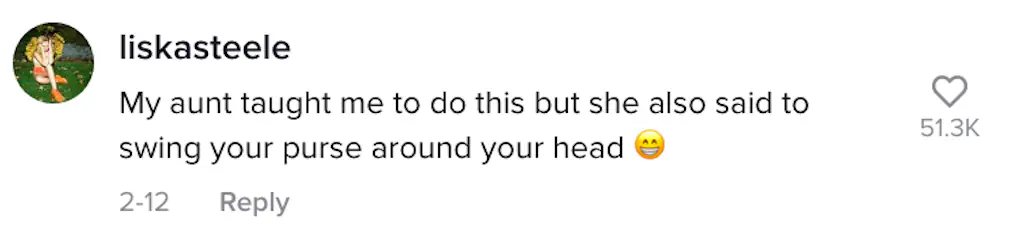
Reacting to the video, one TikTok user wrote: "My aunt taught me to do this but she also said to swing your purse around your head."
Credit: TikTok / liskasteele
A second wrote: "YAAAS QUEEN. get them scared [sic]."
Credit: TikTok / Julian Moncada A
A third similarly added: "YES! LET THEM HEAR YOU ROAR!"
Credit: TikTok / billiewright25
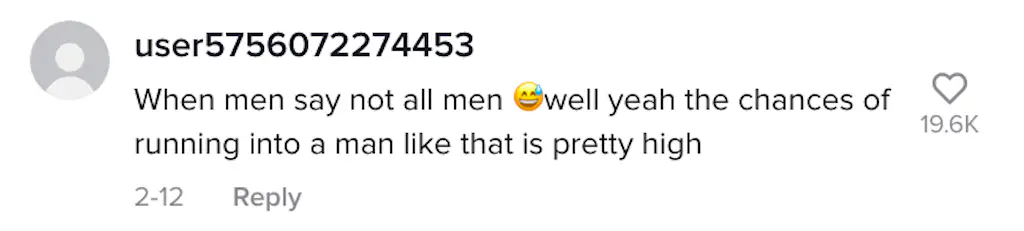
Meanwhile, a fourth pointed out that this technique really is worth knowing as it will most likely come in handy, writing: "When men say not all men. Well, yeah the changes of running into a man like that is pretty high."
Credit: TikTok
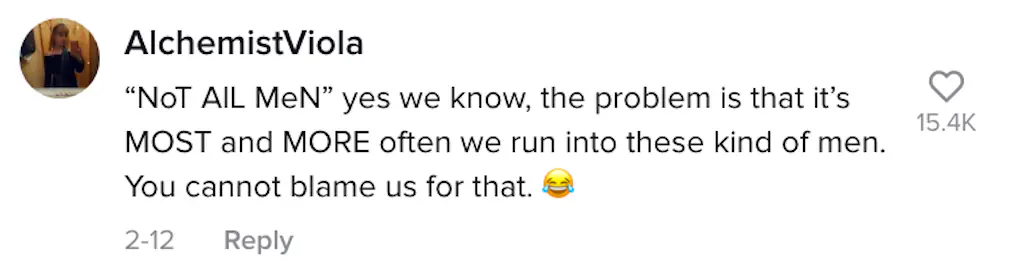
Another TikTok user added: "'NoT AlL MeN' yes we know, the problem is that it's MOST and MORE often we run into these kind of men. You cannot blame us for that."
Credit: TikTok / AlchemistViola
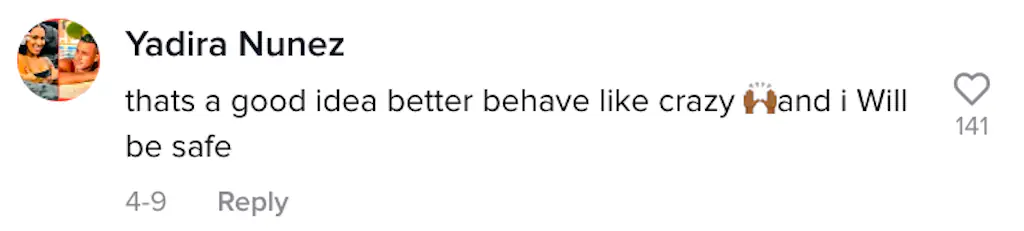
In a nutshell, if you act crazy, you are more likely to be safe.
As this TikTok user wrote:
Credit: TikTok
What do you think of the bizarre safety technique?
In the wake of various sexual harassment scandals coming to light in Hollywood, many people have been asking why incidents aren't reported more often.
The answer to that question is obviously very complex, and will vary from case to case. However, in a vast majority of incidents, people tend to stay quiet about cases of abuse or sexual assault because they feel powerless against the perpetrator, and the trend of victim-blaming further deters individuals from coming forward with their stories.
That being said, sometimes people to find the courage to stand up against their attackers - as demonstrated by one bizarre incident in Brazil.
Footage of the incident, which shows a young woman pinning down a man who had been harassing her, first garnered a lot of attention when it was posted online last year. Due to the somewhat explicit nature of the video, it had to be taken down, but - because of the recent interest in sexual harassment cases and how common they can be - the clip has re-emerged.
During the minute-long video, the woman can be seen hurling abuse at a man on the floor. Allegedly, she had been handing out flyers, and the man had continued to harass her while she was trying to do her job. After becoming impatient with the harasser, she pushed him to the ground and pinned him with her foot, saying, she had been "touched and sexually harassed while just doing her job."
But that was only the start of it.
While on the ground, the alleged assailant claims that he did nothing wrong, and tells her he was simply out shopping with his wife.
However, the woman is having none of it, and shouts: "I'm fed up being treated like a sex object. Is it boobs you want?"
Then, in front of a fair-sized crowd, she suddenly whips off her shirt and pulls down the top that was underneath it, exposing herself not only to the man, but also to everyone who had gathered to witness the scene. That alone would have been a statement enough, but she wasn't done quite yet.
In a surprisingly intimidating fashion, the woman then clambers on top of the man and begins whacking him around the face with her bare chest - an ordeal which he obviously does not enjoy at all.
People who observed the bizarre interaction had mixed opinions on the woman's choice to strip down and literally smack the guy in the face with her breasts, with some thinking that her actions were courageous, and others believing that they were downright inconsiderate to everybody else present.
One woman can even be heard shouting from the crowd: "This is absurd, there is no justification for doing this. How can you do this in front of children in the city centre? You're disrespecting women with your actions."
Ironically, her words are arguably more befitting of the assailant than the woman - but that was the whole point of the scene: to show how women are held to different standards to men, and to educate people on the importance of respecting women and their space.
Yes, unfortunately (or perhaps, fortunately) the whole incident was staged by a theatre company to highlight how inappropriate it is to make sexual advances to somebody who clearly does not want them.
Fausto Ribeiro, the director of the group who created the performance, said:
"We wanted to expose and address something that happens every day to our sisters and female friends.This was meant to challenge people's perceptions and empower women with the shock tactic of retaliation. We wanted to force men to think more responsibly about their actions and the consequences."
A recent YouGov poll found that 97% of women in the UK between the ages of 18-24 have experienced sexual harassment.
With the tragic death of Sarah Everard sending shockwaves throughout the UK and beyond, people are now speaking out about the importance of the '#NotAllMenButAllWomen' movement on social media.
While many men rightfully point out that they are not all guilty of predatory behavior, as the YouGov poll shows, the overwhelming evidence is that almost all women are victims.
Credit: PA Images
Over the last week, women have taken to social media to reveal how they have been conditioned to text friends and family that they have arrived home safe; to cross the street when they sense the slightest bit of danger, and to outright ignore it when strange men tell us to smile or become aggressive when we reject their advances.
And now, many social media users are speaking out and sharing their personal experiences using the hashtag '#NotAllMenButAllWomen' to communicate the message that women do not feel they are safe on our streets.
This comes just hours after the human remains found in a Kent woodland were confirmed to be that of Everard by Metropolitan Police.
Credit: PA Images
The hashtag was a direct response to a '#NotAllMen' hashtag that started trending on Twitter earlier this week.
However, as one social media user explains, "All that the #Notallmen hashtag does it to dismiss the experiences of women and girls who have faced sexual violence or harassment."
They continue: "Of course we know that not every man is responsible but it is important to discuss misogyny and to amplify women's voices. #notallmenbutallwomen"
This is something I can also attest to as a woman in my twenties; I don't know a single other female who has not been sexually harassed or assaulted.
Actor Simon Pegg took to Twitter this morning to share a short video in which he says: "It seems to me that women are constantly given the sort of guidelines to avoid being sexually harassed that families are given when they drive into a safari park.
"Except the difference is, the world is a safari park where you could actually tell the monkeys to stop being f*****g a***holes."
And one Twitter user shared a predatory message she received from a man after she simply ordered a pizza:
A second wrote: "16. Sexually assaulted on the sofa in my own living room. Are you saying I shouldn't have [fallen] asleep in the safety of my own home? #notallmenbutallwomen"
A third added: "18: intoxicated/passed out. Boy from school climbs into bed with me. Spread I 'wanted it'. I was asleep.
"19: grabbed in the street, man fondled my parts. I stood frozen.
"22: attacked in my home. He had to be pinned down to get off me. I am 1 of many.#notallmenbutallwomen"
A fourth wrote: "It might not be all men, but it is all women. Every single [woman] can tell you of a time they have felt uneasy, they have held their bag a little closer, have gripped their keys a little bit tighter and have felt that racing heart. #notallmenbutallwomen I just want to walk home."
The importance of the hashtag was summed up by author Julie Cohen who wrote: "I will say it is extraordinary how many men think that they will convince women that men aren't dangerous by disbelieving them and yelling abuse at them. #notallmenbutallwomen"
Cohen continued: "I've blocked over 100 people in the past few hours and will keep on blocking anyone who not-all-mens me. Trying to force women to justify their experiences to you is yet another form of male violence."
The death of Sarah at just 33 has been an unwelcome reminder of the fact that women are not safe, regardless of whether they are outside or in their homes.


.jpg_I4Ebof?tr=cr-0.338.2730.3068,f-webp,q-70,w-100)











.jpg_I4Ebof?tr=cr-0.338.2730.3068,f-webp,q-70,w-1024)


