ADVERT
US2 min(s) read
The FBI has issued a warning to all phone users to stop using free public charging ports.
Many people are used to just plugging in their devices to charge whether they're getting ready to travel at an airport or sitting down to work at a coffee shop.
It's easy and, best of all, free, but it may carry more danger than you think.
New guidance from homeland security has thrown up serious concerns about hacking that may put you at risk.
The US domestic intelligence and security service have warned the public that hackers have now grown more calculating with how they plan to put malware in your devices.
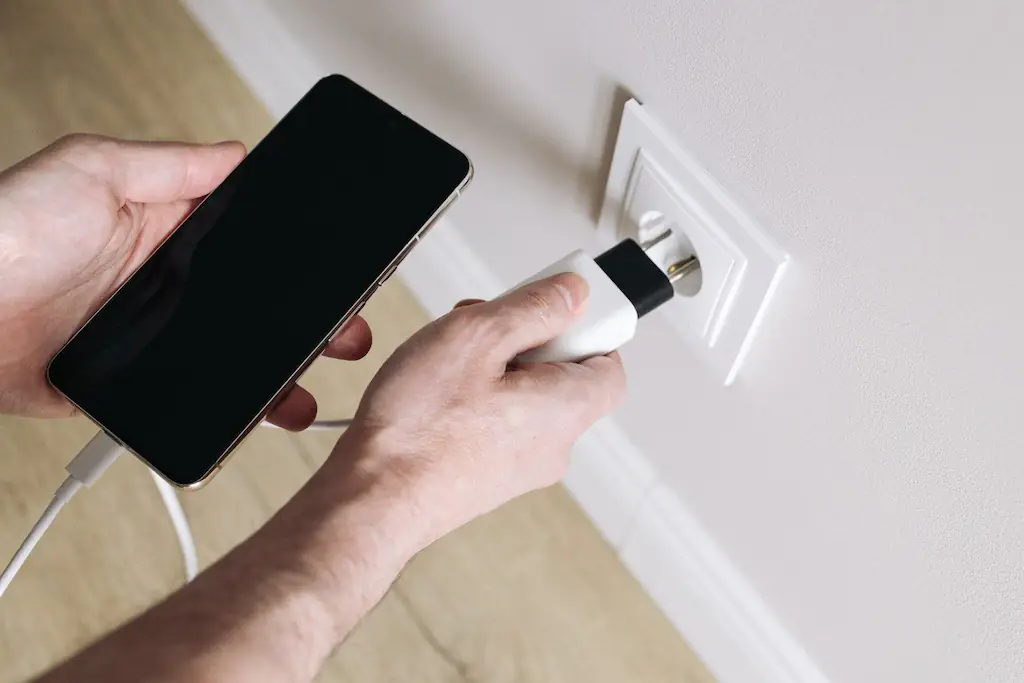
Plugging your phone into a public charging port could mean that these same hackers are able to infect your device with malware and tracking software.
The Denver branch of the FBI issued a public statement saying: "Carry your own charger and USB cord and use an electrical outlet instead."
Cybersecurity experts told Sky News that there are two main methods hackers use of "jacking" the public USB ports you can use to charge your phone.
The first is known as "juice jacking" where criminals can load their malware into the systems of the public charging ports so they can access your device while you're charging it.
Once this malicious software is inside your device, the hackers can then steal your account credentials and other important financial data.
The second is called "video jacking," where the hackers actually plant hidden video equipment in a compromised charging port to record you.
With this footage, they can then screen what you're doing on your phone; which means they'll be able to see who you're messaging, any bank account information you might access and, crucially, your passwords to important accounts.
Muhammad Yahya Patel, lead security engineer at Check Point, told Sky News that public charging ports are a hotspot for hackers because they're very rarely checked, if ever.
"That's what criminals are tapping into and relying on," he explained. "It's really important to be aware - and yes, it's definitely good advice to avoid public USB charging ports altogether."
So the next time your phone is running out of charge and you've stopped to charge it at a public charging port... maybe think twice before plugging it in. You stand to lose a lot more than you gain from a fully charged phone.
innovation2 min(s) read
science & tech3 min(s) read
us2 min(s) read
innovation4 min(s) read
health3 min(s) read
Waking up to a fully charged phone may feel like a productive start to your day, but according to Apple, charging overnight could be extremely hazardous.
The tech giants have been warning against the dangers of sleeping next to your iPhone. So for those of you who don't fancy missing a single notification or middle of the night call or scroll, you might want to pay particularly close attention to this.
In a PSA, Apple have warned against topping up your phone's juice overnight as charging could "result in fire, electric shock, injury, or damage to iPhone or other property."
Not only that, but falling asleep with your phone in your hand is an even bigger risk if it means your device is going to be left "under a blanket, pillow, or your body."
Credit: Justin Sullivan/GettyAir flow is the key in these situations, with the phone's charging port requiring a "well-ventilated area when in use or charging" to avoid overheating and potential fires.
Apple's main message when it comes to charging risks and how to negate them is, "Don’t sleep on a device, power adapter, or wireless charger, or place them under a blanket, pillow, or your body, when it’s connected to a power source.
"Keep your iPhone, the power adapter, and any wireless charger in a well-ventilated area when in use or charging."
The tech company's statement concludes, "Take special care if you have a physical condition that affects your ability to detect heat against the body."
This wasn't the only advice the iPhone overlords wanted to share with customers, however. Apple also wanted to share some notes on the charging cable that comes with your phone as well as the USB power adaptor that can be bought separately.
If you lose your charging cable, Apple suggests replacing it with a "Made for iPhone" or third-party cable and power adapters that are "compliant with USB 2.0 or later."
Apple also recommends that the charger should also have "applicable country regulations and international and regional safety standards". So if you're thinking of seeking out a bargain and buying a cheap charger to save a few bucks, this could mean the charger doesn't "meet applicable safety standards, and charging with such adapters could pose a risk of death or injury."
Credit: Sean Gallup/GettyOther tips that can help users prevent "fire, electric shock, injury, or damage to iPhone or other property" include obvious advice such as avoiding moisture, "metallic cases and metallic foreign objects touching the charger", always charging with your device face up and not using damaged cables or chargers.
Science-wise, there are also a few good reasons not to be strapped to your phone in the middle of the night. Research shows that blue light emitted by the screen inhibits the production of melatonin, the hormone that makes you feel sleepy, meaning your 2am doom scroll might actually be making it more difficult for you to fall asleep.
Health advises to to limit screen time overall, not using your phone in the bedroom at all and, if you absolutely must, switch it to night mode.
Millions of Americans gearing up for holiday shopping are being targeted by a dangerous scam that could wipe out their bank accounts, according to a new warning from the FBI.
As the Christmas season pushes people to snap up last-minute gifts online, scammers are working overtime to exploit the rush. The FBI says Outlook and Gmail users are at particular risk, with fraudsters focusing on these email providers because they make up about 90% of all personal and business accounts.
The federal agency is warning that fake websites and convincing emails are being used to lure people into handing over personal banking details, with one click potentially draining entire accounts. The scam is so widespread that festive fraud has ballooned into a billion-dollar global business.
The FBI is asking the public to be extra cautious when shopping online during the holidays. In a clear message, they said: "As you shop this holiday season, beware of deals that seem too good to be true! Scammers are out in full force."
With fraudsters using increasingly sophisticated tricks, including malicious PDFs that infect your device with viruses, the FBI advises against clicking any suspicious links or attachments in emails, on websites, or via social media. Phishing scams often trick users into revealing personal information such as passwords and bank account numbers.
Another red flag? Companies asking you to update your password or payment info via email. The FBI recommends verifying such requests by independently looking up the company’s official phone number and calling them directly.
Scammers are not just lurking in inboxes. Fake online stores and dodgy sellers are also common traps, designed to steal your money without ever delivering a product. To stay protected, the FBI recommends always using a credit card for online purchases so you can get your money back in case of fraud.
They also urge shoppers to be vigilant when buying from a business or seller for the first time. Key tips include checking the website's URL for legitimacy and reading reviews. Sellers without feedback are more likely to be fake.
On top of that, the FBI is urging everyone to avoid paying via wire transfers or pre-paid gift cards. "In these scams, a seller will ask you to send them a gift card number and PIN. Instead of using that gift card for your payment, the scammer will steal the funds, and you’ll never receive your item," the agency warned.
You can find more holiday scam prevention tips on the FBI’s official website.
Security experts have issued a warning to iPhone users that they need to turn three settings off immediately.
If you're anything like me, then you never read the terms and conditions when getting a new phone; you just click accept and get cracking.
You probably also never check the settings that are on by default because you're too busy getting excited over the new features.
But we might be leaving ourselves vulnerable to hackers, so what settings should we be switching off?
Well, per Forbes, the NSA has given some guidance.
1: The Hidden Dangers of Wi-Fi and Bluetooth
Having Wi-Fi and Bluetooth turned on at all times might seem convenient, but it could be a major security risk.
When your iPhone is constantly searching for available networks, it can automatically connect to a rogue hotspot controlled by hackers. Once connected, cybercriminals can intercept your data, steal passwords, and even install malware on your device - sometimes even after you’ve disconnected.
These attacks are most common in public places like coffee shops, restaurants, and hotels, where hackers disguise their rogue networks by naming them after legitimate businesses. The National Security Agency (NSA) calls this trick an "evil twin" attack.
Cybersecurity firm Kaspersky warns that these types of attacks are one of the biggest threats to free Wi-Fi security. “So instead of talking directly with the hotspot, you’re sending your information to the hacker, who then relays it on,” they explained.
Your iPhone tracks your location constantly, but did you know that allowing apps to access your location “at all times” could be giving hackers a detailed map of your daily routine?
3: App Tracking: Is Your Phone Listening to You?
Ever had a conversation about a product, only to see ads for it moments later? It might feel like your phone is listening to you - but in reality, it’s tracking everything you do.
Apps constantly gather data, including your name, email, device ID, and browsing habits, and then share this information with advertisers. This allows them to build a detailed profile about you, leading to eerily accurate targeted ads.
Luckily, Apple has a built-in feature called App Tracking Transparency that lets you see which apps are collecting data about you - and stop them.
It's always better to be safe than sorry!
Masturbation is a key aspect of exploring sexuality, but some have taken it to the extreme, with the use of hands-free masturbation devices that have experts concerned about safety.
The conception of hands-free technology was quite the phenomenon when it was launched in 1999, allowing drivers to circumvent laws that prohibited them from being on the phone while at the wheel.
While keen masturbators won’t be able to benefit from such a legal bypass, for it is illegal to be masturbating behind the wheel of a vehicle, whether it is hands-free or not, this new technology might just accommodate those with stronger propensities towards sedentary lifestyles.
Electro play, sometimes referred to as erotic electrostimulation or e-stim, incorporates electricity to stimulate those sensitive areas of the body with specialized equipment.
According to enthusiasts, electro play is generally much safer and more focused on sensation and enjoyment than many people expect when self-pleasuring.
Users are able to control the intensity and experience according to their comfort level, which uses low-voltage electrical currents to create physical stimulation.
Speaking to Metro, sexologist Becky Crepsley-Fox described the practice as: “E-stim is a sexual practice popular within BDSM communities that uses low-voltage electrical currents to stimulate nerve and muscle endings, creating heightened sensation throughout the body.”
Although it may sound intimidating, e-stim does not involve electricity from household power outlets. Instead, participants use specially designed devices that safely deliver controlled electrical pulses.
Crepsley-Fox explained that common equipment includes a shaft ring, similar to a c**k ring, which sends mild electrical pulses through the penis and is connected to a dedicated stimulator.
She added: “There are also adhesive pads to attach to your testicles, or insertable toys for both anal and vaginal use.”
She further explained how setups can vary, saying: “A typical set-up might place a loop around the shaft and a second contact on the perineum or inner thigh, allowing current to travel through a highly sensitive pathway. Vaginal users might combine a probe with an adhesive pad placed above the pubic mound.”
However, experts warn that e-stim is not without risks. According to Crepsley-Fox, placing electrodes too high on the body can be dangerous. “Placing pads too high on the body can cause cardiac disruption,” she said, adding that “Anyone with a heart condition or epilepsy shouldn’t try e-stim.”
Safety guidance from electrosex communities generally recommends keeping stimulation below the waist, as electrical currents near the head or neck can increase the risk of seizures. People with pacemakers are also advised against the practice because electrical pulses may interfere with the device's operation.
Crepsley-Fox noted additional risks, including “muscle spasms, nerve damage, and electrical burns.”
While e-stim remains a relatively niche practice, experts stress that anyone interested should understand the potential risks, use equipment specifically designed for electrostimulation, and follow safety guidance carefully.
While exploring new sexual practices is often exciting, the prospect of electrocuting one’s own genitalia in the process certainly isn’t.