ADVERT
US2 min(s) read
Published 13:24 29 Jun 2026 GMT
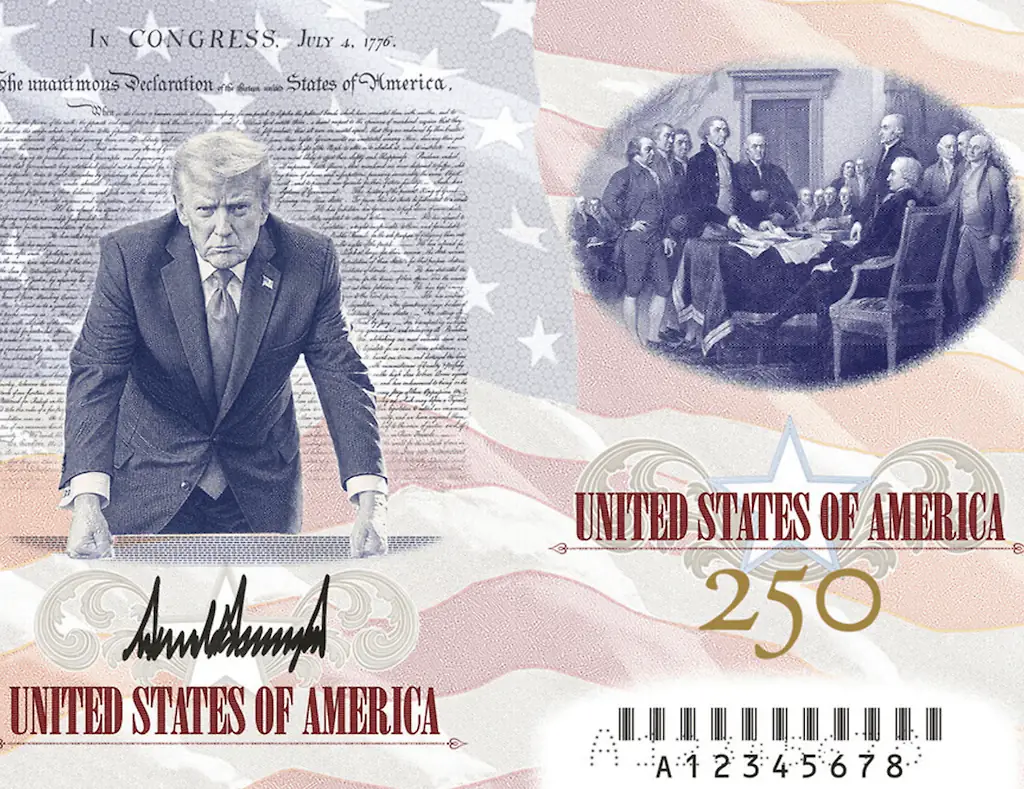
Donald Trump has sparked debate yet again after sharing an image he described as a commemorative US passport celebrating the nation’s 250th anniversary.
Posting the design, he wrote: “The U.S.A.'s New Passport, which says, 'Welcome, but be good!' President DJT."
Despite his claim, people were quick to point out that the passport didn't appear to feature those words at all.
The image featured Trump’s photo alongside patriotic-themed iconography, including a copy of the Declaration of Independence, as well as John Trumbull’s famous painting of the signers of the country’s ‘birth certificate’.
The commemorative passport will become available on July 6 while supplies last. Americans must apply in person at the Washington Passport Agency or at designated commemorative passport events, with only 40,000 set to be issued.
The wording quickly drew criticism, particularly from anti-Trump conservative outlet The Bulwark. During a video segment, host Tim Miller questioned whether the message reflected a misunderstanding of what a passport is actually used for.
Referencing the phrase “Welcome, but be good,” Miller said: “This raises the question, does Donald Trump know what a passport is for? Welcome to who? The US passport is for Americans. We use it to go other places.”
He went on to suggest the issue could point to something more serious, stating: “It's pretty concerning that the President of the United States either is so stupid that he doesn't know what a passport is or that his mentals are declining at such a rate that he's forgotten.”
Miller also mocked the design itself, describing it as “a glowering president reminding Americans welcome in your own house, in your own country,” before adding a pointed aside: “I've been indicted several times.”
He ended the segment with a blunt conclusion: “This is it, I guess. This is real life.”
Conservative commentator Bill Kristol later echoed the criticism, praising Miller’s segment as “very good.”
He added: “Trump clearly doesn't understand that a passport is for Americans, since the message he's delivering is suitable for a visa for foreigners.”
us4 min(s) read
us4 min(s) read
us3 min(s) read
us2 min(s) read
Published 14:45 10 Aug 2021 GMT
us3 min(s) read
Published 16:35 29 Apr 2026 GMT
Some Americans have noticed what could potentially become a huge problem with Donald Trump’s new US passports with his own face on.
The passports, created to celebrate both America’s 250th anniversary and the President himself, aren’t exactly subtle.
If there’s one thing Donald Trump likes, it’s leaving his mark on things.
In fact, the President of the United States seems to be totally obsessed with his legacy.
From the Kennedy Center - now the Trump Kennedy Center - to the new White House ballroom that he has proposed, right through to the Presidential Walk of Fame, which features portraits of all - well, almost all - previous presidents, Trump has really worked hard to ensure that history won’t forget him.
As if it was going to…
His latest move is to stick himself on some new US passports that are to be issued to coincide with the 250th anniversary of the signing of the Declaration of Independence.
So, in keeping with that theme - or not, as the case may be - he’s decided to plaster his own face across them.
The passports feature the text of the declaration itself, as well as a picture of Trump, then another picture of the Founding Fathers.
You don’t have to be a genius to work out what the intended comparison is.
Elsewhere on the document is Trump’s signature and the cover, which features the words ‘United States of America’ in bright gold lettering.
US State Department spokesperson Tommy Pigott said: "These passports will feature customised artwork and enhanced imagery while maintaining the same security features that make the US passport the most secure documents in the world.”
Around 25-30,000 of these documents will be available to Washington DC passport applicants from just before July 4, and it will be the default option to anyone applying in person at the office, although normal passports will be available to those who go through other channels.
As some have pointed out, you might want to.
Some have been quick to point out the The Donald isn’t exactly flavor of the month in a lot of places around the world, where they might not be too happy to see his face appearing at their border gates.
One person commented: “If I was another country and someone was trying to enter with one of these I would immediately deny entry.”
A second said: “I wonder how many countries will now deny Americans from entry at their borders because they have Trump's photo on their passport?
“This is next level vanity. Imagine having your passport defiled by an Epstein fella.”
A third wrote: “Wait until countries start banning holders from entry.”
Of course, the likelihood of this happening is unclear, as you can’t simply ban someone on those grounds, even though you wouldn’t be against some governments trying.
According to the state department, there will be no extra fee for these passports, which are set to be released alongside special commemorative gold coins that also feature Trump’s visage.
What’s more, the department of the treasury has also confirmed that Trump’s likeness will appear on paper currency as well, the first time a sitting POTUS has done so.
Oh, and he’s planning a massive triumphal arch in Washington DC featuring golden lions, eagles, and statues.
That’ll be nice and understated too, you’d have to imagine.
Published 16:12 28 May 2026 GMT
Trump administration officials have reportedly been pushing for a new $250 banknote featuring President Donald Trump’s portrait, according to a report from The Washington Post.
The proposal, which would mark the first time a living person has appeared on U.S. currency in more than 150 years, was allegedly pushed by Treasury Department political appointees Brandon Beach and Mike Brown. Current and former employees at the Bureau of Engraving and Printing told the outlet the pair repeatedly urged staff to create prototypes of the bill despite legal concerns surrounding the idea.
Mock-up designs of the proposed note were reportedly handed to bureau staff in August and September last year. One design featured Trump’s portrait centered on the bill alongside the signatures of the president and Treasury Secretary Scott Bessent. The artwork was created by British painter Iain Alexander, who claimed Trump personally approved changes to the design.
“He likes to call me his favorite British artist,” Alexander said.
According to The Washington Post, bureau director Patricia “Patty” Solimene and other staff repeatedly informed Treasury officials that current laws only allow deceased individuals to appear on U.S. currency.
Employees also reportedly warned that producing a new denomination would take years because of the extensive coordination required with the Federal Reserve, Secret Service, and private sector partners.
“She had told them we’re not authorized to do this. We can’t progress any further, and all the stakeholders have not even met to discuss the next steps,” one employee told the paper. “Currency often takes six to eight years to produce a new bill, particularly one of such high value.”
Former Bureau of Engraving and Printing director Larry R. Felix also questioned the legality of the proposal.
“a $250 note is not statutorily authorized” without an act of Congress, Felix said.
“The secretary has to be given authority to do that,” he added.
The Treasury Department denied claims that officials requested the bill be printed before legislation passed, saying in a statement that the agency “is conducting appropriate planning and due diligence” regarding the proposal.
“Should this legislative mandate be signed into law, the BEP is moving proactively to produce a $250 commemorative note which will appropriately recognize the 250th Anniversary of our great nation,” the statement said.
The report also stated that Solimene was abruptly reassigned from her position in April.
In a farewell email obtained by The Washington Post, she reportedly described leaving with a “heavy heart” and said the reassignment was “not my choice.”
She also wrote: “never sacrificed the values or character of myself or the organization and always prioritized the U.S. Currency Program and the value each employee brings to the mission.”
“The buck stopped here,” she added.
Brown, who previously served as a senior adviser to Beach, has since become the bureau’s acting director, according to the report.
Employees also claimed the bureau had agreed to another Trump administration request involving $100 bills carrying Trump’s signature. Those notes are reportedly already being printed in Washington.
“Based on the recommendation of U.S. Treasurer Brandon Beach, Secretary Bessent will recognize the historic achievements of our great country and President Trump by adding his signature to the currency,” the Treasury statement said.
Alexander said Trump approved several adjustments to the artwork, including adding the colors of the American flag and a logo commemorating America’s 250th anniversary.
For the reverse side of the note, Alexander said he proposed a “women’s liberation” theme featuring Betsy Ross.
“He absolutely loved it,” Alexander said.
The proposed bill reportedly ties into broader plans for America’s 250th anniversary celebrations. Trump has previously proposed a 250-foot triumphal arch near Arlington National Cemetery and a “Garden of Heroes” featuring 250 statues in Washington.
Legislation introduced by Rep. Joe Wilson in February 2025 would direct the Treasury secretary “to print $250 Federal reserve notes featuring a portrait of Donald Trump.” The bill has not yet received a hearing.
Wilson’s office told The Washington Post that both Trump and Treasury Secretary Scott Bessent had expressed support for the proposal.
“We can also confirm that both Treasury Secretary Bessent and President Trump have spoken with Rep. Wilson about their support for this on multiple occasions,” the statement said.
Alexander also revealed he is working on a larger project connected to the America 250 celebrations, though he said communication with Trump has slowed recently because of international tensions.
“You can appreciate all he’s got on his plate at the moment,” Alexander said.
Published 14:50 27 Mar 2026 GMT
President Donald Trump’s signature will soon appear on U.S. paper currency, making him the first sitting president to have signed American money, the Treasury Department announced Thursday.
Per Reuters, the first $100 bills bearing Trump’s signature, alongside that of Treasury Secretary Scott Bessent, will roll off the presses in June, with other denominations to follow. The updated bills will take several weeks to reach circulation.
For now, the Treasury is still issuing notes featuring the signatures of former Treasury Secretary Janet Yellen and former Treasurer Lynn Malerba. Malerba will be the last of an unbroken line of treasurers whose signatures have featured on U.S. federal currency since paper money was introduced in 1861.
The move is part of a broader campaign to place Trump’s name on public institutions, programs, and even currency. Recently, a Trump-appointed arts panel approved “the design for a commemorative gold coin with Trump’s image.”
The redesign of U.S. notes coincides with the upcoming 250th anniversary of American independence. However, this new series will break a long-standing 165-year tradition by omitting the signature of the U.S. treasurer. Instead, it will bear only the signatures of the president and the Treasury secretary.
Legally, the issue touches on both the “letter of the law” and the “spirit of the law.” Strictly speaking, the Thayer Amendment of 1866 forbids using the image of any living person on “the bonds, securities, notes, or postal currency of the United States.” This rule arose after Treasury official Spencer Clark placed his own face on a note meant to honor explorer William Clark.
The Presidential $1 Coin Act of 2005 reinforced this principle, specifying that “No coin issued may bear the image of a living former or current President.” Still, a few exceptions have occurred—most notably when President Calvin Coolidge appeared on a 1926 half dollar marking the nation’s 150th birthday.
The deeper reason for banning living figures on currency stems from America’s rejection of monarchy. As the Federal Reserve Bank of San Francisco notes, “To avoid the appearance of a monarchy, it was long-standing tradition to only feature portraits of deceased individuals on currency and coin.” George Washington himself refused to appear on the first U.S. silver dollar for that very reason.
In 2021, Congress granted the Treasury special authority to issue coins “emblematic” of the nation’s founding. Treasury Secretary Bessent later explained, “There is no profile more emblematic for the front of this coin than that of our serving President, Donald J. Trump.”
While countries such as Britain, Canada, and Saudi Arabia commonly feature living monarchs on their money, many Americans see this as contrary to democratic principles.
Donald Trump has unveiled a brand-new Make America Great Again hat that he's been working on, and it'll set you back $25 a pop.
According to The New York Post, the former President of the United States announced the new merchandise venture in a fundraising email to supporters sent out over the weekend.
The email included an image of the red hat, complete with white "MAGA" lettering and gold trim, as well as options for Trump's supporters to donate $25, $50, $100, or $250 to his cause.
Per the above publication, in Trump's email to his followers on the newsletter service Save America PAC, he wrote:
"I just designed our BRAND NEW MAGA Hat and I want YOU to have it. You’ve always been one of my most LOYAL supporters, so I don’t want you to have just ANY hat…
"I want YOU to have the MAGA Hat that I personally HAND-SIGNED for YOU. [sic]"
He added: "Our movement isn’t slowing down, in fact, it’s only speeding up. That’s why I wanted to design a NEW HAT for all of our best supporters. [sic]"
Indeed, the 75-year-old ex-POTUS hinted that he had ambitions to re-enter politics in an attempt to win a second term in a recent interview with Fox News anchor Sean Hannity.
When asked about the possibility of running for office again, Trump claimed that it would be important to first endorse the right supporters in Congress, stating:
"I've got tremendous numbers ... there is more popularity [for me] now than there was the day before the election. Because they see how bad things are at the border.
"They see what is going on, they see that their guns are gonna be gone ... their taxes are going up. Regulations are going through the roof. Job [losses] are going to go up.
"So I say this: I am looking at it very seriously. Beyond seriously. From a legal standpoint, I don’t want to really talk about it yet. It's a little too soon."
And in a speech made a speech at the 2021 Conservative Political Action Conference in Florida, Trump again alluded to his future ambitions.
Per Global Times, he told a crowd of his supporters: "With your help, we will take back the House, we will win the Senate, and then a Republican president will make a triumphant return to the White House – and I wonder who that will be?"
Published 15:00 19 Apr 2025 GMT
President Donald Trump has planned to ban specific passports, and here's what you need to know about it.
Since reclaiming the presidency on January 20, Trump has wasted no time signing off on a storm of executive orders - about 200 of them - touching on everything from climate change and immigration to the LGBTQ+ community.
And one of those orders just sparked a serious legal showdown.
Titled “Defending Women From Gender Ideology Extremism and Restoring Biological Truth to the Federal Government,” the executive order declared that only two genders - male and female - would be recognized under U.S. law, per ABC News.
That means, according to Trump’s administration, trans and non-binary identities no longer legally exist.
And the ripple effects? They hit hard, especially for non-binary folks whose gender identity had previously been recognized on federal documents - most notably, passports.
Under President Joe Biden, non-binary Americans were able to mark an “X” on their passports starting in October 2021. But under Trump’s order, those “X” applications were frozen. In short: no more gender-neutral passports.
In an email obtained by The Guardian, Secretary of State Marco Rubio doubled down on the change: “The policy of the United States is that an individual’s sex is not changeable.” He added that documents like passports and consular reports of birth abroad must now reflect sex, not gender.
So, what’s new?
Here's the update that just turned everything on its head: A federal judge has officially blocked the ban.
US District Judge Julia Kobick didn’t hold back. According to The Independent, she ruled: “The Executive Order and the Passport Policy on their face classify passport applicants on the basis of sex and thus must be reviewed under intermediate judicial scrutiny.”
In short, if the government wants to enforce something like this, it has to prove that the policy is closely tied to an important governmental interest. According to Kobick, they failed to do that.
She continued, stating that the plaintiffs in the case have shown that the new rules “are based on irrational prejudice toward transgender Americans and therefore offend our Nation’s constitutional commitment to equal protection for all Americans.”
The lawsuit was spearheaded by the American Civil Liberties Union (ACLU), representing five transgender individuals and two non-binary plaintiffs.
Their legal argument is that the policy would prevent them from getting accurate identity documents.
Sruti Swaminathan, a lawyer for the ACLU, said: “We all have a right to accurate identity documents, and this policy invites harassment, discrimination, and violence against transgender Americans who can no longer obtain or renew a passport that matches who they are.”
But the Trump administration pushed back, claiming the policy “does not violate the equal protection guarantees of the Constitution.”
Their stance is that affected individuals can still apply for and use passports - they just have to use sex markers (male or female) instead of gender-neutral ones.
According to Trump’s team, the plaintiffs wouldn't be harmed by the gender restriction and could “travel freely.” Just not with a passport that reflects their gender identity.